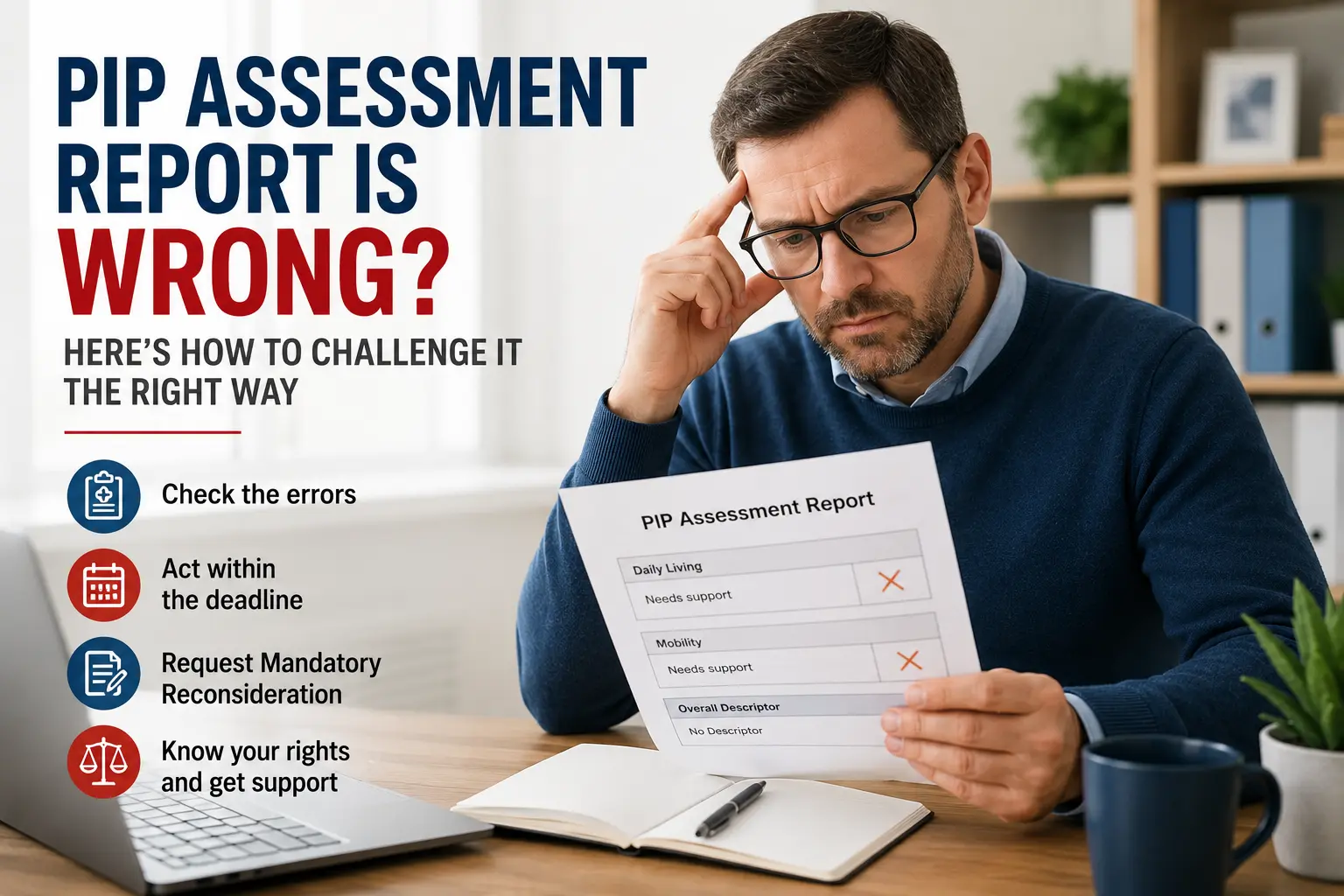
If your PIP assessment report is wrong, do not waste the appeal deadline arguing about every sentence. The strongest challenge is targeted. Identify the errors that affected the points, show what the correct position is, connect it to the PIP activities and reliability rules, and support it with evidence.
Many claimants read their assessment report and feel shocked. The report may appear to misquote what they said, leave out important difficulties, rely on a brief observation, or describe them as able to do tasks they cannot do safely or repeatedly. Some people search for phrases such as “PIP assessor lied” or “PIP report full of inaccuracies”. The understandable anger behind those searches is real. But a successful challenge usually depends on evidence and precision, not labels.
The assessment report is important, but it is not the legal test by itself. The question is whether the DWP decision correctly reflects your ability to carry out the relevant daily living and mobility activities. A health professional provides advice to the DWP; the final benefit decision rests with the DWP decision maker. Official DWP guidance also requires functional ability to be considered through the PIP descriptors and the reliability rules.
Quick answer
If the PIP report is wrong, request a copy if you do not already have it, check the date on the decision letter, identify the material errors, compare them with your form and evidence, and ask for Mandatory Reconsideration within the usual one-month time limit. A complaint about the assessment service is separate from challenging the benefit decision and should not distract you from the deadline.
Your 24-hour action plan if the PIP report is wrong
When the report arrives, use this order:
- Check whether you have received the DWP decision letter as well as the assessment report.
- Write down the deadline immediately. You usually need to ask for Mandatory Reconsideration within one month of the date on the decision letter.
- Keep your original PIP2 form, review form, assessment report, decision letter, medical evidence and any notes or recording of the assessment together.
- Mark the report only where an error could affect a descriptor, points, reliability or the overall reasoning.
- Create a short error schedule instead of writing a long emotional complaint.
- Gather evidence that proves the correct functional position.
- Submit the challenge in time. Do not wait indefinitely for perfect evidence or a complaint response.
Why this order matters: a missed appeal deadline can cause more damage than an imperfect first draft. You can explain the errors clearly and add relevant evidence, but you must protect the procedural route first.
What is the PIP assessment report - and who makes the final decision?
The PIP assessment report records the health professional’s functional advice to the DWP. Depending on the type of assessment, the report is commonly referred to as a PA4 consultation report. It may summarise your medical history, social and occupational history, account of a typical day, observations, examination findings and the assessor’s suggested descriptor choices.
The assessor does not make the final award decision. Official DWP assessment guidance states that health professionals provide impartial, objective and evidence-based advice so DWP case managers can make decisions, and that final decisions rest with the case manager. That distinction matters. Your challenge should not simply say “the assessor was wrong”. It should explain why the decision should not rely on the disputed advice.
A useful challenge therefore asks:
- What exactly does the report say?
- What is factually wrong, incomplete or misleading?
- Why does the error matter to a PIP activity or descriptor?
- What evidence supports the correct position?
- What descriptor should apply instead, and why?
How to get a copy of your PIP assessment report
If you do not already have the full assessment report, ask the DWP for a copy. Official PIP assessment guidance says the health professional cannot give the claimant the report at the consultation; the claimant can request a copy from the DWP.
When you receive it, compare the report with:
- your PIP2 “How your disability affects you” form or award review form;
- any written evidence you sent before the assessment;
- your own notes made immediately after the assessment;
- any authorised or lawful recording of the assessment, if one exists;
- your medication list, care plan and relevant clinical records;
- letters from people who regularly see the help, prompting or supervision you need.
Do not wait for the report if the deadline is close
If the one-month Mandatory Reconsideration deadline is approaching, protect the deadline first. Explain that you dispute the decision and that further reasons or evidence will follow if necessary. The exact approach depends on the case, but waiting for paperwork should not cause you to miss the usual time limit.
What counts as a material error in a PIP report?
Not every spelling mistake or imperfect sentence will change a PIP award. A material error is one that may have influenced the points, the reliability analysis or the DWP’s understanding of your functional difficulties.
Examples include:
- The report says you completed an activity unaided when you explained that you needed prompting, supervision, assistance or an aid.
- The report records a distance, frequency or duration that you did not give.
- The report treats a one-off task as proof that you can repeat the activity whenever reasonably required.
- The report relies on you attending the assessment, driving, working, caring for someone or using a phone without explaining why that fact proves the specific PIP activity can be completed reliably.
- The report ignores pain, fatigue, breathlessness, panic, cognitive problems or after-effects that prevent reliable repetition.
- The report describes your “typical day” in a way that leaves out the bad days or fails to consider how often each level of difficulty occurs.
- The report says there was “no evidence” of a problem when relevant evidence was supplied but not addressed.
- The report uses an informal observation that does not match the wider evidence or the actual activity being assessed.
- The report records you as calm, engaged or cognitively intact during a short consultation and uses that to reject difficulties that arise in different settings or over time.
The tactical rule: challenge the errors that change the legal analysis. A ten-page attack on minor wording can bury the three points that could actually change the award.
How to challenge a PIP assessment report step by step
Step 1 - Protect the deadline
If the DWP has made a decision you disagree with, the usual first step is Mandatory Reconsideration. GOV.UK says you usually need to ask within one month of the date on the decision letter. Late requests may sometimes be accepted where there is a good reason, but relying on that creates avoidable risk.
Keep the decision letter. Record the date. Keep proof of posting or submission where available.
Step 2 - Build a PIP report error schedule
This is the most useful practical step. Do not write “the whole report is lies”. Build a table that forces each disputed point into evidence.
| What the report says | Correct position | Why it matters | Evidence | PIP issue |
| “Walked 20 metres normally to the room.” | I completed one short walk, then needed to stop and later had increased pain. I cannot repeat it as often as needed. | A short observation does not by itself answer repeatability or after-effects. | Pain diary; witness statement; physiotherapy notes. | Moving around; repeatedly; reasonable time. |
| “Manages medication independently.” | My partner prompts me daily and checks whether I have taken the correct dose. | The issue is the underlying need for prompting or supervision, not whether help is always available. | Partner statement; dosette box; medication incidents. | Managing therapy or monitoring a health condition. |
| “Drives a car.” | I drive only short, familiar routes on better days and cannot undertake unfamiliar journeys alone because of overwhelming distress. | Driving is a fact to explain, not an automatic answer to every mobility activity. | Journey examples; support-person statement; treatment records. | Planning and following journeys. |
| “No signs of anxiety observed.” | My anxiety fluctuates and is triggered by unfamiliar journeys and social situations; I masked symptoms during a short remote assessment. | A short observation must be weighed against the wider functional evidence. | Care plan; therapy records; witness statement; real-world examples. | Engaging with people; planning/following journeys. |
Step 3 - Link each error to a descriptor or reliability rule
PIP is not awarded simply because a report contains errors. The challenge must show what legal or factual conclusion should change. Identify the relevant activity and explain the level of help you need.
For each activity, consider:
- Can you do it safely?
- Can you do it to an acceptable standard?
- Can you do it repeatedly, as often as reasonably required?
- Can you do it within a reasonable time?
- On how many days does the difficulty apply?
- Do you need an aid, prompting, supervision or physical assistance?
- What happens before, during and after the activity?
Official DWP guidance states that if a claimant cannot complete an activity reliably, they should be treated as unable to complete it at that level. The guidance also addresses fluctuating conditions: where a descriptor applies on more than 50 per cent of days in the relevant period, that frequency can determine the descriptor selection.
Step 4 - Support the correction with evidence
Evidence is strongest when it proves the disputed function. A diagnosis letter may prove that you have a condition; it may not prove whether you need prompting to prepare food, whether you can walk repeatedly, or whether you can follow an unfamiliar journey.
Good evidence often answers the exact disputed point. For example:
- A witness statement explains the help another person actually gives and how often.
- A pain or fatigue diary shows distance, time, recovery and after-effects over several days.
- Occupational therapy records show aids, adaptations or safety risks.
- Mental health records show panic, avoidance, prompting or support needed to engage or travel.
- Employer records show adjustments, absences or support that contradict an assumption based simply on being employed.
- Prescription history, care plans or treatment records support the level and persistence of the difficulties.
- Contemporaneous notes or a recording may help test a specific disputed quote, where available and lawfully obtained.
Step 5 - Prepare Mandatory Reconsideration or appeal grounds
A strong Mandatory Reconsideration should be organised by disputed activity, not by emotion or chronology alone. For each activity:
- state the descriptor or functional issue in dispute;
- quote or summarise the relevant part of the report;
- explain the factual correction;
- explain the reliability problem;
- give one or two real examples;
- identify the evidence supporting the correction;
- state the outcome you say should follow.
The four PIP reliability rules assessors and decision makers must consider
The most important section of many challenges is not “what can you do once?” It is “what can you do reliably?” The four tests are:
| Reliability rule | What it means in practice | Questions to ask yourself |
| Safely | The activity should not create a material risk of harm during or after it. | Do you fall, burn yourself, become confused, panic, overdose, choke or face another risk? |
| Acceptable standard | The result must be good enough for the purpose of the activity. | Is food properly prepared? Are you washed adequately? Can you communicate effectively? |
| Repeatedly | You must be able to do it as often as reasonably required. | Can you do it again later the same day? What recovery is needed? What are the after-effects? |
| Reasonable time | The activity should not take more than twice as long as it would normally take a person without your impairment. | How long does it take? Do pain, fatigue, anxiety or cognitive problems cause major delay? |
These rules are especially important where a report uses a single observation to make a broad conclusion. A claimant may be able to perform an activity once but not safely, not repeatedly, or not within a reasonable time. The report should be tested against the whole functional picture.
Common PIP report problems and how to answer them
“You looked well, calm or not anxious”
Explain why a short appointment is not representative of the relevant activity. Give real examples from the settings that trigger the difficulty. Avoid simply saying the observation is false if you did appear calm. The stronger point may be that calm presentation during a structured consultation does not answer what happens during unfamiliar journeys, social engagement or repeated daily tasks.
“You drove to the assessment”
Do not ignore the fact. Explain it. Was the route familiar? Did someone accompany you? Was it a better day? How often do you drive? What happened before or after? Which specific PIP activity is disputed? The legal question is functional ability under the relevant descriptor, not whether you have ever driven a vehicle.
“You work, so you can manage the activity”
Employment can be relevant evidence, but it should be analysed properly. Explain adjustments, reduced hours, home working, assistance, sickness absence, mistakes, recovery time and whether the work task is genuinely comparable to the PIP activity. Do not hide work. Explain the actual conditions under which you manage it.
“You used a phone or answered questions well”
A short conversation or use of a familiar device may not answer complex communication, reading, budgeting, social engagement or cognitive difficulties. Identify what the activity requires and why the observation does or does not transfer to that task.
“No evidence of the problem”
Identify the evidence that was available and where it can be found. If the evidence did not actually address function, obtain better evidence. A large medical bundle is not automatically persuasive. The useful question is: what does this document prove about the disputed activity?
“You can do it on a good day”
For fluctuating conditions, explain frequency. Use a diary or calendar. Official DWP guidance considers whether a descriptor applies on more than 50 per cent of days. Avoid vague phrases such as “sometimes” or “often” where you can give a more precise pattern.
What evidence is strongest when the PIP report is inaccurate?
The best evidence depends on the error. Use the smallest set of documents that proves the important points clearly.
|
Evidence |
What it can prove |
Common mistake |
|
Your original PIP form |
What you reported before the assessment and whether the report contradicts it. |
Assuming the DWP will find the contradiction for you. |
|
Assessment notes or recording |
A specific disputed exchange or omission. |
Treating it as a reason to ignore the descriptors. |
|
Medical and therapy records |
Diagnosis, treatment, symptoms, risks, fluctuation and professional observations. |
Sending hundreds of pages without linking them to a disputed activity. |
|
Witness statement |
The help, prompting, supervision or after-effects seen in real life. |
Using vague praise instead of concrete examples and frequency. |
|
Diary |
Patterns over time, bad days, recovery and repetition. |
Creating a diary that is too general or inconsistent with the claim. |
|
Aids and adaptations evidence |
The practical support needed to complete activities. |
Assuming ownership of an aid automatically proves entitlement. |
|
Employer or education evidence |
Adjustments, support, absence or functional limitations. |
Hiding work or study instead of explaining how it is managed. |
Can you complain about a PIP assessor?
Yes, a service complaint may be appropriate where the issue concerns how the assessment was conducted, factual inaccuracies, treatment, conduct or service quality. But a complaint and a benefit challenge are not the same process.
The DWP complaints procedure expressly separates complaints from challenges to benefit decisions. If you want the award decision changed, you normally need to use Mandatory Reconsideration and, if necessary, appeal. A complaint should not be allowed to distract you from the benefit deadline.
A useful complaint should identify:
- what happened and when;
- which part of the report or service is disputed;
- what evidence supports the complaint;
- how the issue affected you;
- what remedy you are asking for.
Important: avoid assuming that a complaint will automatically rewrite the assessment report, change the award or extend the Mandatory Reconsideration deadline. Protect the appeal route separately.
Common mistakes that weaken a challenge
- Calling the assessor a liar throughout the submission without identifying the exact disputed words and evidence.
- Challenging every sentence instead of the errors that affect descriptors or reliability.
- Missing the one-month Mandatory Reconsideration deadline while waiting for a complaint response.
- Focusing only on diagnoses instead of functional difficulty.
- Sending a large bundle of records without explaining what each document proves.
- Using copied template wording that does not match your actual circumstances.
- Saying “I can never do this” when the evidence shows fluctuation. Explain frequency accurately.
- Ignoring facts such as work, driving, caring responsibilities or hobbies. Explain the real context instead.
- Changing the account to fit the descriptors. The case must remain truthful and consistent.
- Failing to explain what descriptor or outcome should replace the disputed conclusion.
How Zain Legal & Co can help
A PIP challenge is often won or lost in the detail. Zain Legal & Co provides structured, affordable support for claimants who need help understanding what the report says, what actually matters, and how to turn a long set of documents into a focused challenge.
We can assist with:
Forensic assessment report review: We compare the report with your form, decision letter and supporting documents to identify material inconsistencies, assumptions and missing evidence.
Descriptor and reliability analysis: We assess which daily living and mobility activities are genuinely in dispute and whether the report properly deals with safety, acceptable standard, repetition and reasonable time.
PIP report error schedule: We organise the strongest disputed points into a clear table showing the report wording, the correction, the evidence and the PIP issue affected.
Mandatory Reconsideration preparation: We help prepare focused written reasons explaining why the decision should be changed and what evidence supports the challenge.
Evidence gap analysis: We identify what is missing and what type of evidence could actually prove the disputed functional difficulty.
Witness statement and supporting evidence: We help organise practical evidence from family members, carers or others who see the help you need.
Tribunal appeal preparation: If Mandatory Reconsideration is refused, we can help organise appeal grounds, review the bundle and prepare written submissions.
Hearing preparation: We can help you understand likely questions, identify the key disputed activities and prepare to explain your daily difficulties clearly and truthfully.
Support in Birmingham and across England and Wales: We provide remote and local support, with lay assistance or representation where permitted and appropriate.
Why people choose Zain Legal & Co
You do not need another generic leaflet about PIP. You need someone to read the papers you actually received, identify what is wrong, separate strong points from weak points, and help you present the case in a form the DWP or tribunal can follow. Our focus is practical case preparation, clear written argument and affordable support.
Frequently Asked Questions
What should I do if my PIP assessment report is wrong?
Get the report, check the date on the decision letter, identify the material errors, link them to the PIP activities and reliability rules, gather evidence, and protect the Mandatory Reconsideration deadline. Do not spend so long complaining about the report that you miss the route to challenge the decision.
How do I get a copy of my PIP assessment report?
Ask the DWP for a copy. Official PIP assessment guidance states that the health professional cannot provide the report at the consultation and that claimants can request it from the DWP.
What is a PA4 PIP report?
The PA4 is the consultation report used to record assessment advice following a consultation. It can contain the history, observations, functional analysis and suggested descriptor advice provided to the DWP.
What if the PIP assessor lied or misquoted me?
Focus on what you can prove. Identify the exact wording, state what was actually said or happened, explain why it matters to the decision, and provide supporting evidence. A specific evidence-led correction is usually stronger than a general accusation of dishonesty.
Can I challenge the report before the DWP makes a decision?
You can raise concerns and provide relevant information, but the formal route to challenge the benefit decision normally begins once the DWP has made the decision. If a decision has already been issued, protect the Mandatory Reconsideration deadline.
How long do I have to ask for Mandatory Reconsideration?
You usually need to ask within one month of the date on the decision letter. Late requests may sometimes be accepted where there is a good reason, but it is safer to act promptly.
What if the report ignored my medical evidence?
Identify the specific evidence, explain what it proves about the disputed activity, and show why the report or decision is inconsistent with it. If the medical evidence does not address day-to-day function, consider what additional functional evidence is needed.
Does driving mean I cannot get PIP?
Not automatically. Driving can be relevant evidence, but the correct question is how the facts relate to the particular PIP activity and whether you can complete that activity reliably. Explain frequency, route familiarity, support, symptoms and after-effects honestly.
Does working mean I cannot get PIP?
No. PIP is not means-tested and work does not automatically prevent entitlement. However, work activities can be considered as evidence, so explain any adjustments, help, reduced hours, sickness absence or differences between work tasks and the PIP activity.
Can I complain about a PIP assessor?
Yes, a service complaint may be appropriate. But a complaint is separate from challenging the benefit decision. Use the correct Mandatory Reconsideration and appeal route if you want the award changed.
Can Zain Legal & Co review my PIP assessment report?
Yes. We can review the report against your form, decision letter and evidence, identify material errors, map the issues to the PIP descriptors and reliability rules, and help prepare the next step.
Get help before the deadline passes
If your PIP assessment report does not reflect what you said or how your condition affects you, act now. The strongest cases are built by identifying the material errors early, protecting the deadline and linking the evidence to the actual PIP rules.
Book a consultation
Zain Legal & Co can review your PIP assessment report, decision letter and supporting evidence, identify the strongest challenge points and help you prepare a focused Mandatory Reconsideration or tribunal appeal.
Telephone: 0121 817 0033
Website: www.zainlegal.co.uk