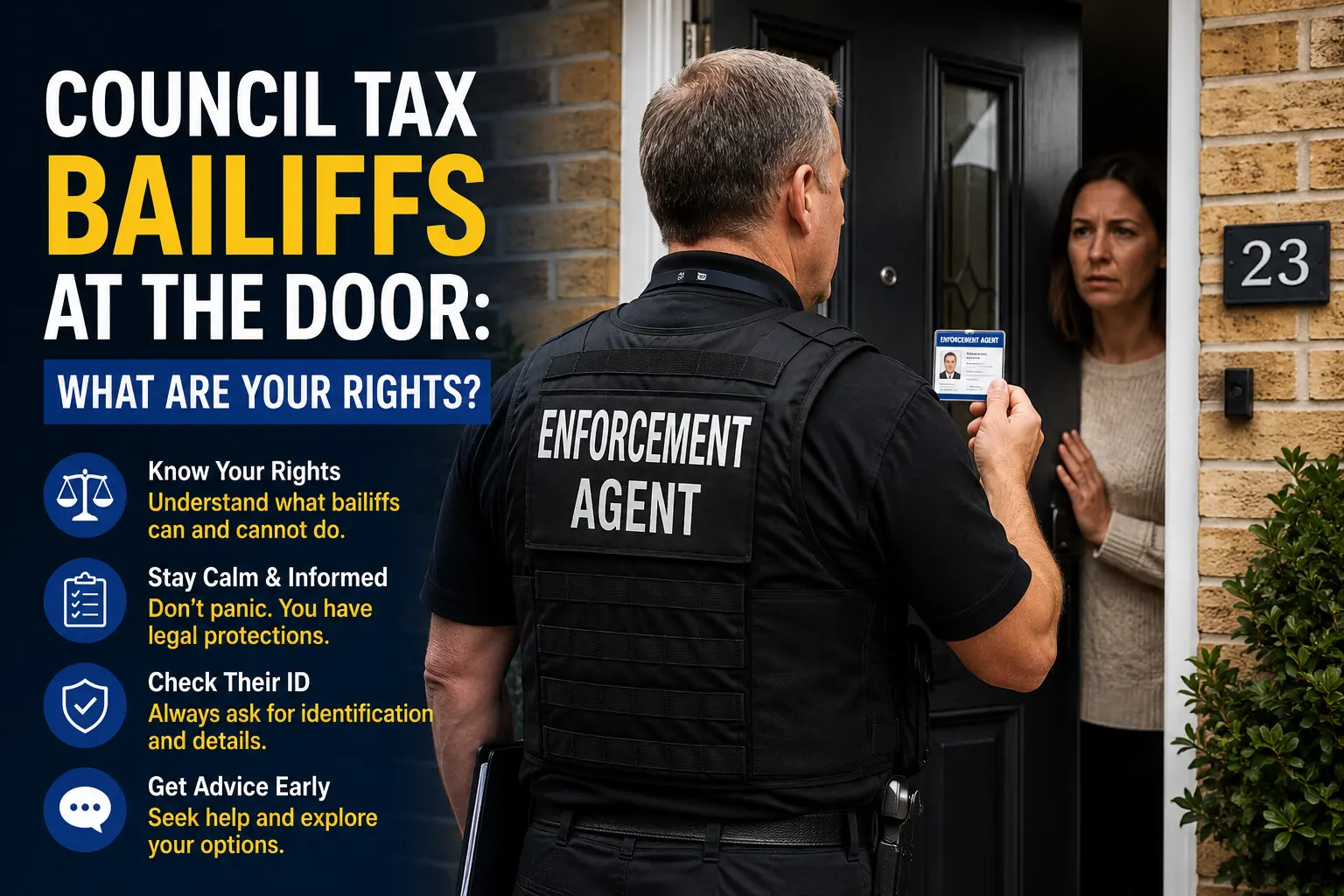
A council tax bailiff at the door is frightening. It can feel as though you have no choice but to open the door, pay immediately, or let the enforcement agent take control of your belongings. That is not always correct.
For council tax arrears in England and Wales, bailiffs are usually called enforcement agents. They do have legal powers, but those powers are not unlimited. In most council tax cases, you do not have to let them into your home. They cannot simply force their way in on a first visit for council tax arrears. They must also follow strict rules about notice, identity, entry, goods, fees and vulnerability.
This guide explains what your rights are, what council tax bailiffs can and cannot do, and what steps you should take if an enforcement agent attends your property.
Quick Answer: What Should You Do If Council Tax Bailiffs Attend?
If a council tax bailiff is at your door, stay calm. Do not panic. Do not open the door unless you have taken advice and understand what you are doing.
- Speak through the closed door, upstairs window, video doorbell or letterbox.
- Ask for their name, enforcement company, certificate number and ID.
- Ask which council instructed them and what liability order or council tax account they are enforcing.
- Ask for a full written breakdown of the debt, fees and enforcement stage.
- Do not sign a controlled goods agreement unless you understand the consequences.
- Do not let them in simply because they say you must.
- If you are vulnerable, tell them immediately and ask them to return the account to the council or place enforcement on hold.
- Contact the council and enforcement company in writing as soon as possible.
- Get urgent help if the debt is wrong, you are not liable, you have not received notices, or enforcement is causing serious hardship.
The immediate aim is to stop the situation escalating. The next aim is to check whether the debt is correct, whether the enforcement is lawful, and whether a realistic payment arrangement or challenge can be made.
Why Are Bailiffs Chasing Council Tax Arrears?
Council tax is treated as a priority debt. If you miss payments, the council will normally send reminder notices. If payment is not made, the council can take legal action. In many cases, the council applies to the Magistrates’ Court for a liability order.
A liability order confirms that the council can take enforcement steps to recover the unpaid council tax. Once a liability order is made, the council may consider different recovery options. These can include deductions from wages, deductions from certain benefits, enforcement agent action, charging orders, insolvency action, or, in serious cases, committal proceedings.
Bailiff action should not be treated as just an ordinary debt letter. It means the matter has already moved into formal recovery. The sooner you respond, the more options you usually have.
What Is a Council Tax Liability Order?
A council tax liability order is a Magistrates’ Court order confirming that council tax is unpaid and allowing the council to take enforcement steps. It does not automatically mean bailiffs can force entry into your home. It does, however, give the council stronger recovery powers.
Before a liability order is made, there should normally have been council tax bills, reminders, a summons and a court hearing date. If you never received these, if they went to the wrong address, or if the council has the wrong liable person, that matters. It may support a complaint, a request to withdraw enforcement, or a request for the council to review liability.
Common problems include:
- the council using the wrong address;
- bills being sent to an old property;
- the wrong person being treated as liable;
- failure to apply a discount, exemption or council tax support;
- failure to account for a move-out date;
- arrears being duplicated or miscalculated;
- enforcement being passed to bailiffs while a dispute or complaint is unresolved.
If any of these apply, do not simply argue with the enforcement agent at the door. The enforcement agent usually acts on the instruction they have received. The stronger route is to challenge the council and enforcement company in writing, with evidence.
Can Council Tax Bailiffs Force Entry?
In most council tax cases, enforcement agents cannot force entry into your home on a first visit. You usually do not have to open the door or let them in. They should not push past you, climb through a window, enter through anything other than a door, or attend between 9pm and 6am unless an exception applies.
For council tax arrears, Citizens Advice states that bailiffs are not allowed to force entry and that you have the right to keep them outside and speak through the closed door. That is a crucial protection.
There is an important exception. If you previously let an enforcement agent in and signed a controlled goods agreement, and then breached that agreement, the agent may have stronger re-entry rights. That is why signing anything at the door without advice can create serious consequences.
What Can Council Tax Bailiffs Take?
If an enforcement agent lawfully takes control of goods, they may look to take non-essential items which belong to the debtor and can be sold to reduce the debt and enforcement fees. This can include items such as televisions, games consoles, vehicles, jewellery, and other non-essential belongings.
Vehicles are often targeted because they are outside and easier to identify. If a car is on your driveway or on the road and appears to belong to you, it may be at risk. If the vehicle is on finance, belongs to someone else, is essential for disability needs, or is needed for work, evidence must be gathered quickly. Do not rely on verbal explanations alone. Get documents.
Useful evidence may include:
- vehicle finance agreement;
- V5C logbook, if relevant, although this is not always proof of ownership;
- purchase receipt or bank transfer proof;
- insurance documents;
- blue badge or medical evidence if the vehicle is needed because of disability;
- employment evidence if the vehicle is necessary for work.
What Bailiffs Cannot Take
Enforcement agents cannot simply take everything. There are protected items and practical limits. GOV.UK states that bailiffs cannot take things you need, such as clothes, a cooker or fridge, work tools and equipment worth less than £1,350, or belongings that belong to someone else.
They should not take:
- basic household essentials;
- clothing and bedding needed by the household;
- items belonging to children;
- goods owned by another person;
- necessary disability equipment;
- essential work tools below the protected value;
- items already subject to valid finance or third-party ownership, where evidence proves this.
If the enforcement agent threatens to take goods that are protected or belong to someone else, ask them to put their position in writing. Gather evidence immediately. A complaint or urgent challenge may be needed.
What to Say Through the Door
If you are not opening the door, keep the wording simple. Do not get drawn into a doorstep argument.
You can say:
“I am not refusing to deal with this matter, but I am not allowing entry. Please put your ID, authorisation and full breakdown through the letterbox. I will contact the enforcement company and the council in writing. If you say I must let you in, please identify the legal power you rely on.”
If the debt is not yours, say clearly:
“I dispute liability. This is not my debt. Please leave the documents and I will provide evidence to the enforcement company and the council.”
If you are vulnerable, say:
“I am vulnerable and this visit is causing serious distress. Please place enforcement on hold and refer the account back to your welfare team and the council. I will provide evidence.”
Keep a record of the visit. Save ring doorbell footage, screenshots, letters, notices, texts, emails and payment demands. Record the date, time, names and what was said.
Notice of Enforcement: How Much Warning Should You Get?
Before enforcement agents attend to take control of goods, you should usually receive a Notice of Enforcement. From 1 May 2026, the minimum notice period was extended to 14 clear days. In some personal debt cases, a debt advice provider may request an extension to 28 clear days before enforcement action moves forward.
A proper notice should tell you important information, including the debt, the creditor, the enforcement company, the amount claimed, and how to pay or make contact. If the notice went to the wrong address, was not received, or did not contain required information, this may be relevant to a complaint or request to suspend enforcement.
Do not ignore a Notice of Enforcement. This is the best stage to act because fees and pressure can increase once the enforcement agent attends.
Can You Make a Payment Plan?
Yes. You can ask for a payment arrangement. The enforcement company does not have to accept every offer, but a sensible and evidenced proposal is harder to ignore.
A weak offer is simply saying, “I can pay £10 a month.” A stronger offer includes:
- current income;
- essential household expenses;
- benefits or wage deductions already being made;
- rent or mortgage payments;
- dependants and childcare costs;
- health or disability evidence;
- a realistic monthly payment that can actually be maintained.
Do not agree to an unaffordable plan just to make the bailiff leave. If you default, the matter may escalate and further enforcement costs may follow. It is better to make a realistic proposal supported by evidence.
Vulnerability, Mental Health and Urgent Protection
If you are vulnerable, enforcement should be handled carefully. Vulnerability can include serious illness, disability, pregnancy, age-related issues, mental health difficulties, bereavement, domestic abuse, language barriers, learning difficulties, or severe financial hardship.
If vulnerability applies, do not leave it vague. Put it in writing and attach evidence where possible. Useful documents include:
- GP letter or fit note;
- mental health crisis team letter;
- social worker letter;
- DWP award letter;
- hospital appointment letters;
- domestic abuse support letter;
- evidence of children or dependants in the household;
- income and expenditure schedule.
The request should ask for enforcement to be placed on hold, for the case to be reviewed by a welfare team, and for the council to consider affordability, vulnerability and any discretionary support.
When the Council Tax Debt May Be Wrong
Not every council tax enforcement case is correct. A person may be chased for arrears that are inflated, outdated, sent to the wrong address, or based on the wrong liability period.
You should urgently check:
- Which property does the debt relate to?
- Which tax year does it relate to?
- Who is named as liable?
- Was there a joint tenant, landlord, managing agent, student exemption, single person discount or council tax support issue?
- Were any payments missed, misallocated or paid to the wrong account?
- Were you living at the property for the whole period claimed?
- Was the property empty, uninhabitable, exempt or subject to a discount?
- Has the council added costs or enforcement fees correctly?
If the debt is wrong, you need evidence. That may include tenancy agreements, completion statements, sale documents, utility bills, bank statements, council letters, benefit letters, emails, text messages, medical evidence, or proof of address.
Can Council Tax Arrears Be Reduced or Written Off?
In some cases, councils have discretion to reduce council tax liability or provide hardship support. This is not automatic. It usually requires a structured request with evidence of income, essential expenditure, vulnerability, hardship and why enforcement is disproportionate.
Possible routes include:
- council tax support or backdated council tax support;
- single person discount or other discounts;
- exemptions;
- Section 13A discretionary reduction;
- complaint where the council’s recovery process was unfair;
- payment arrangement based on affordability;
- temporary hold because of vulnerability or crisis.
The strongest requests are evidence-led. A short emotional email is rarely enough. The council needs clear documents and a properly structured explanation.
Common Mistakes That Make Council Tax Bailiff Problems Worse
- Ignoring letters because you feel overwhelmed.
- Opening the door without understanding your rights.
- Signing a controlled goods agreement without advice.
- Making an unaffordable payment plan that later fails.
- Arguing with the enforcement agent but not writing to the council.
- Failing to send evidence of vulnerability.
- Assuming Universal Credit automatically covers council tax support.
- Not checking whether the council has the correct address or liability period.
- Waiting until goods are clamped or removed before seeking help.
The tactical point is simple. Do not fight the problem only at the doorstep. Build the evidence, identify the legal or factual issue, and force the council or enforcement company to deal with it properly in writing.
How Zain Legal & Co Can Help
Zain Legal & Co assists clients facing urgent council tax enforcement, liability-order issues and bailiff action. The focus is practical, evidence-led help. The aim is to stop the matter spiralling, identify weaknesses in the council’s position, and put forward a clear route to resolve the case.
We can assist with:
- reviewing council tax bills, reminders, summonses, liability orders and enforcement notices;
- checking whether the council has named the correct liable person;
- checking whether the arrears period is accurate;
- drafting urgent letters to the council and enforcement company;
- requesting an enforcement hold where vulnerability, hardship or dispute exists;
- preparing an affordability proposal with supporting evidence;
- challenging wrong or excessive enforcement action;
- helping prepare complaints where council recovery has been unfair;
- assisting with council tax support, discount, exemption and discretionary reduction issues;
- preparing evidence for council tax appeals or Valuation Tribunal matters where relevant.
If a bailiff has attended, do not wait. The earlier the paperwork is reviewed, the easier it may be to challenge errors, request a hold, or put forward a realistic payment plan.
Frequently Asked Questions
How Zain Legal & Co Can Help
In most council tax cases, enforcement agents cannot force entry on a first visit. You usually do not have to let them in. The position can change if you previously allowed entry and signed a controlled goods agreement which has then been breached.
Do I have to pay a council tax bailiff on the doorstep?
You can pay on the doorstep if you choose to, but you do not normally have to let the bailiff into your home to pay. Always ask for a receipt and a full breakdown.
Can bailiffs take my car for council tax?
They may try to take control of a vehicle if they believe it belongs to you. If the vehicle is on finance, belongs to someone else, or is essential because of disability or work, gather evidence immediately.
What if the council tax debt is not mine?
Tell the enforcement agent that you dispute liability and ask them to leave documents. Then send evidence to the enforcement company and council. This may include tenancy agreements, proof of address, sale documents, or council correspondence.
Can I make a payment plan after a liability order?
Yes, you can ask for one. The offer should be realistic and supported by income and expenditure evidence. Do not agree to a plan you cannot maintain.
What if I have mental health problems or serious illness?
Tell the enforcement agent and enforcement company immediately. Ask for the case to be placed on hold and reviewed as a vulnerability case. Send medical or support evidence where possible.
Can I complain about a council tax bailiff?
Yes. You can complain to the enforcement company, the council that instructed them, and potentially escalate the complaint if it is not dealt with properly. Keep evidence of visits, calls, letters and conduct.
Can council tax arrears be reduced?
In some cases, council tax liability may be reduced through council tax support, discounts, exemptions, backdating, discretionary reduction or complaint resolution. Evidence is essential.
Book a Consultation
If council tax bailiffs are at your door, or you have received a Notice of Enforcement, book a consultation with Zain Legal & Co. Bring or upload your council tax bill, liability order paperwork, enforcement notice, bailiff letters, payment history, benefit letters, tenancy documents and any evidence of vulnerability.
We can review the paperwork, identify the strongest points, and help you take the next step with confidence.