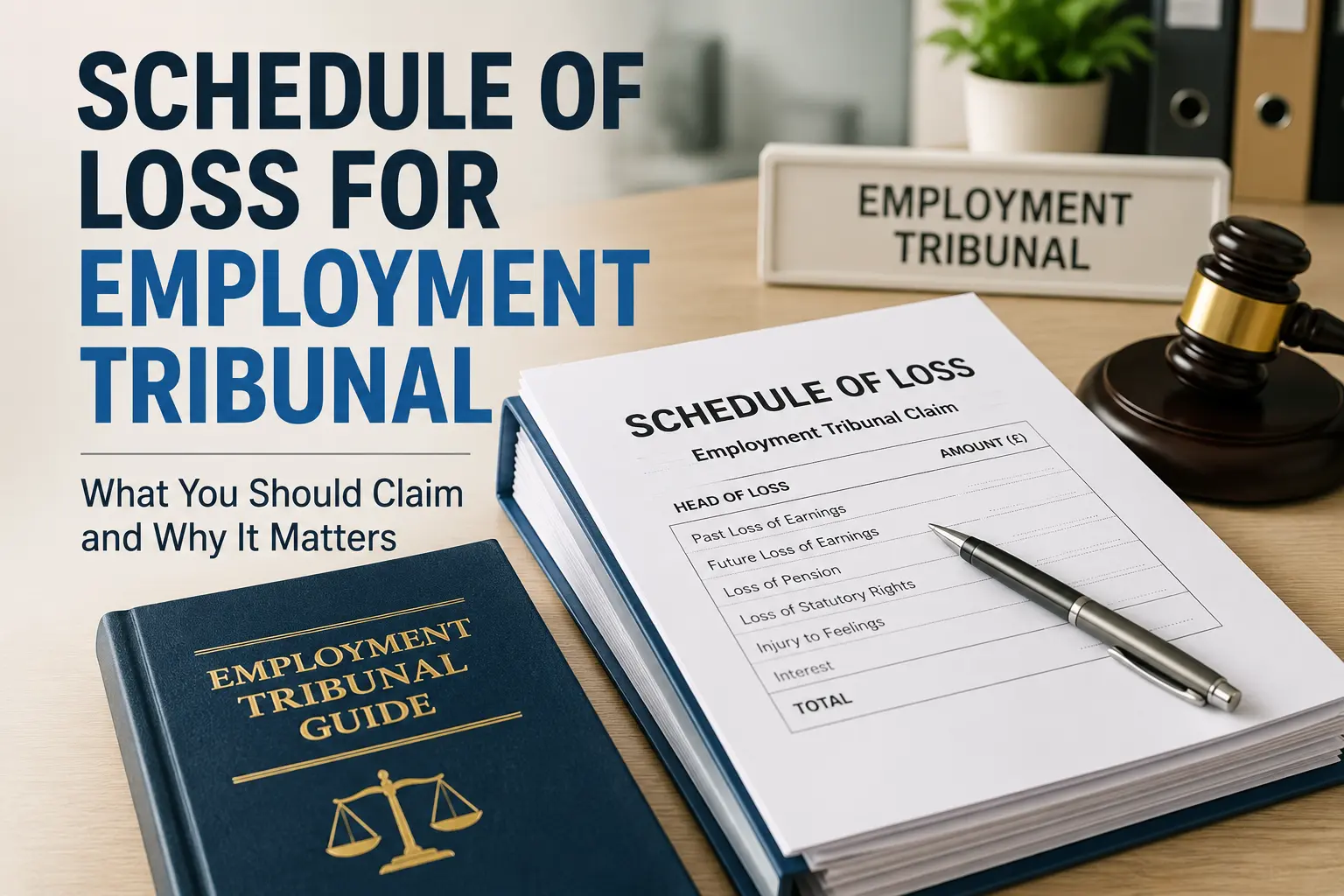
A schedule of loss is one of the most important documents in an Employment Tribunal claim. It tells the tribunal and the respondent how much compensation you are seeking, why you say you are entitled to it, and how you have calculated each figure.
Many claimants underestimate their claim. Others overstate it without evidence. Both mistakes can damage credibility. A strong schedule of loss is clear, realistic, evidence-backed and tied directly to the legal claims pleaded in the ET1.
This guide explains what a schedule of loss is, what you may be able to claim, what evidence you should gather, and how Zain Legal & Co can help you prepare or challenge a schedule of loss before an Employment Tribunal hearing.
What is a schedule of loss in an Employment Tribunal?
A schedule of loss is a written breakdown of the compensation a claimant is asking the Employment Tribunal to award. It normally sets out each head of loss, the calculation for each figure, and the total amount claimed.
The tribunal will often direct a claimant to prepare one as part of case management directions. It may also be used during settlement discussions, ACAS early conciliation, judicial mediation or before a final hearing.
There is no single compulsory form for every case. The structure depends on the type of claim, the facts, and the legal remedies available. An unfair dismissal claim will usually look different from a discrimination, whistleblowing, unpaid wages or breach of contract claim.
Why your schedule of loss matters
- It values the case. It gives the tribunal and the respondent a clear figure to assess.
- It shapes settlement. A strong schedule can put pressure on the employer to negotiate properly.
- It exposes weak evidence. If you cannot prove a claimed loss, the respondent will attack it.
- It helps hearing preparation. It forces you to organise payslips, contracts, benefits, mitigation evidence and future loss arguments.
- It protects credibility. A realistic, properly evidenced schedule is usually stronger than an inflated document with weak calculations.
What should you claim in a schedule of loss?
The correct heads of loss depend on your claim. Do not assume you can claim everything in every case. The starting point is always the ET1, the issues list and the legal remedy available for each claim.
Basic award in unfair dismissal claims
In an ordinary unfair dismissal claim, the basic award is usually calculated using age, length of service and weekly pay, subject to the statutory weekly pay cap. It is similar to the statutory redundancy pay calculation.
For dismissals on or after 6 April 2026, the statutory weekly pay cap is £751. The maximum basic award is usually 30 weeks’ pay, which produces a maximum of £22,530. Always check the applicable rate based on the effective date of termination.
If the claimant has already received statutory redundancy pay, this may reduce or extinguish the basic award because the tribunal will usually avoid double recovery.
Past loss of earnings
Past loss of earnings covers lost net income from the date of dismissal, resignation or unlawful treatment up to the date of the schedule or hearing. This usually requires payslips, P45/P60 documents, bank statements, benefit records and evidence of any new income.
If you found a new job, the income from that role must usually be deducted. If the new job pays less, you may be able to claim the difference. If there was a gap between jobs, explain the period and provide job-search evidence.
Future loss of earnings
Future loss is the amount you say you are likely to lose after the hearing or calculation date. This can be important where you remain unemployed, have moved to lower-paid work, or your dismissal has made it harder to secure comparable employment.
The tribunal will expect a realistic explanation. You should not simply pick a large number. Explain the job market, your applications, interviews, health position, sector, seniority, location, caring responsibilities and any barriers to finding similar work.
Notice pay, holiday pay, bonus and commission
You may be able to claim unpaid notice pay if the employer failed to pay contractual or statutory notice. This is often framed as wrongful dismissal or breach of contract.
You may also need to include unpaid holiday pay, unpaid wages, overtime, commission, contractual bonuses or other sums owed. These figures should be supported by your contract, payslips, rota records, commission plan, bonus scheme, timesheets, emails and bank records.
Pension loss and employment benefits
Pension loss is often missed. If your employer contributed to your pension and you lost those contributions because of the dismissal or unlawful treatment, that loss may need to be included.
Other benefits may include private medical insurance, car allowance, company car, life insurance, share options, staff discount, phone allowance, accommodation or other contractual benefits. You need evidence of the value and the period of loss.
Loss of statutory rights
A claimant who loses employment may lose statutory protection built up through continuous service. Tribunals can sometimes award a modest sum for loss of statutory rights, commonly claimed as a separate head of loss in unfair dismissal cases.
The amount should be reasonable and explained. Do not treat it as automatic or use an inflated figure without justification.
Injury to feelings in discrimination claims
Injury to feelings is not available in an ordinary unfair dismissal claim. It is usually relevant to discrimination, harassment and victimisation claims under the Equality Act 2010.
The tribunal uses the Vento bands to assess injury to feelings. For claims presented on or after 6 April 2026, the lower band is £1,300 to £12,600, the middle band is £12,600 to £37,700, and the upper band is £37,700 to £62,900, with the most exceptional cases capable of exceeding £62,900.
The correct band depends on the seriousness of the treatment, duration, impact, medical evidence, vulnerability, whether the conduct was isolated or repeated, and the overall harm caused.
ACAS uplift, interest, deductions and mitigation
In relevant disciplinary and grievance cases, an Employment Tribunal can increase or reduce compensation by up to 25% where there has been an unreasonable failure to follow the ACAS Code of Practice.
You may also need to consider interest, tax, recoupment, benefits received, contributory conduct, Polkey arguments, failure to mitigate and any sums already paid. These issues can materially change the final value of a claim.
Mitigation is critical. A claimant is expected to take reasonable steps to reduce their loss, usually by looking for work. Keep job applications, rejection emails, interview notes, CV updates and evidence of recruitment activity.
What evidence should support your schedule of loss?
A persuasive schedule of loss should not stand alone. It should sit beside a clear evidence trail.
|
Loss claimed |
Useful evidence |
|
Lost earnings |
Payslips, P45, P60, bank statements, contract, dismissal letter, new job payslips. |
|
Future loss |
Job applications, rejection emails, recruitment searches, medical evidence, sector evidence. |
|
Notice pay |
Employment contract, staff handbook, dismissal letter, payslips. |
|
Holiday pay |
Holiday records, payslips, rota, HR emails, contract. |
|
Pension loss |
Pension statements, employer contribution rate, scheme documents, payslips. |
|
Benefits |
Contract, benefit policy, car allowance details, private medical evidence, bonus/commission scheme. |
|
Injury to feelings |
Witness statement, GP records where relevant, counselling records, diary entries, messages, grievance evidence. |
|
Mitigation |
Job applications, CV, recruiter emails, Universal Credit/job search records, interview evidence. |
Common mistakes that weaken a schedule of loss
- Claiming round figures without showing the calculation.
- Using gross pay where net pay is required, or failing to explain the basis of the calculation.
- Forgetting pension contributions, benefits, holiday pay or notice pay.
- Claiming injury to feelings in a simple unfair dismissal claim where there is no discrimination or harassment claim.
- Failing to deduct new income from a replacement job.
- Ignoring mitigation and failing to keep job-search evidence.
- Using an old compensation cap or outdated Vento band.
- Claiming losses that are not linked to the ET1 or the agreed list of issues.
- Overstating future loss without evidence of job-market difficulty.
- Failing to update the schedule before settlement discussions or hearing.
What if you are an employer or respondent?
Respondents should not ignore a schedule of loss. It is often the claimant’s opening valuation. Some schedules are carefully prepared. Others contain errors, double recovery, unsupported future loss or heads of loss that are not legally available.
A respondent should check the pleaded claims, dates, pay calculations, mitigation evidence, new earnings, benefits received, pension assumptions, ACAS uplift, Vento band, Polkey issues and contributory conduct. A clear counter-schedule can narrow the dispute and improve settlement positioning.
If the claimant has claimed an unrealistic figure, the response should be forensic but proportionate. The aim is to expose weak assumptions, not merely say the figure is too high.
How Zain Legal & Co Can Help
Zain Legal & Co assists claimants and respondents with practical Employment Tribunal preparation. We focus on the documents that decide cases: ET1, ET3, schedules of loss, witness statements, grievance records, disciplinary papers, settlement correspondence and tribunal bundles.
A schedule of loss is not just arithmetic. It is litigation strategy. The figure must be high enough to protect your position, but credible enough to withstand challenge.
- Review your ET1, ET3, ACAS certificate, tribunal directions and issues list.
- Identify which heads of loss are legally available in your case.
- Calculate past loss, future loss, notice pay, holiday pay, pension loss and benefits where relevant.
- Prepare or review your schedule of loss in a clear tribunal-ready format.
- Challenge an inflated or defective schedule of loss served by the other side.
- Help organise evidence such as payslips, contracts, job-search records, medical evidence and settlement correspondence.
- Prepare you for ACAS negotiations, preliminary hearings, final hearings and settlement discussions.
Need help with a schedule of loss? Zain Legal & Co can review your paperwork, calculate your potential losses, identify weak points and prepare a clear schedule of loss for your Employment Tribunal case. Book a consultation here: https://zain-legal-co.sumupstore.com/products or call 0121 817 0033.
Frequently Asked Questions
What is a schedule of loss?
It is a document setting out the compensation you are asking the Employment Tribunal to award, with calculations and supporting explanation.
When do I need to submit a schedule of loss?
The tribunal may order you to serve it by a specific date. It is often required before a preliminary hearing, final hearing or settlement discussions. Always check the tribunal directions.
Can I update my schedule of loss?
Usually yes, if your losses change or further evidence becomes available. However, you should do this properly and serve the updated version on the tribunal and the respondent in accordance with directions.
Can I claim injury to feelings?
What is the basic award?
What is the compensatory award?
The compensatory award is intended to compensate for financial losses caused by the dismissal, such as lost earnings and benefits, subject to statutory limits in ordinary unfair dismissal claims.
Can my employer challenge my schedule of loss?
Do I need legal help?
You are not required to have representation, but a well-prepared schedule can materially improve settlement discussions and hearing preparation. Legal support is often valuable where the claim includes future loss, discrimination, pension loss or multiple heads of loss.
Book a Consultation
Zain Legal & Co can review your paperwork, calculate your potential losses, identify weak points and prepare a clear schedule of loss for your Employment Tribunal case.
Legal information note: This article provides general information for England and Wales. It is not a substitute for case-specific advice. Employment Tribunal deadlines are strict and compensation depends on the facts, pleadings, evidence and applicable law at the relevant date.