What Changed in April 2026 and Why This Matters
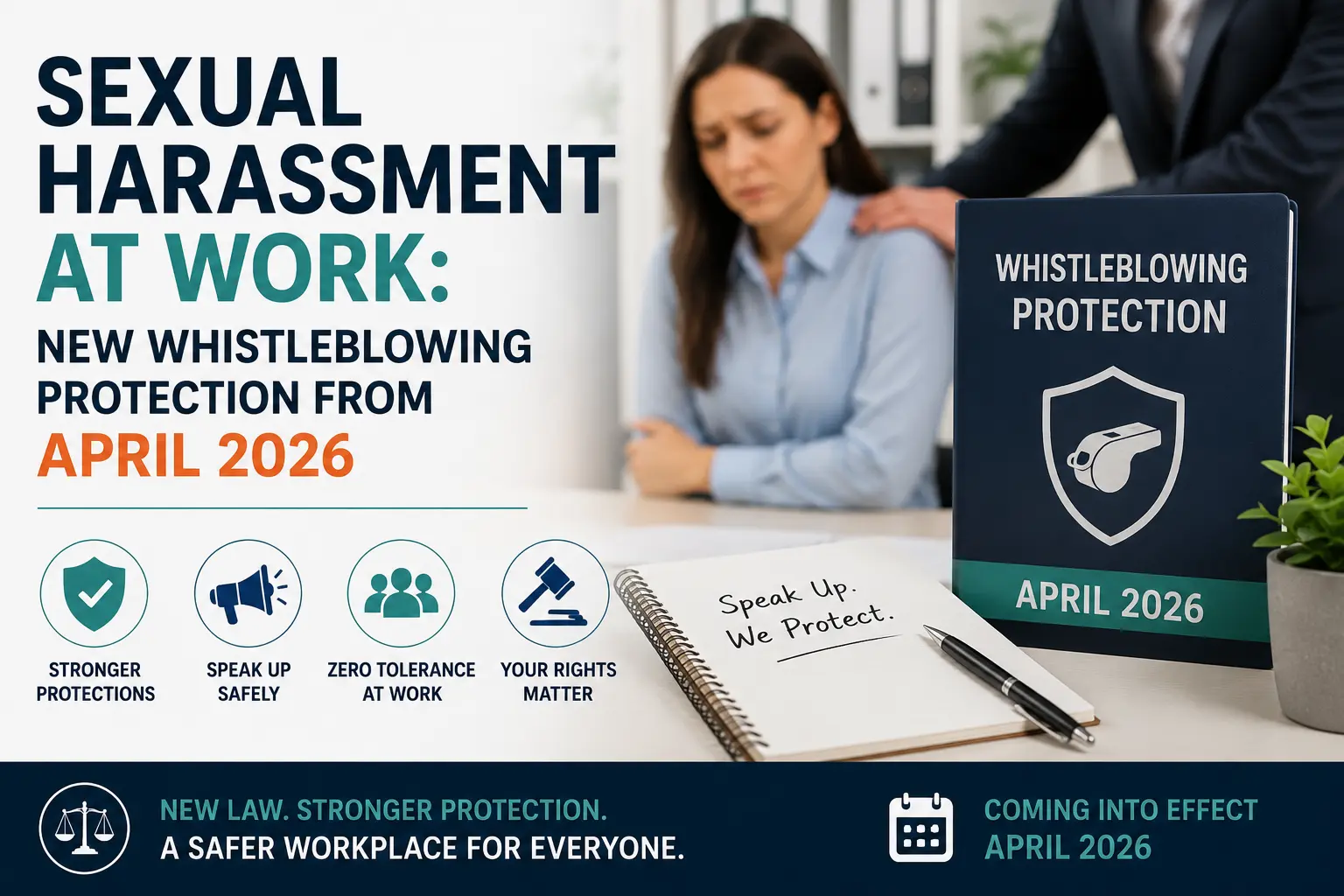
From 6 April 2026, sexual harassment became a qualifying disclosure under whistleblowing law. That is a major employment-law change because it gives workers a clearer and stronger legal route when they speak up about sexual harassment at work.
Before this change, someone reporting sexual harassment might still try to argue that their disclosure fell within one of the existing categories of wrongdoing, such as a breach of a legal obligation or a danger to health and safety. But that was not always straightforward. The legal route could feel less certain, and many workers were left worrying that speaking up might cost them their job, damage their career, or expose them to retaliation.
The April 2026 change matters because it removes a lot of that uncertainty. Sexual harassment is now expressly treated as a qualifying disclosure under whistleblowing law. In practical terms, that means a worker who blows the whistle on sexual harassment can have protection from detriment and, where the legal status of employee applies, automatic unfair dismissal if they are dismissed because of the disclosure.
This change also sits alongside another very important development. Since 26 October 2024, employers have had a legal duty to take reasonable steps to prevent sexual harassment of employees. So the legal picture is now much more demanding for employers. They are not only expected to prevent sexual harassment in the workplace, they are also operating in a legal environment where workers who report sexual harassment have stronger whistleblowing protection.
That combination makes this a powerful topic for SEO and for real client concern. Employees are worried about whether they are protected if they report sexual harassment. Employers are worried about policies, procedures, training, culture, complaints handling, and the risk of tribunal claims if they get things wrong. Both sides are searching online for clear answers.
This is why this blog matters. It answers what changed, what the law now protects, what workers should do, what employers should do, and when to get legal help. It is not just a legal update. It is a practical guide for people dealing with a problem that is serious, sensitive and often urgent.
At Zain Legal & Co., we know this is one of those areas where clients do not want vague legal theory. They want to know, in plain English, whether the law protects them, what evidence matters, what to do next, and how to avoid making the position worse. That is exactly why this is such a strong blog subject for your website and such a strong traffic-driver for your employment-law pages.
What Counts as Sexual Harassment at Work?
Sexual harassment is not just inappropriate behaviour in a general sense. It has a specific legal meaning and it is important to explain that clearly because many people search online trying to work out whether what happened to them was “bad behaviour” or something legally actionable.
Under the Equality Act 2010, sexual harassment is unwanted conduct of a sexual nature which has the purpose or effect of violating someone’s dignity, or creating an intimidating, hostile, degrading, humiliating or offensive environment for them. That can include spoken comments, messages, images, jokes, physical behaviour, invitations, propositions, gestures, repeated conduct, or unwanted sexual attention.
In real workplaces, the problem is often more subtle than people expect. It may involve:
• comments dressed up as banter
• repeated messages or invitations after refusal
• unwanted touching or closeness
• sexual jokes in team chat groups
• senior staff exploiting workplace power
• customer or client behaviour that management fails to address
• retaliation after someone objects or reports the conduct
This is one reason why high-ranking blog content on sexual harassment at work has to be practical rather than abstract. Searchers are often not asking for a textbook definition. They are trying to work out whether what happened to them “counts”, whether they should raise it, whether the employer should have stopped it, and whether they are at risk if they report it.
That is also why the 2026 whistleblowing change is so important. If a worker reports sexual harassment, the issue is no longer only about a grievance or equality complaint. It may also be about a qualifying disclosure under whistleblowing law. That creates a stronger and more urgent protection framework around the act of speaking up.
At Zain Legal & Co., we help clients cut through that uncertainty. We help them identify what the conduct actually was, how it fits within the legal framework, how it should be documented, and what route is likely to give them the strongest protection or the clearest response.
How the New Whistleblowing Protection Works
Whistleblowing law protects workers who make qualifying disclosures in the right circumstances. The big change from 6 April 2026 is that sexual harassment is now expressly treated as a qualifying disclosure.
That means the worker who reports sexual harassment may now have whistleblowing protection if they suffer detriment because they spoke up. If they have the legal status of employee and are dismissed because of the disclosure, the dismissal can be treated as automatically unfair dismissal. That is a very important point because automatic unfair dismissal does not work like an ordinary unfair dismissal claim with the usual length-of-service issues.
This change is powerful because it targets one of the most common fears in sexual harassment cases: retaliation. Workers often worry that once they report what happened, they will suddenly be performance-managed, excluded, ignored, treated as difficult, denied opportunities, or pushed out. In other words, the biggest fear is often not the original conduct alone, but what happens next after the complaint is raised.
Now the law is clearer. If the worker blows the whistle on sexual harassment, the disclosure itself can attract whistleblowing protection. That means employers need to think carefully not only about the original sexual harassment complaint, but also about how they treat the worker afterwards. The risk is no longer only an Equality Act issue. It may also be a whistleblowing detriment or dismissal issue.
This is exactly why employers should not see sexual harassment complaints as routine HR noise. They are high-risk issues with multiple legal angles:
• sexual harassment itself
• failure to prevent sexual harassment
• victimisation
• grievance unfairness
• whistleblowing detriment
• automatic unfair dismissal
• wider cultural and reputational risk
For employees and workers, this change gives a stronger basis for acting. For employers, it raises the stakes if complaints are ignored, minimised, or mishandled.
At Zain Legal & Co., we help clients understand how these legal routes overlap. In many cases, the question is not “is this only a whistleblowing case or only a sexual harassment case?” The real question is how the legal routes interact and which points should be raised, documented, and prepared properly from the start.
The Difference Between a Grievance, a Discrimination Claim and a Whistleblowing Case
One reason people search online repeatedly for help in this area is confusion. They are not sure whether they should raise a grievance, report sexual harassment, bring a discrimination complaint, or think in terms of whistleblowing. In reality, the answer is often that more than one route may matter.
A grievance is the internal complaint process. It is usually the first structured step when a worker wants the employer to investigate and deal with the issue properly. A grievance helps create a written record of what happened, what was said, when it was reported, and how the employer responded.
A discrimination or harassment claim under the Equality Act 2010 focuses on the unlawful conduct itself. It is concerned with whether the worker was sexually harassed, victimised, or otherwise treated in a way that breaches equality law.
A whistleblowing case focuses on the disclosure and what happened after the disclosure. It is concerned with whether the worker made a qualifying disclosure and then suffered detriment or dismissal because of that act of speaking up.
These are different but overlapping routes. A worker may:
• raise a grievance about sexual harassment,
• rely on the Equality Act 2010 for the harassment itself,
• and rely on whistleblowing protection if they are penalised for reporting it.
That is why practical legal support matters. Many people accidentally weaken their position by treating the matter as only one type of case when it should be presented more broadly. Others delay raising anything at all because they are frightened of “getting it wrong”.
At Zain Legal & Co., we help clients structure the issue properly. We look at the complaint, the disclosure, the treatment afterwards, the documents, the time limits and the likely litigation or settlement strategy. That helps clients move from confusion to clarity.
What Employers Must Do Now
Employers should treat this 2026 change as a serious compliance and culture issue, not a technical footnote.
Since October 2024, employers have been under a legal duty to take reasonable steps to prevent sexual harassment of employees. That means employers should already be:
• assessing risk,
• updating policies,
• training managers and staff,
• improving reporting routes,
• taking complaints seriously,
• and acting quickly when problems are raised.
From April 2026, the risk picture becomes even sharper because the worker who reports sexual harassment now has clearer whistleblowing protection. That means employers should review not only prevention measures, but also:
• whistleblowing policies,
• reporting procedures,
• complaint-handling processes,
• confidentiality and NDA wording,
• manager training on retaliation,
• record-keeping,
• and escalation routes for serious complaints.
A common employer mistake is to focus only on the original complaint and ignore the treatment afterwards. That is dangerous. A poorly handled complaint can generate new liabilities even if the employer thinks it is “investigating”. Excluding the complainant, mishandling the process, warning the complainant, or treating them as the problem may deepen the legal exposure significantly.
This is one of the reasons this topic will continue to rank and drive traffic. Employers are actively searching for:
• what to do about sexual harassment complaints,
• how whistleblowing protection now applies,
• what policies to update,
• whether third-party behaviour matters,
• and how to avoid tribunal risk.
At Zain Legal & Co., we help employers and workers understand the real practical obligations here. That includes reviewing how complaints are framed, how evidence is handled, what correspondence should say, and how to reduce avoidable risk.
How Zain Legal & Co. Can Assist
At Zain Legal & Co., we provide practical legal support in statutory demand matters for both debtors and creditors. We understand that clients usually come to us in one of two situations: either they have just received a statutory demand and do not know what to do, or they are owed money and want to know whether a statutory demand is the right recovery tool.
We assist with:
• urgent review of the statutory demand and deadlines
• set-aside strategy for individuals
• company response strategy where a winding-up petition risk exists
• disputed debt analysis
• evidence preparation and chronology drafting
• negotiation and repayment proposals
• wider debt recovery and insolvency-risk planning
• court paperwork and hearing preparation where needed
Why does this matter? Because these are not situations where vague internet advice is enough. Clients need someone to assess the real position, explain the risk in plain English, and help them take the right step fast.
That is also why this blog should convert well. It is not just educational. It is problem-solving content aimed at people who are already under pressure and need help now.
What Employees and Workers Should Do If They Report Sexual Harassment
If you are dealing with sexual harassment at work and are thinking about reporting it, the biggest mistakes are often delay, poor documentation and informal complaint routes that leave no proper record.
In practical terms, workers should usually think about:
• keeping copies of messages, emails, screenshots and notes,
• writing down dates, times, names and what happened,
• identifying witnesses where possible,
• preserving any internal complaint trail,
• raising concerns clearly rather than vaguely,
• and getting advice early if they fear retaliation.
The April 2026 whistleblowing change does not mean every workplace complaint will automatically succeed as a whistleblowing case. The facts still matter. But it does mean workers who report sexual harassment now have a clearer legal basis for protection if they are treated badly because they spoke up.
That is why timing and structure matter. A clear complaint, a well-documented chronology and the right follow-up can all strengthen the position. A weak, rushed, or purely verbal complaint can make it harder to prove what was disclosed and how the employer reacted.
At Zain Legal & Co., we help clients with:
• grievance drafting,
• response letters,
• evidence organisation,
• ACAS preparation,
• tribunal-focused case preparation,
• and practical strategy about what to say and what to do next.
How Zain Legal & Co. Can Help
At Zain Legal & Co., we provide practical support in employment disputes within the scope of unreserved legal services. We help clients understand the issue, frame the complaint properly, organise the evidence, and take the right next step.
In sexual harassment and whistleblowing matters, we can assist with:
• grievance drafting,
• response letters,
• evidence and chronology preparation,
• ACAS early conciliation preparation,
• witness statements,
• hearing preparation,
• tribunal support,
• and practical lay representative or McKenzie Friend style support where appropriate and permitted.
What makes this valuable is not just knowing the law. It is helping clients use the law properly when the problem is real, stressful and time-sensitive. That is where clear structure, strong drafting and practical next-step support make the difference.
Frequently Asked Questions
What changed on 6 April 2026?
From 6 April 2026, sexual harassment became a qualifying disclosure under whistleblowing law. That means workers who blow the whistle on sexual harassment can have whistleblowing protection from detriment and, where applicable, automatic unfair dismissal.
What legal duty do employers already have?
Since 26 October 2024, employers have had a legal duty to take reasonable steps to prevent sexual harassment of employees.
Does this mean sexual harassment is now whistleblowing?
Reporting sexual harassment can now be a qualifying disclosure for whistleblowing purposes. That does not remove the Equality Act issues. It adds another potential layer of protection around speaking up.
Can I still raise a grievance?
Yes. In many cases you should still think carefully about the internal grievance route, because it creates an important written record and forces the employer to respond formally.
Can I be dismissed for reporting sexual harassment?
If the report is protected as a qualifying disclosure, dismissal because of that disclosure may be legally significant as automatic unfair dismissal. The facts and legal status still matter, so early advice is important.
What should employers update now?
Policies, manager training, complaint-handling procedures, whistleblowing routes, reporting culture and the way retaliation risks are managed should all be reviewed.
Call to Action
If you are dealing with sexual harassment at work, retaliation after reporting it, or employer compliance concerns after the April 2026 whistleblowing change, do not leave the issue to drift.
Book a consultation through:
Zain Legal & Co. can review the position, explain the legal routes clearly, and help you take the right next step with confidence.