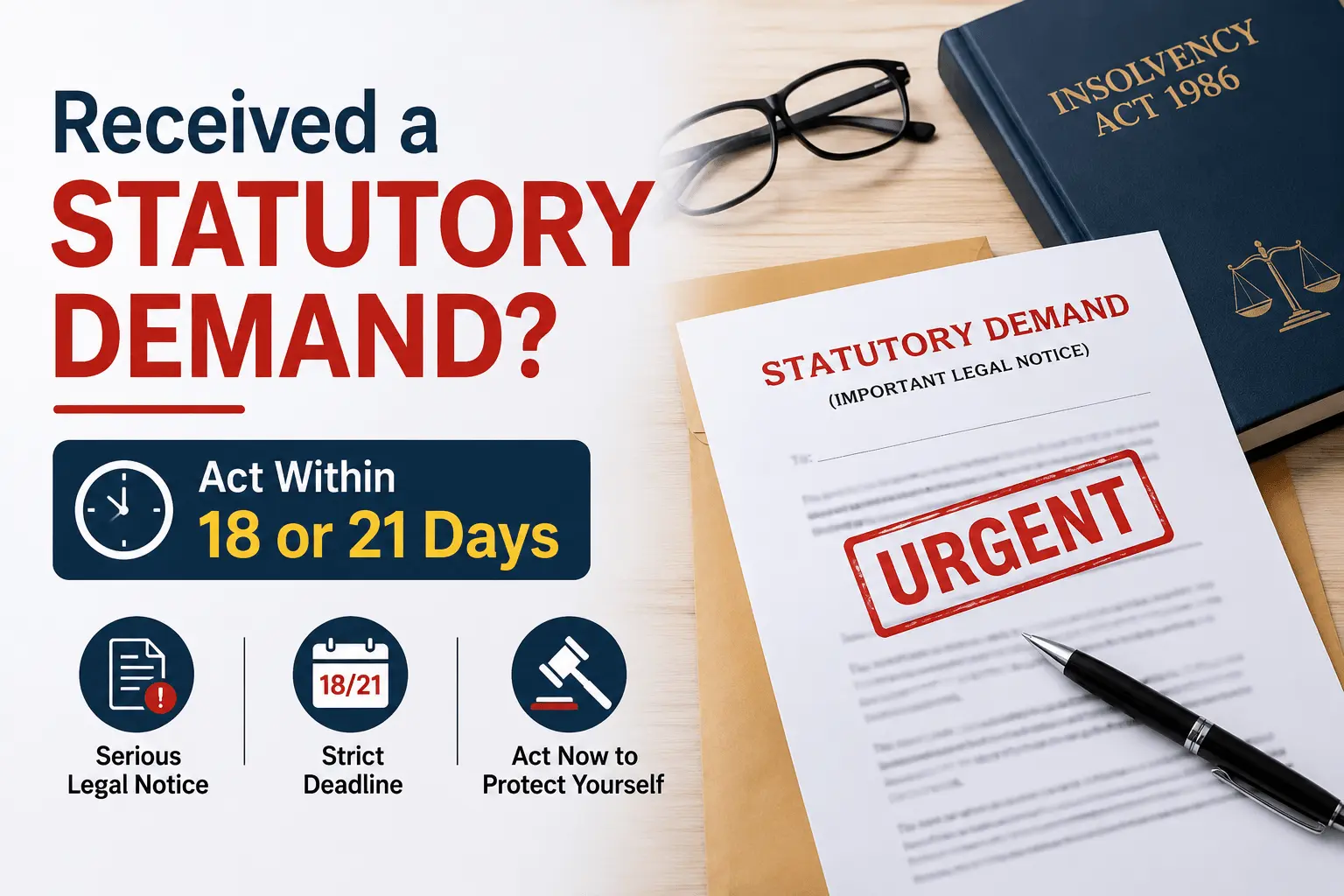
What is a Statutory Demand and Why Is the Clock Ticking?
A statutory demand is not just another debt collection letter. It is a formal insolvency step used to demand payment of a debt and create immediate pressure on the person or company that has been served. That is why the moment a statutory demand arrives, the clock starts ticking.
In simple terms, a statutory demand is often used where a creditor says the debt is clear, presently due, and serious enough to justify insolvency pressure rather than ordinary chasing letters alone. If it is ignored, the consequences can become severe very quickly. Current GOV.UK guidance states that after a statutory demand is received, the debtor usually has 21 days to either pay the debt or reach an agreement to pay. If they do not, the creditor can move towards bankruptcy proceedings against an individual or winding-up proceedings against a company.
This is exactly why so many people search online in a panic for phrases such as “received a statutory demand”, “18 day statutory demand deadline”, “21 day statutory demand deadline”, “how to set aside a statutory demand”, or “what happens if I ignore a statutory demand”. These are high-intent searches. The person searching is usually frightened, time-pressured, and looking for urgent practical help.
A statutory demand matters because it is not aimed at proving the debt in the ordinary way. It is usually used as a precursor to insolvency action. For individuals, that means the real risk is bankruptcy if the debt is at or above the bankruptcy threshold. For companies, the real risk is a winding-up petition if the statutory conditions are met and the creditor decides to escalate. In both situations, the law treats continued non-compliance as powerful evidence that the debtor cannot pay.
That is where the distinction between an ordinary debt claim and a statutory demand becomes crucial. A normal money claim can be defended and argued through the court process. A statutory demand is supposed to be used only where the debt is genuinely undisputed and insolvency pressure is justified. If the debt is genuinely disputed on substantial grounds, using a statutory demand can be risky for the creditor and potentially challengeable by the debtor.
In practice, the first questions that matter are:
• Is the debt really due?
• Is it actually disputed?
• Was the statutory demand served properly?
• Are you an individual or a company?
• Which deadline applies to you?
• What can still be done before the position gets worse?
Those questions decide everything that follows. The biggest mistake people make is assuming they can “wait and see”. In statutory demand cases, delay is often the worst possible strategy. Evidence goes stale, application windows close, and the other side gains leverage.
At Zain Legal & Co., we help clients cut through that confusion quickly. If you have received a statutory demand, or are considering using one, the issue is not just legal theory. The real issue is what the document means in your specific case, what deadline is now running, and what practical steps should happen next to protect your position.
The 18-Day Deadline: How Individuals Can Set Aside a Demand
For individuals, one of the most important search phrases is “18 day statutory demand deadline”, because that is usually the point at which the opportunity to apply to set the demand aside becomes critical.
Current GOV.UK guidance says that if an individual does not agree with the statutory demand, they can apply to challenge it and have it set aside. The usual deadline is 18 days if the person was in the UK when the statutory demand was received. GOV.UK also directs individuals to download and complete Form IAA when making the application.
That 18-day period matters because it is not a soft deadline. It is a serious procedural point. The formal statutory rule sits in rule 10.4 of the Insolvency (England and Wales) Rules 2016, which provides for an application to the court to set aside the statutory demand. This is one of the official sources that should be linked in the live blog because it adds trust and legal accuracy.
So when can an individual apply to set aside a statutory demand? In practical terms, some of the most common grounds include:
• the debt is genuinely disputed on substantial grounds
• the debt is below the relevant bankruptcy threshold
• the creditor holds security and the debt position is therefore different from how it has been presented
• the debtor has a counterclaim, set-off or cross-demand that reduces or extinguishes the alleged debt
• the statutory demand has been used oppressively or as an abuse of process
• there are defects in the demand or problems with service
• the debt is statute-barred or otherwise not properly enforceable
One of the most commercially important points for SEO and client education is the genuinely disputed debt point. A statutory demand should not usually be used as a pressure tactic for a debt that is truly disputed. If the debtor can show a real and substantial dispute, that can be powerful grounds for a set-aside application. This is also why searches like “can I set aside a statutory demand for a disputed debt” or “statutory demand disputed debt over £5,000” are so important to target naturally in the content.
Another common issue is confusion about the debt level. GOV.UK guidance says that after 21 days, a creditor can start bankruptcy proceedings against an individual who owes £5,000 or more. That does not mean every demand over £5,000 is automatically valid, but it does explain why that figure appears repeatedly in help-seeking searches.
A properly prepared set-aside application is not just about saying “I disagree”. The court will want proper grounds, a clear explanation, and supporting evidence. That often means pulling together:
• the statutory demand itself
• the contract or agreement relied on
• invoices, statements or account history
• relevant emails, messages and letters
• proof of dispute or complaint
• any evidence of payment, set-off or counterclaim
• a clear chronology explaining what happened and when
This is where early help can change the outcome. Many debtors leave the application too late or send weak informal correspondence instead of making the proper court application in time. At Zain Legal & Co., we help clients identify whether there are real grounds to challenge the demand, prepare the written material properly, and act before the 18-day window is lost.
What Companies Must Do Immediately (Why the 18-Day Rule Does Not Apply)
One of the biggest misunderstandings online is the belief that companies can deal with a statutory demand in the same way as individuals. They cannot. That is why a strong blog on this topic needs a separate section aimed directly at company directors, business owners and finance teams.
Current GOV.UK guidance states that a company cannot challenge a statutory demand by applying to set it aside in the same way as an individual. Instead, if a company wants to stop the creditor moving forward, it may need to apply to court to restrain the presentation of a winding-up petition. GOV.UK says this usually has to be done within 21 days of getting the statutory demand.
The 21-Day Expiry: What Happens If You Do Nothing?
The 21-day deadline is the final warning point and one of the most searched parts of the entire statutory demand process. People want to know exactly what happens if they do nothing, whether they are an individual or a company.
Current GOV.UK guidance is clear: after 21 days, if the statutory demand has not been dealt with, the creditor can move towards bankruptcy against an individual or winding up a company. That is why searches like “what happens after 21 days statutory demand” and “ignored statutory demand consequences” are so common.
The reason this is so serious is that insolvency law treats continued non-compliance as evidence of inability to pay. For companies, section 123 of the Insolvency Act 1986 states that a company is deemed unable to pay its debts if, among other things, a creditor owed more than the statutory minimum serves a written demand and the company neglects for three weeks to pay, secure or compound the debt to the creditor’s reasonable satisfaction. For individuals, sections 267 and 268 of the Insolvency Act 1986 connect the bankruptcy petition route to the debtor appearing unable to pay the debt following service of the statutory demand.
In plain English, the law allows the court to treat non-compliance after the statutory period as evidence of insolvency. That does not mean bankruptcy or winding up is automatic, but it does mean the creditor’s position becomes much stronger if the debtor has simply done nothing.
For an individual, the consequences may include:
• a bankruptcy petition
• public court proceedings
• increased legal costs and pressure
• serious financial and credit consequences
• potential risk to assets depending on the wider financial position
For a company, the consequences may include:
• a winding-up petition
• severe reputational risk
• supplier and banking concerns
• pressure from other creditors
• possible freezing consequences once a petition is advertised
• significant disruption to trading and rescue options
That is why “do nothing” is not a neutral choice. It is often the most dangerous choice.
This is also the point at which a creditor has to think strategically. Just because the 21 days have expired does not mean bankruptcy or winding-up proceedings are always the best next move. Sometimes a payment plan, negotiated settlement, money claim or other commercial route is more effective. A high-quality blog should say that honestly, because it builds trust. Creditors searching “serve a statutory demand” also want to know whether it is worth using, and whether the debt is suitable for insolvency pressure.
At Zain Legal & Co., we help on both sides of that problem. If you are a creditor, we can help you decide whether to escalate, negotiate, or change route. If you are a debtor, we can help you assess whether there is still a way to limit the damage, respond sensibly, or take urgent steps before a petition is issued. That includes practical support with evidence, chronology, challenge grounds, repayment proposals, and urgent next-step strategy.
From an SEO perspective, this section is one of the most valuable parts of the whole blog because it answers the fear-based search intent that drives urgent enquiries. It should be written clearly, firmly, and without fluff. That is exactly what people need when they are searching online under pressure.
Common Mistakes People Make After Receiving a Statutory Demand
A strong blog should also answer the hidden search intent behind the problem: people want to know what not to do.
The most common mistakes include:
• assuming a statutory demand is just a scare tactic and ignoring it
• missing the 18-day deadline for an individual set-aside application
• not understanding that companies do not use the same set-aside route
• sending weak complaint emails instead of making the right application
• failing to gather the contract, invoices and evidence early
• using a statutory demand as a creditor even though the debt is genuinely disputed
• waiting until day 20 or day 21 to seek help
• focusing only on the amount claimed and ignoring the surrounding insolvency risk
Avoiding those mistakes can often be the difference between controlling the process and being controlled by it.
How Zain Legal & Co. Can Assist
At Zain Legal & Co., we provide practical legal support in statutory demand matters for both debtors and creditors. We understand that clients usually come to us in one of two situations: either they have just received a statutory demand and do not know what to do, or they are owed money and want to know whether a statutory demand is the right recovery tool.
We assist with:
• urgent review of the statutory demand and deadlines
• set-aside strategy for individuals
• company response strategy where a winding-up petition risk exists
• disputed debt analysis
• evidence preparation and chronology drafting
• negotiation and repayment proposals
• wider debt recovery and insolvency-risk planning
• court paperwork and hearing preparation where needed
Why does this matter? Because these are not situations where vague internet advice is enough. Clients need someone to assess the real position, explain the risk in plain English, and help them take the right step fast.
That is also why this blog should convert well. It is not just educational. It is problem-solving content aimed at people who are already under pressure and need help now.
Frequently Asked Questions
Can I ignore a statutory demand if I think it is wrong?
That is usually a bad idea. If you are an individual, you may need to apply within 18 days to set it aside. If you are a company, you may need to act within 21 days to restrain a winding-up petition. Ignoring it can allow the creditor to escalate.
What form do I use to challenge a statutory demand?
For individuals, current GOV.UK guidance says you usually use Form IAA when applying to challenge the statutory demand and have it set aside.
Can a company file Form IAA too?
Not in the same way. A company does not use the same set-aside route as an individual. The company usually needs urgent court action to restrain the presentation of a winding-up petition.
What if the debt is genuinely disputed?
A genuinely disputed debt is one of the most important reasons why a statutory demand may be challengeable or inappropriate. Insolvency pressure is not usually the right tool for a debt that is truly disputed on substantial grounds.
How long does a creditor have to act after serving the demand?
Current GOV.UK guidance says the creditor will usually have 4 months after service to apply for bankruptcy or winding up if the statutory demand has been ignored.
Can a statutory demand be used for an old debt?
Usually not if the debt is over 6 years old. Current GOV.UK guidance says you cannot usually make a statutory demand for a debt older than 6 years.
Official Resources
GOV.UK statutory demand guide:
https://www.gov.uk/statutory-demands
Challenge a statutory demand:
https://www.gov.uk/statutory-demands/challenge-a-statutory-demand
Insolvency (England and Wales) Rules 2016, rule 10.4:
https://www.legislation.gov.uk/uksi/2016/1024/rule/10.4
Insolvency Act 1986, section 123:
https://www.legislation.gov.uk/ukpga/1986/45/section/123
Insolvency Act 1986, sections 267 and 268:
Call to Action
If you have received a statutory demand, or if you are considering serving one, do not wait for the deadlines to shrink your options.
Book a consultation through:
Zain Legal & Co. can review the paperwork, assess the urgency, and help you take the right next step before the situation escalates.