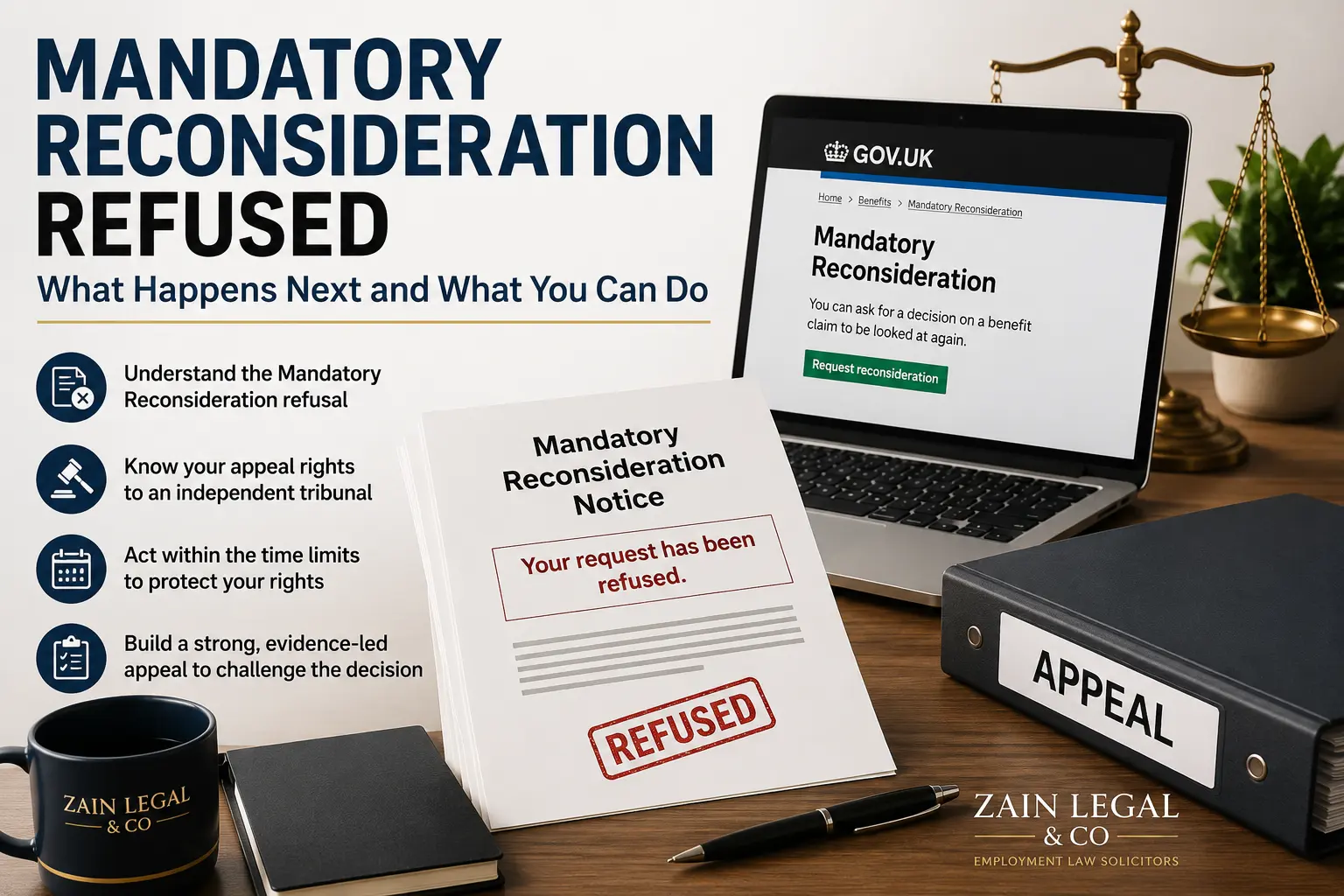
If your Mandatory Reconsideration has been refused, the case is not over. For many PIP and benefit claimants, this is the point where the appeal needs to become more organised, more evidence-led and more focused on the legal test the tribunal must apply.
A refusal at Mandatory Reconsideration does not automatically mean the DWP is right. It means the DWP has looked at the decision again and decided not to change it, or not to change it enough. The next stage is usually an appeal to the Social Security and Child Support Tribunal, which is independent of the DWP.
The critical point is timing. You normally need to appeal within one month of the date on your Mandatory Reconsideration Notice. If you leave it too late, you may still be able to appeal, but you will need to explain the delay and the tribunal may need to decide whether to accept the late appeal.
Do not give up if your Mandatory Reconsideration has been refused
Many claimants feel defeated when they receive a Mandatory Reconsideration Notice saying the decision has not changed. That reaction is understandable. The letter can feel final. It often repeats points from the original decision. It may also appear to ignore important medical evidence, daily difficulties, pain, fatigue, mental health symptoms, risk, supervision needs or mobility problems.
But the Mandatory Reconsideration stage is not the final appeal stage. If you disagree with the outcome, the next step is usually to appeal to an independent tribunal. The tribunal is not part of the DWP. It can look at the evidence and decide whether the original benefit decision was wrong.
The strongest appeals are not emotional complaints. They are structured. They identify the disputed activities, explain the real functional difficulty and show why the decision maker reached the wrong conclusion. For PIP appeals, that usually means focusing on daily living and mobility descriptors, not simply repeating the diagnosis.
What is a Mandatory Reconsideration Notice?
A Mandatory Reconsideration Notice is the written decision you receive after asking the DWP or another decision-making body to look again at a benefit decision. It should explain whether the decision has changed and, if not, why it has stayed the same.
For most DWP benefit decisions, you usually need a Mandatory Reconsideration Notice before you can appeal to the tribunal. This is why the notice is important. Do not throw it away. Do not ignore it. Keep the full letter, including all pages, because it is usually needed when you lodge the appeal.
If you have lost the notice, contact the DWP and request a copy immediately. Delay can put your appeal deadline at risk.
Can you appeal after Mandatory Reconsideration is refused?
Yes. If you are still unhappy after Mandatory Reconsideration, you can usually appeal to the Social Security and Child Support Tribunal. The appeal is normally made to HM Courts and Tribunals Service, not back to the DWP.
You can usually appeal online through GOV.UK or by using form SSCS1 if you are appealing a DWP social security benefit decision. If you are appealing by post, you normally need to include a copy of your Mandatory Reconsideration Notice.
The appeal should not simply say, “I disagree.” That is too weak. Your grounds of appeal should explain why the decision is wrong. In a PIP appeal, this should usually identify which daily living or mobility activities you dispute, what help you need, how often you need it and why you cannot do the activity reliably.
How long do you have to appeal?
In an ordinary unfair dismissal claim, the basic award is usually calculated using age, length of service and weekly pay, subject to the statutory weekly pay cap. It is similar to the statutory redundancy pay calculation.
For dismissals on or after 6 April 2026, the statutory weekly pay cap is £751. The maximum basic award is usually 30 weeks’ pay, which produces a maximum of £22,530. Always check the applicable rate based on the effective date of termination.
If the claimant has already received statutory redundancy pay, this may reduce or extinguish the basic award because the tribunal will usually avoid double recovery.
Past loss of earnings
The usual time limit is one month from the date of the Mandatory Reconsideration Notice. That deadline matters. You should act quickly, even if you are still gathering medical evidence.
If you cannot obtain all evidence before the deadline, it is often better to lodge the appeal on time and explain that further evidence will follow. Missing the deadline creates an avoidable risk.
If the one-month deadline has already passed, do not assume the case is finished. You may still be able to appeal late, but you must explain why the appeal is late. Common reasons may include illness, bereavement, mental health crisis, hospital admission, caring responsibilities, postal problems, language barriers, disability-related difficulty dealing with paperwork, or not receiving the notice in time. The reason should be clearly explained and supported where possible.
Future loss of earnings
Future loss is the amount you say you are likely to lose after the hearing or calculation date. This can be important where you remain unemployed, have moved to lower-paid work, or your dismissal has made it harder to secure comparable employment.
The tribunal will expect a realistic explanation. You should not simply pick a large number. Explain the job market, your applications, interviews, health position, sector, seniority, location, caring responsibilities and any barriers to finding similar work.
What should you do immediately after receiving the refusal?
The first 48 hours after receiving the refusal should be used carefully. Do not rush into a vague appeal. Do not wait until the last few days either. The following steps will put the case in a stronger position.
|
Stage |
What the client should do |
Why it matters |
|
Step 1 |
Check the date on the Mandatory Reconsideration Notice. |
This normally starts the appeal deadline. |
|
Step 2 |
Read the reasons for refusal carefully. |
You need to know exactly what points the DWP accepts, rejects or misunderstands. |
|
Step 3 |
Identify which activities or decisions are disputed. |
A focused appeal is stronger than a general complaint. |
|
Step 4 |
Request the assessment report if you do not already have it. |
For PIP, the report can reveal assumptions, contradictions and factual errors. |
|
Step 5 |
Prepare appeal grounds. |
The tribunal needs to understand why the decision is wrong. |
|
Step 6 |
Submit the appeal on time. |
You can usually add further evidence later. |
|
Step 7 |
Start collecting evidence immediately. |
Medical letters, care notes, prescriptions, diaries and witness statements can all help. |
What should your appeal grounds say?
Your appeal grounds should be clear, specific and linked to the legal test. They do not need to be a full skeleton argument at the start, but they should give the tribunal enough information to understand what is being challenged.
A weak appeal ground says:
“I disagree with the decision because I am ill and I need help.”
A stronger appeal ground says:
“I disagree with the decision because it fails to properly assess my ability to prepare food, wash, dress, manage therapy and move around safely, repeatedly, to an acceptable standard and within a reasonable time. The decision relies too heavily on the assessment report and does not properly reflect my daily difficulties, the help I receive from family and the risk of falls, fatigue and pain after activity.”
The difference is obvious. The stronger wording directs the tribunal to the actual issues. It also signals that the appeal will be evidence-led.
What evidence helps at a PIP or benefit tribunal?
Evidence should not be dumped into the appeal without structure. The tribunal needs to understand what each document proves. For PIP, the best evidence usually shows how your condition affects specific daily living and mobility activities.
- The original decision letter and Mandatory Reconsideration Notice.
- The PIP assessment report, if available.
- GP letters, consultant letters, mental health team letters, physiotherapy notes or occupational therapy reports.
- Medication lists, prescription records and side-effect evidence.
- Hospital letters, discharge summaries and appointment records.
- Care plans, social care assessments, support worker notes or carer evidence.
- A short daily diary showing pain, fatigue, panic attacks, falls, incontinence, confusion, prompting needs or recovery time.
- A witness statement from a partner, relative, friend, carer or support worker who sees the daily difficulties.
- Evidence of aids, appliances, adaptations or supervision needs.
- Relevant photographs where appropriate, for example adaptations, mobility aids or safety equipment.
Medical evidence is useful, but it is not enough on its own if it only confirms a diagnosis. A diagnosis does not automatically score PIP points. The evidence must explain what you cannot do, what help you need, how often the problem arises and what happens if you try to manage without help.
The PIP reliability test
For PIP, the key question is not whether you can do something once on a good day. The question is whether you can complete the activity reliably. That means safely, to an acceptable standard, repeatedly and within a reasonable time.
This is where many DWP decisions are vulnerable. A decision may say the claimant “can walk”, “can cook” or “can engage”, but it may fail to ask whether they can do that activity repeatedly, safely, without unacceptable pain, without risk, without prompting, and within a reasonable time.
When preparing an appeal, each disputed activity should be tested against those reliability questions. For example:
- Can you do it safely, or is there a risk of falls, burns, self-neglect, panic, harm or injury?
- Can you do it to an acceptable standard, or is the result poor, incomplete or unsafe?
- Can you repeat it as often as reasonably required, or do pain, fatigue, breathlessness or mental distress stop you?
- Can you do it within a reasonable time, or does it take much longer because of your condition?
Common mistakes that weaken benefit appeals
A refused Mandatory Reconsideration can often be rescued at tribunal, but avoidable mistakes can weaken the case. The most common problems are these:
- Missing the appeal deadline and giving no proper explanation.
- Submitting an appeal that only says “I disagree” without explaining why.
- Focusing only on diagnosis instead of functional difficulty.
- Failing to challenge factual errors in the assessment report.
- Sending large amounts of evidence without explaining what it proves.
- Ignoring the PIP descriptors and reliability test.
- Not obtaining a witness statement from someone who sees the claimant daily.
- Assuming the tribunal already understands fluctuating conditions.
- Underplaying symptoms because of embarrassment or pride.
- Giving answers at hearing that are too vague, too short or inconsistent with the written evidence.
Should you make a new claim or appeal the old decision?
This is a common question. Some claimants receive a refused Mandatory Reconsideration and wonder whether it is better to start again with a new claim.
There is no single answer. It depends on the facts. An appeal usually looks at whether the decision was wrong at the time it was made. A new claim may be relevant if your condition has changed significantly after that decision. However, starting a new claim instead of appealing can sometimes lose potential backdating and may fail to challenge the original wrong decision.
Before deciding, consider:
- When the original decision was made.
- Whether your difficulties existed at that time.
- Whether the DWP misunderstood or ignored evidence.
- Whether your condition has worsened since the decision.
- Whether there is a deadline to appeal the Mandatory Reconsideration Notice.
- Whether backdated entitlement could be significant if the appeal succeeds.
If in doubt, obtain advice quickly. The wrong choice can affect both timing and money.
Common mistakes that weaken a schedule of loss
- Claiming round figures without showing the calculation.
- Using gross pay where net pay is required, or failing to explain the basis of the calculation.
- Forgetting pension contributions, benefits, holiday pay or notice pay.
- Claiming injury to feelings in a simple unfair dismissal claim where there is no discrimination or harassment claim.
- Failing to deduct new income from a replacement job.
- Ignoring mitigation and failing to keep job-search evidence.
- Using an old compensation cap or outdated Vento band.
- Claiming losses that are not linked to the ET1 or the agreed list of issues.
- Overstating future loss without evidence of job-market difficulty.
- Failing to update the schedule before settlement discussions or hearing.
What happens after you submit the appeal?
After the appeal is submitted, HMCTS should register the appeal and notify the DWP. The DWP will then usually prepare a response bundle. This bundle should contain the decision, Mandatory Reconsideration Notice, assessment report, evidence and the DWP’s reasons for resisting the appeal.
Do not assume the bundle is correct. Read it carefully. Look for missing documents, wrong dates, inaccurate summaries, selective quoting from medical evidence, contradictions in the assessment report and assumptions that are not supported by the evidence.
You can usually send further evidence and written submissions before the hearing. This is where a well-prepared appeal can become much stronger. The tribunal needs a clear route through the evidence. It should not have to guess what your case is.
Should you attend the tribunal hearing?
In many cases, attending the hearing gives the claimant the best opportunity to explain their difficulties in their own words. The hearing is not a criminal trial. It is usually less formal than many people expect. However, it is still important. The panel will ask questions and will be looking for clear, consistent evidence about how the condition affects daily living or mobility.
If you cannot attend because of illness, mental health, disability, caring duties or other serious reasons, you should explain this and ask about reasonable adjustments or alternative arrangements. Do not simply fail to attend without explanation.
How Zain Legal & Co Can Help
Zain Legal & Co assists clients who have received a refused Mandatory Reconsideration and need practical help preparing the next stage of their benefit appeal. The value is not just “filling in a form”. The value is identifying the weak points in the DWP decision and presenting the appeal in a structured, evidence-led way.
We can assist with:
- Reviewing the Mandatory Reconsideration Notice and original decision letter.
- Checking the PIP assessment report for factual errors, contradictions and unsupported assumptions.
- Identifying which daily living and mobility descriptors should be argued.
- Preparing clear grounds of appeal for the SSCS1 or online appeal.
- Drafting written submissions for the tribunal.
- Preparing witness statements from the claimant, family members, carers or support workers.
- Creating an evidence checklist so the client knows what documents to obtain.
- Reviewing medical evidence and explaining whether it actually supports the legal test.
- Helping clients prepare for tribunal questions.
- Preparing a clear case theory so the tribunal understands exactly why the decision is wrong.
Our approach is direct. We look at what the DWP says, what the evidence actually shows, where the assessment report is weak, and what the tribunal needs to see. The aim is to put your case in the strongest possible position before the hearing.
When should you get help?
You should get help as soon as possible if:
- your Mandatory Reconsideration has been refused;
- you are close to the one-month appeal deadline;
- you scored zero points but your daily life is significantly affected;
- the assessment report contains errors;
- you have mental health, autism, ADHD, chronic pain, fatigue, mobility problems or fluctuating symptoms that were not properly understood;
- you struggle to explain your difficulties in writing;
- you are worried about answering tribunal questions;
- you have a hearing date and your evidence is disorganised.
Early preparation matters. A rushed appeal prepared days before the hearing is rarely as strong as one built properly from the beginning.
Frequently Asked Questions
What happens if Mandatory Reconsideration is refused?
You can usually appeal to the Social Security and Child Support Tribunal. The appeal is made to HMCTS, not simply back to the DWP. You should act quickly because the normal deadline is one month from the date of the Mandatory Reconsideration Notice.
Can I appeal a PIP Mandatory Reconsideration refusal?
Yes. If you disagree with the decision after Mandatory Reconsideration, you can usually appeal. For PIP, your appeal should focus on the daily living and mobility activities, the descriptors, the reliability test and the evidence showing how your condition affects you.
How long do I have to appeal after Mandatory Reconsideration?
The usual deadline is one month from the date on the Mandatory Reconsideration Notice. If you are late, you should explain the delay clearly. Do not assume you cannot appeal without getting advice.
Do I need new evidence to appeal?
New evidence can help, but the appeal can also challenge how the existing evidence was interpreted. The key is to explain why the decision is wrong and how the evidence supports the benefit entitlement.
What is the SSCS1 form?
SSCS1 is the paper appeal form used for many social security benefit appeals to HMCTS. Many appeals can also be started online through GOV.UK.
Should I ask for the assessment report?
Yes, especially in PIP appeals. The assessment report may contain errors, assumptions or contradictions that need to be challenged in the appeal.
Can I make a new claim instead of appealing?
Sometimes a new claim may be appropriate, especially if your condition has changed. However, appealing may preserve the chance of backdated entitlement if the original decision was wrong. Take advice before choosing.
Can Zain Legal & Co represent me at tribunal?
Zain Legal & Co can assist with appeal preparation, written submissions, evidence review, witness statements, tribunal preparation and support where appropriate. The exact support depends on the case, the deadline and the paperwork.
Book a PIP or benefit appeal paperwork review
If your Mandatory Reconsideration has been refused, do not wait until the deadline has nearly expired. Zain Legal & Co can review your decision paperwork, identify the strongest appeal points and help you prepare the next stage.
Bring or send the decision letter, Mandatory Reconsideration Notice, assessment report, medical evidence and any appeal paperwork you have received.