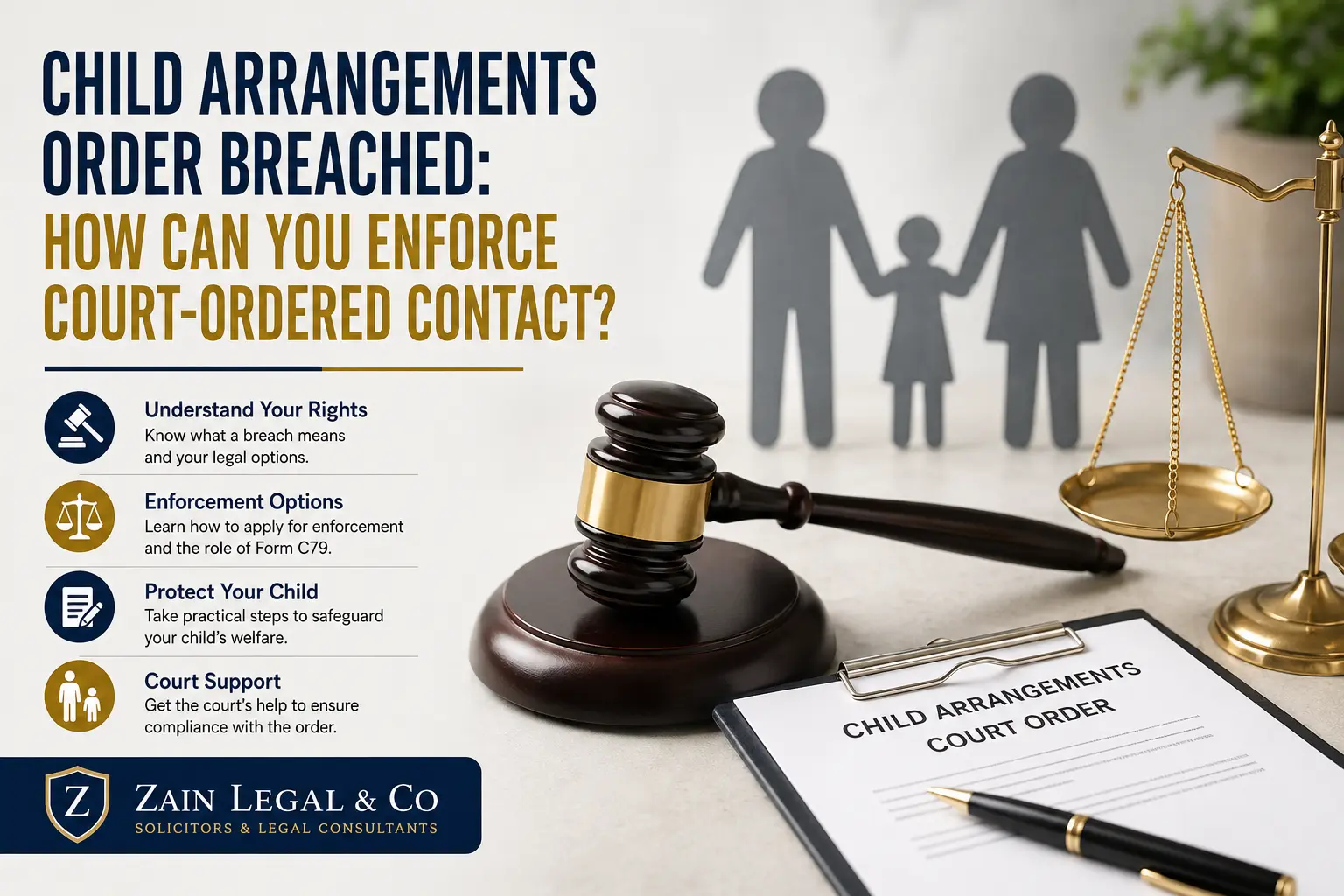
When a Child Arrangements Order is repeatedly ignored, the parent losing contact may feel that the court order has become meaningless. It has not. A sealed order is legally binding, but enforcement is not automatic. You normally need to place clear evidence before the Family Court, explain the precise breaches and ask for an order that protects the child’s welfare and makes future arrangements workable.
Quick answer: If an existing Child Arrangements Order has been breached without a reasonable excuse, you can apply for enforcement using Form C79. Keep a factual breach chronology, preserve messages and handover evidence, and show what practical steps you took to resolve the problem. The court may confirm or vary the arrangements, order make-up contact, request Cafcass input, impose an unpaid-work enforcement order, award compensation for actual financial loss, or use other powers. The child’s welfare remains the court’s paramount consideration.
Form C79 was updated by HMCTS on 1 June 2026. The current GOV.UK guidance states that an enforcement application costs £270, subject to checking the latest fee and eligibility for Help with Fees.View the current C79 form and guidance.
What Should You Do After Missed Court-Ordered Contact?
- Read the sealed order word for word. Check dates, times, handover locations, notice requirements, conditions and whether the wording is mandatory or flexible.
- Confirm that the order contains a warning notice. Orders made on or after 8 December 2008 should normally include one.
- Record the missed contact immediately: date, time, what the order required, what happened and the explanation given.
- Preserve WhatsApp messages, emails, call logs, school information, travel receipts and any handover evidence.
- Send one calm, child-focused message asking for compliance and a sensible replacement arrangement.
- Avoid threats, abusive messages or repeated confrontational contact. Your own communication may later be read by the judge or Cafcass.
- Consider mediation or another safe attempt to resolve the practical issue where there is no domestic abuse or safeguarding risk.
- If breaches continue, prepare a focused C79 application and evidence schedule rather than an emotional account of the entire relationship.
- Seek urgent advice if the child is at immediate risk, has been removed, or the order intersects with domestic abuse, prohibited steps or abduction concerns.
The best evidence is usually contemporaneous. A short message sent at the handover time, a travel receipt and a clear entry in a breach chronology may be more persuasive than a lengthy statement written months later.
What Counts as a Breach of a Child Arrangements Order?
A breach occurs where a person does not comply with a clear provision of the order. The court will examine the exact wording, the event complained of and whether there was a reasonable excuse.
|
Possible breach |
What the court will examine |
|
Contact does not take place |
Whether the order required contact on that date, what each parent did and the explanation given. |
|
The child is repeatedly returned late |
How late, how often, whether notice was given and the impact on the child. |
|
Holiday contact is refused |
Notice requirements, passports, travel information, safeguarding concerns and whether the order was sufficiently clear. |
|
Telephone or video contact is blocked |
The frequency required by the order, practical attempts to facilitate it and whether technology or timing caused genuine difficulty. |
|
Handover conditions are ignored |
Location, supervision, third-party arrangements, prohibited contact and safety requirements. |
|
The child is not returned to the parent named in a live-with provision |
The wording of the order, immediate welfare concerns, the child’s location and whether urgent court or police action is required. |
A Disagreement Is Not Always an Enforceable Breach
An informal parenting plan, text-message arrangement or routine followed by agreement is not the same as a sealed Child Arrangements Order. Form C79 is used to enforce an existing order. If there is no order, or the order no longer covers the current arrangements, a C100 application for a new, varied or discharged order may be required.
Check the Exact Wording Before Applying
Some orders use precise language: ‘The child shall spend time with the father every alternate Saturday from 10am to 6pm.’ Others record expectations or permit the parties to agree details. The more ambiguous the wording, the more difficult it may be to prove a deliberate breach.
- Is the provision mandatory or expressed as an agreement?
- Does the order require advance notice?
- Are school holidays defined?
- Who must collect and return the child?
- Does supervision have to be provided by a named person or service?
- Were later orders or written agreements made?
- Does the order contain a warning notice?
What Is Form C79?
Form C79 is the application used for orders related to enforcement of a Child Arrangements Order. It can be used to seek an enforcement order, compensation for actual financial loss, or certain orders concerning an existing enforcement order.
Form C79 is not the same as Form C100. C79 is directed at non-compliance with an existing Child Arrangements Order. C100 is generally used to apply for a new section 8 order or to vary or discharge an existing order.
What Should the C79 Application Explain?
- the date and terms of the existing Child Arrangements Order;
- the warning notice and any later variation orders;
- each specific breach, with dates and short factual descriptions;
- the explanation given by the other parent, if any;
- your attempts to resolve the matter safely;
- the impact on the child and the stability of arrangements;
- the outcome you ask the court to consider;
- any actual financial loss for which compensation is sought.
Do You Need Mediation Before a C79 Application?
A C79 enforcement application is not the same as a new C100 application. The current C79 form does not contain the MIAM certification section used for C100 applications. That means a MIAM is not generally treated as the formal gateway requirement for filing C79.
However, the court will still consider whether the problem could have been resolved safely and proportionately. Cafcass advises parents to try amicable resolution and mediation where suitable, unless there is domestic abuse, safeguarding risk or another reason that makes mediation inappropriate.
Practical position: You do not have to continue unsafe or pointless negotiations before protecting a child or enforcing a clear order. But where it is safe, evidence of a calm request for compliance, a proposed replacement date or an invitation to mediation can demonstrate a child-focused approach.
Should You Contact the Police?
The police do not normally enforce routine contact arrangements. A missed weekend or refusal to facilitate ordinary contact is usually a Family Court enforcement issue.
Contact the police or emergency services where there is an immediate safeguarding or criminal concern. Examples can include violence, threats, abduction risk, a child missing, unlawful retention in circumstances requiring urgent protection, or breach of a separate protective injunction. In an emergency, the correct response may also include an urgent Family Court application.
What Evidence Should You Keep?
|
Evidence |
What it can show |
|
Sealed Child Arrangements Order |
The exact legal obligation, warning notice and any conditions. |
|
Breach chronology |
Dates, pattern, frequency, explanations and replacement contact. |
|
WhatsApp, text and email messages |
What was agreed, refused, cancelled or offered. |
|
Handover records |
Attendance, lateness, third-party witnesses and what occurred. |
|
Travel and booking receipts |
Attendance and any actual financial loss. |
|
Call logs and video-contact records |
Attempts to exercise ordered remote contact. |
|
School or nursery records |
Attendance, collection issues and relevant events. |
|
Witness statement |
Independent evidence of handovers, refusals or the support given. |
|
Police or safeguarding records |
Serious incidents, risk and official reports. |
|
Evidence of proposed solutions |
Make-up contact offers, mediation invitations and child-focused communication. |
Use a Breach Chronology, Not a General Complaint
|
Date and order term |
What happened |
Explanation given |
Evidence |
Replacement offered? |
|
12 June – Saturday contact 10am to 6pm |
Child was not brought to handover. Applicant waited until 10.45am. |
Message at 10.20am said the child did not want to attend. |
Order, timestamped messages, parking receipt. |
Applicant offered 13 or 14 June; no response. |
|
26 June – Saturday contact |
Cancelled the evening before. |
Child allegedly had a family event. |
WhatsApp exchange. |
Applicant proposed the following Sunday; refused. |
|
10 July – video call at 6pm |
No call took place and no explanation was given. |
None. |
Call log and follow-up message. |
Applicant proposed 11 July; no response. |
What If the Other Parent Says the Child Refuses Contact?
A child’s wishes and feelings matter, particularly as age and understanding increase. But the phrase ‘the child refuses’ is not automatically a complete answer to an enforcement application.
The court may ask: Why is the child refusing? What steps did the parent take to encourage and prepare the child? Were there genuine safeguarding concerns? Is the order workable? Has the child been exposed to adult conflict? Would a gradual, supported or therapeutic plan better protect welfare?
- Do not pressure or interrogate the child.
- Record the exact explanation given without adding assumptions.
- Ask for practical steps: supported handover, shorter contact, indirect contact or a staged reintroduction where appropriate.
- Consider whether Cafcass input, a section 7 report or other professional assessment is needed.
- Address any allegations of harm directly and with evidence.
A parent is generally expected to take reasonable steps to comply with the order. The court will distinguish a genuinely distressed child and a parent who has taken reasonable steps from a situation where refusal is simply repeated without meaningful encouragement or investigation.
What Is a Reasonable Excuse for Breaching the Order?
The court considers the facts of each incident. A reasonable excuse may include a genuine medical emergency, an immediate and evidenced safeguarding concern, impossibility caused by circumstances outside the person’s control, or another compelling reason.
A bare assertion is unlikely to be enough. The court will examine what happened, what evidence supports the explanation, whether the other parent was informed and whether reasonable alternatives were offered.
|
Possible explanation |
Questions the court may ask |
|
Child was ill |
Was medical advice obtained? How serious was the illness? Was replacement contact offered? |
|
Transport failed |
Was alternative transport possible? Was notice given promptly? Is this a repeated issue? |
|
Safeguarding concern |
What was the concern, when did it arise, was it reported, and was urgent court action taken? |
|
Child refused |
What steps were taken to understand, encourage and support compliance? |
|
Holiday or family event |
Was the event genuinely unavoidable, and why should it override a court order? |
What Enforcement Powers Does the Court Have?
The court is not limited to punishing the parent said to be in breach. Its wider objective is to protect the child and make the arrangements workable.
Confirm or clarify the existing order: The court may give clearer directions about dates, handovers, notice and communication.
Vary the Child Arrangements Order: The court can alter contact or living arrangements where the welfare evidence shows a different order is required.
Order make-up or replacement contact: The court can build compensatory time into a revised or clarified arrangement, although there is no automatic hour-for-hour entitlement.
Refer the parents to support or non-court resolution: This may include parenting work, mediation or another intervention where safe and suitable.
Request Cafcass involvement: The court may seek welfare advice, a report or risk assessment before deciding the next step.
Make an enforcement order: If the statutory test is met, the court may impose 40 to 200 hours of unpaid work.
Make a suspended enforcement order: The unpaid-work consequence may be suspended on terms designed to secure future compliance.
Order compensation for financial loss: The court can order repayment of actual financial loss caused by the breach, such as a wasted holiday cost.
Fine or committal for contempt: These are serious remedies and are not the routine outcome of an ordinary first enforcement application.
Make a costs order: Family costs orders are exceptional rather than automatic, but unreasonable litigation conduct can be relevant.
What Must Be Proved for an Unpaid-Work Enforcement Order?
Section 11J of the Children Act 1989 provides that the court may make an unpaid-work enforcement order where it is satisfied beyond reasonable doubt that a person failed to comply with a provision of the Child Arrangements Order. The court cannot make that enforcement order where the person had a reasonable excuse.
Can You Recover Lost Contact Time?
There is no automatic right to receive exactly the same number of missed hours later. The court can, however, order make-up contact, clarify the schedule or vary the order where that promotes the child’s welfare.
Financial compensation is different. Under the enforcement provisions, compensation is for actual financial loss caused by no
Can the Court Change the Existing Order?
Yes. An enforcement application can lead the court to look again at whether the current order remains workable and safe. The court may make the arrangements more specific, change handovers, introduce supported contact, alter frequency, reconsider where the child lives, or make another welfare-based order.
Enforcement can therefore carry strategic risk. The court is not required simply to punish the other parent and restore the original arrangement unchanged. Before filing, assess whether the order still serves the child’s welfare and whether the evidence could lead to a wider review.
What Happens at a C79 Enforcement Hearing?
- The judge or magistrates identify the order and alleged breaches.
- The applicant explains the incidents and evidence relied upon.
- The respondent gives their explanation and any claimed reasonable excuse.
- The court considers safeguarding information and whether Cafcass input is required.
- The court decides whether a breach is proved and what outcome best serves the child.
- Directions may be made for statements, a report, further evidence or a later hearing.
Will Cafcass Be Involved Again?
Cafcass may carry out safeguarding checks and can be asked to advise the court. Where the dispute concerns the child’s refusal, domestic abuse, risk, a major change in arrangements or the impact of an enforcement sanction, the court may request further work.
What If the Breaches Keep Happening?
Repeated non-compliance should be presented as a pattern, not a collection of emotional accusations. Update the chronology after every incident, preserve evidence, comply with your own obligations and bring the matter back promptly where the existing order is not working.
- Ask for a more defined order with precise times and handover arrangements.
- Request a staged or supported plan if the child’s relationship has deteriorated.
- Ask the court to address repeated failure to facilitate contact.
- Consider whether a variation is required alongside or instead of punitive enforcement.
- Seek urgent protection if the child is being withheld in circumstances creating immediate risk.
Common Mistakes That Weaken an Enforcement Application
- Applying without reading the exact wording of the order.
- Calling every disagreement a breach.
- Filing a general history instead of a dated breach schedule.
- Using abusive or threatening messages after contact is cancelled.
- Asking the police to resolve routine contact enforcement.
- Ignoring genuine safeguarding concerns raised by the child or other parent.
- Assuming the child’s refusal automatically proves manipulation.
- Seeking punishment without proposing a workable child-focused solution.
- Failing to disclose occasions when replacement contact was offered or took place.
- Exaggerating financial loss or claiming compensation for hurt feelings.
- Describing a McKenzie Friend as having an automatic right to speak for you.
Worked Example: Missed Contact and the Child Allegedly Refusing
|
Weak presentation |
Stronger evidence-led presentation |
|
“The mother has breached the order every time and alienated the child.” |
“Contact ordered for 12 June, 26 June and 10 July did not take place. The attached chronology identifies the order term, message, explanation and replacement proposal for each date.” |
|
“She says the child refuses, but that is a lie.” |
“The explanation given was that the child refused. I asked what support had been offered and proposed shorter contact, a neutral handover and a Cafcass-supported plan. No alternative was accepted.” |
|
“I want her punished.” |
“I ask the court to restore predictable contact, clarify handovers, consider make-up time and obtain Cafcass advice if the child’s stated resistance requires assessment.” |
Family Court Support in Birmingham and Across England and Wales
Parents often search online for a family solicitor in Birmingham when an order has been breached because they need urgent help understanding Form C79, organising evidence and preparing for a hearing. Zain Legal & Co provides family court support and McKenzie Friend assistance in Birmingham, the West Midlands and remotely across England and Wales.
The service must be described accurately. A McKenzie Friend can ordinarily provide moral support, take notes, help manage case papers and quietly advise. A McKenzie Friend has no automatic right to act on your behalf, address the court, examine witnesses or sign documents. Any wider participation depends on the court’s permission and the circumstances.
How Zain Legal & Co Can Help
Review the existing order: We identify the exact obligations, warning notice, conditions, ambiguity and whether enforcement or variation is the correct route.
Prepare a breach chronology: We convert missed contact, cancellations and late handovers into a clear dated schedule linked to the order.
Analyse WhatsApp, email and handover evidence: We identify the messages that prove non-compliance, reasonable proposals, explanations and the pattern of conduct.
Assist with Form C79: We help complete the application accurately, define the breaches and state the orders you ask the court to consider.
Prepare witness and position statements: We organise the facts, welfare issues, evidence and proposed outcome in a format the court can follow.
Draft proposed directions: We help formulate practical requests concerning contact, handovers, Cafcass work, evidence, make-up time or variation.
Prepare for the hearing: We explain the likely issues, organise the bundle, prepare questions and help you present the case calmly and child-focused.
Attend as a McKenzie Friend: Subject to the court’s approval, we can provide quiet advice, note-taking, moral support and help managing papers during the hearing.
Why a Consultation Is Important
An enforcement consultation is not simply a discussion about whether the other parent behaved unfairly. It is used to determine whether a clear order exists, whether the events amount to breaches, what reasonable-excuse arguments may arise, whether safeguarding changes the position and what order is realistically required.
- It prevents a C79 application being used where C100 variation is the correct route.
- It identifies the strongest breaches and removes weak or irrelevant allegations.
- It creates a usable evidence and chronology plan.
- It helps frame a child-focused outcome rather than a punitive demand.
- It explains the limits and potential wider consequences of enforcement proceedings.
What to Send Before Your Consultation
- The sealed Child Arrangements Order and any later orders.
- A list of every alleged breach with dates.
- Relevant WhatsApp messages, emails and call logs.
- Handover evidence and witness details.
- Any police, social services, school or Cafcass documents.
- Evidence of replacement contact offered or refused.
- Receipts for any actual financial loss.
- The next hearing date or urgent safeguarding information.
Why an Early Consultation Matters
The first consultation is not merely a discussion about whether the claim feels fair. It is used to identify the deadline, the correct procedural route, the evidence required, any admissions that should be avoided, the strength of the defence and whether settlement, set-off or counterclaim should be considered.
- A defence drafted before the evidence is organised may omit decisive points.
- A rushed admission may be difficult to reverse.
- A weak generic defence can damage credibility and increase costs.
- Early review creates time to request focused documents, preserve evidence and negotiate from a stronger position.
- Where the case requires a solicitor, barrister or specialist regulated representation, we will say so plainly.
What to Send Before Your Consultation
- The complete claim form and particulars of claim.
- The N9 response pack or screenshots from the online claim account.
- The envelope, issue notice or email showing how and when the papers arrived.
- Any letter before claim and your response.
- The contract, quotation, invoice, terms and relevant correspondence.
- Payment records and a short chronology.
- Any photographs, reports or evidence supporting your defence or counterclaim.
Frequently Asked Questions
What counts as a breach of a Child Arrangements Order?
A breach occurs when a person does not comply with a clear term of the sealed order. The court will examine the wording, what happened and whether there was a reasonable excuse.
Can I enforce a private agreement using Form C79?
No. C79 is used where a Child Arrangements Order already exists. If the arrangements were informal, you may need a C100 application for an order.
Should I contact the police if court-ordered contact is refused?
Routine contact disputes are normally dealt with by the Family Court. Contact the police where there is immediate risk, violence, abduction concern, a missing child or another potential criminal or protective-order issue.
Do I need mediation before applying on Form C79?
The current C79 form does not contain the MIAM certification used for C100 applications. A MIAM is not generally the formal gateway for C79, although safe attempts to resolve the problem and mediation can still be relevant.
What is Form C79?
It is the HMCTS application form for orders related to enforcement of an existing Child Arrangements Order, including an enforcement order or compensation for actual financial loss.
How much does a C79 application cost?
Current GOV.UK guidance states that the fee is £270. Check the latest fee before filing and whether you qualify for Help with Fees.
What evidence should I keep?
Keep the sealed order, a dated breach chronology, messages, emails, call logs, handover records, travel receipts, witness evidence and proof of replacement contact offered.
What if the other parent says the child refuses contact?
The court will consider the child’s wishes and feelings, age, understanding, welfare and the steps taken to support compliance. A child’s refusal is not automatically a complete excuse.
Can the court change the existing order?
Yes. The court may clarify or vary contact, handovers, supervision, frequency or living arrangements where a different order better protects the child’s welfare
What enforcement powers does the court have?
The court can confirm or vary the order, direct make-up contact, request Cafcass work, impose unpaid work, award compensation for actual financial loss, and in serious cases consider contempt remedies.
Can I recover missed contact time?
There is no automatic hour-for-hour entitlement, but the court can order replacement or make-up contact where that is in the child’s interests.
Can I recover money lost because contact was cancelled?
The court can order compensation for actual financial loss caused by breach, such as a wasted holiday cost. It cannot award compensation merely for distress or inconvenience.
What if the breaches continue after the hearing?
Keep updating the evidence and return to court promptly where necessary. The court may impose stronger enforcement measures or vary the arrangements.
Can I apply if the order was made before December 2008?
You may first need to use Form C78 to attach a warning notice. Check the order and current HMCTS guidance.
Can a McKenzie Friend help at the hearing?
Subject to the court’s approval, a McKenzie Friend can provide moral support, take notes, help with papers and quietly advise. They do not automatically have the right to speak, examine witnesses or act on your behalf.
Can Zain Legal & Co help outside Birmingham?
Yes. Document review, C79 support, statement preparation and hearing preparation can usually be provided remotely across England and Wales, with Birmingham and West Midlands court support subject to availability.
Important Legal Notice
This article provides general information about enforcement of Child Arrangements Orders in England and Wales. It is not legal advice on an individual case. Family Court decisions are welfare-based and fact-sensitive. Domestic abuse, safeguarding, abduction and contempt issues may require urgent specialist advice.
Repeated missed contact should be addressed with evidence, a clear application and a workable plan for the child.
Book a consultation with Zain Legal & Co for a focused review of the order, breach chronology, Form C79, evidence and hearing strategy.
Telephone: 0121 817 0033 | Email: info@zainlegal.co.uk