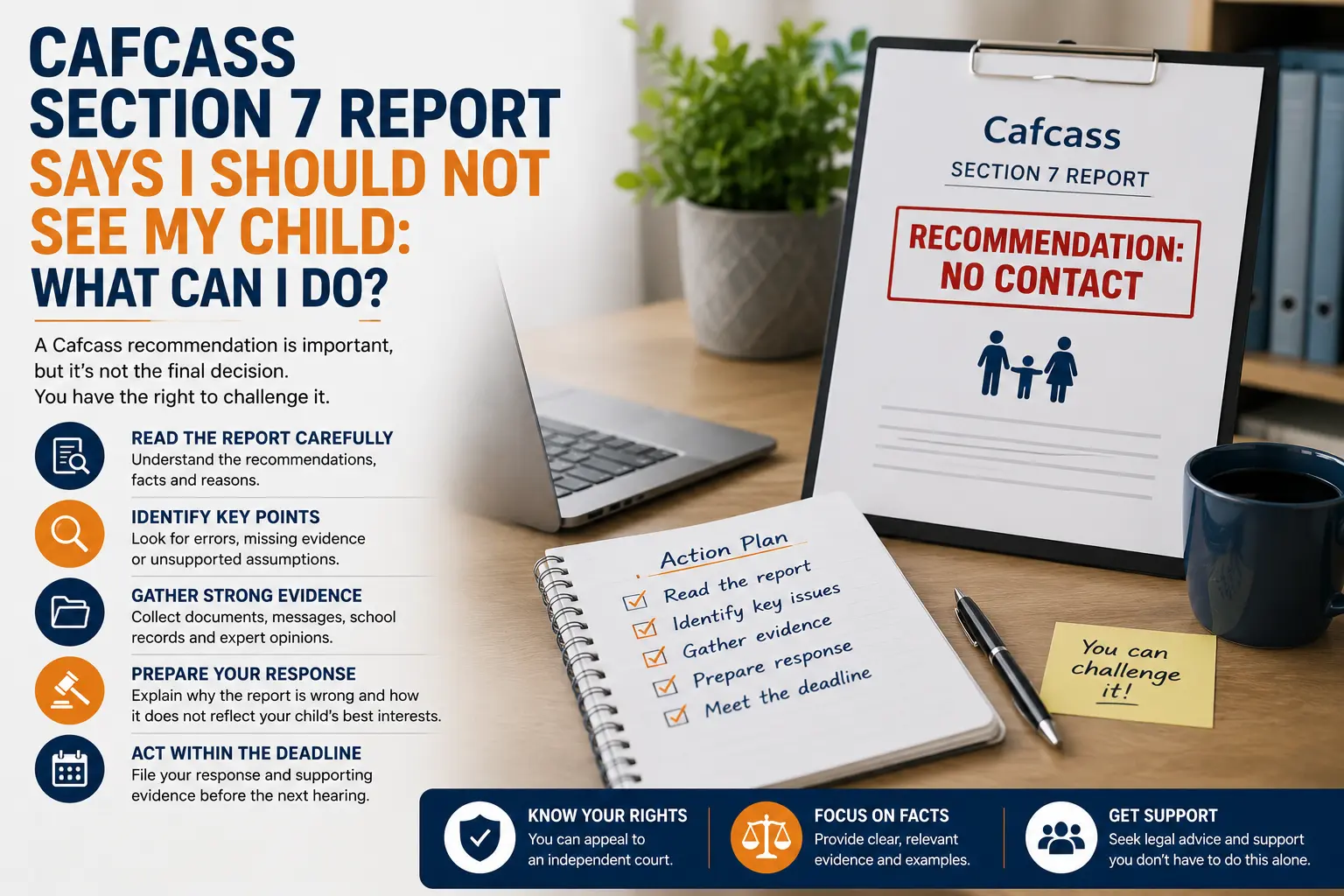
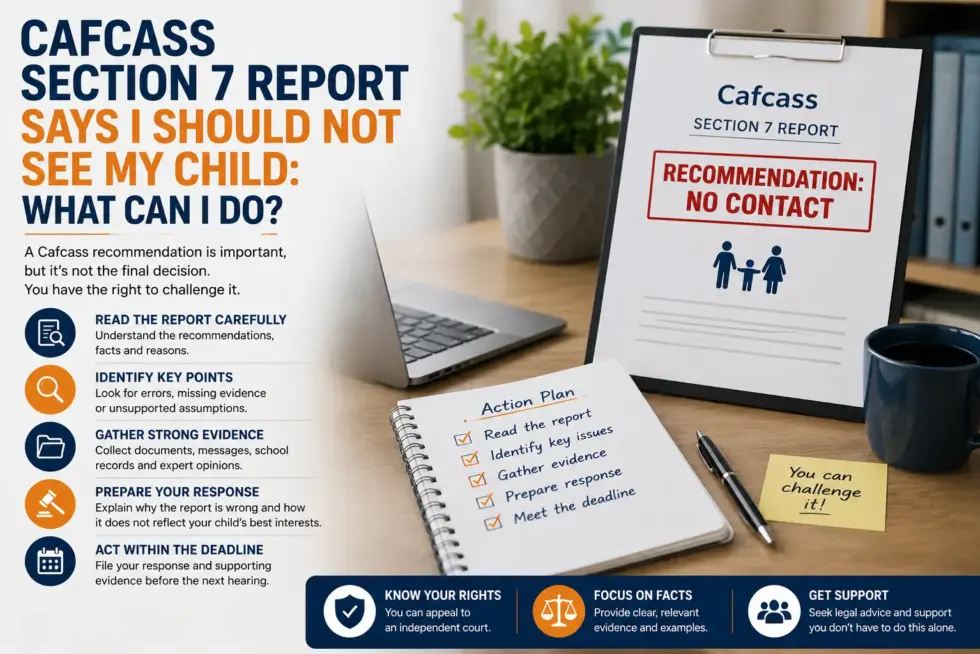
A Cafcass Section 7 report that recommends no contact, supervised contact or a serious restriction on your relationship with your child can feel devastating. It can also create immediate panic before the next family court hearing.
The first point to understand is this: a Cafcass recommendation is important evidence, but it is not the final court order. The judge or magistrates decide what order to make. A strong response is not an angry attack on Cafcass. It is a focused, child-centred challenge that identifies material errors, missing evidence, unsupported assumptions and practical alternatives.
If your Cafcass Section 7 report says you should not see your child, read the court order and hearing date first. Then work out exactly what the report recommends, why it recommends it, which facts are accepted or disputed, and what evidence can realistically change the court’s view.
Quick answer
Yes, you can challenge the content and recommendations of a Cafcass Section 7 report through the family court process.
Do not simply write that the officer is biased or that the report is “full of lies”. Identify each important point, show the correct position, link it to evidence and explain why it matters to your child’s welfare.
A complaint to Cafcass does not replace your response to the court. Cafcass itself says that challenges to assessments or recommendations, other than purely factual errors, must be made through the court process.
What Should You Do in the First 48 Hours?
- Read the latest court order. Check the next hearing date, filing deadline and whether the court has directed a position statement, witness statement, response, schedule or other evidence.
- Read the recommendation first. Is Cafcass proposing no direct contact, indirect contact, supervised contact, a pause in contact, further assessment or another specific arrangement?
- Mark every paragraph that materially affects the recommendation. Ignore minor wording points unless they genuinely matter to the welfare analysis.
- Gather the evidence that already exists. Do not start sending emotional messages or creating new conflict.
- Prepare a structured response before the hearing. The strongest response usually separates factual errors, omissions, disputed allegations, analytical weaknesses and your proposed child-focused plan.
- Get early case-specific support if the report recommends no contact or the hearing is close. The wrong response can waste the limited time available before the court considers the report.
What Is a Cafcass Section 7 Report?
A Section 7 report is a welfare report ordered by the family court under section 7 of the Children Act 1989. The court may ask Cafcass or a local authority to investigate specified issues and report on the child’s welfare.
A Cafcass Family Court Adviser may speak with the parents, usually speak with the child where appropriate, and may obtain information from other relevant people or professionals. Cafcass says its assessment is made using the Child Impact Assessment Framework and is intended to advise the court about the child’s welfare and best interests.
The report may consider the child’s wishes and feelings, safety, emotional and practical needs, the effect of conflict, allegations of harm, each parent’s ability to meet the child’s needs, and the arrangements that Cafcass believes should happen next.
The Court - Not Cafcass - Makes the Final Decision
Parents often search: “Does the judge have to follow Cafcass?” The answer is no. Cafcass advises the court. The court decides the application.
That does not mean the report can be ignored. A detailed Section 7 report may carry significant weight because it is professional welfare evidence prepared for the court. The practical task is therefore to show the judge, clearly and respectfully, why part of the report should not be accepted or why the recommendation should be changed.
The court’s central concern is the child’s welfare. Under the Children Act 1989, the court considers matters including the child’s wishes and feelings in light of age and understanding, physical and emotional needs, the likely effect of change, relevant background and characteristics, harm suffered or risk of harm, and the capability of the parents or other relevant adults to meet the child’s needs.
How long do you have to appeal?
Cafcass cannot itself make a child arrangements order. It can recommend that direct contact should stop, be supervised, be indirect, or take place under conditions. The court decides whether to make an order.
The position may be urgent if an interim order is already in force or the next hearing is close. Do not breach an existing order or attempt contact that the court has prohibited. If you believe the recommendation or order is wrong, challenge it through the proper court process.
Why Might Cafcass Recommend No Contact?
There is no single reason. The report should be read on its own facts. Possible concerns may include an assessed risk of harm, unresolved domestic abuse allegations, substance misuse, unsafe behaviour, serious conflict affecting the child, emotional harm, a child’s expressed wishes and feelings, or concern that a parent lacks insight into the impact of events on the child.
A recommendation against contact should not be challenged by saying only that children need both parents. The stronger question is: what specific risk does the report identify, what evidence supports it, what evidence is missing or misunderstood, and what safe arrangement could meet the child’s needs?
How to Read a Negative Section 7 Report Strategically
1. Separate Factual Errors From Professional Opinion
A factual error can often be checked against a document, message, date, court order or record. For example, the report may give the wrong date, say a contact session did not happen when a contact-centre record shows that it did, or attribute a statement to you that you did not make.
A professional opinion is different. You may strongly disagree with a conclusion such as “the parent shows limited insight”. The response needs to examine the facts and reasoning behind that opinion rather than simply label it wrong.
2. Identify Important Omissions
Ask what relevant evidence was not addressed. Did the report overlook positive supervised-contact notes, a previous finding, a completed course, medical evidence, police outcomes, school information, proposals you made for safe contact, or messages that materially change the chronology?
An omission matters most when it could affect the recommendation. Do not overload the court with every missing detail from the history.
3. Check Whether the Conclusion Follows From the Evidence
A focused response asks whether the recommendation is proportionate to the identified risk and whether safer alternatives were properly considered.
4. Check Whether the Child’s Voice Has Been Understood in Context
A child’s wishes and feelings can be highly important, particularly as the child gets older and has greater understanding. They are not the only factor the court considers.
A careful response may need to examine how the child’s views were obtained, whether the words are accurately recorded, whether the child’s reasons are explained, whether fear or pressure is alleged, and how the views fit with the wider evidence. Do not attack the child or accuse the child of lying.
5. Check Whether Serious Allegations Are Still Unresolved
Where domestic abuse or other harm is alleged, the court may need to decide whether facts are admitted, proved, disputed or require a separate determination. Practice Direction 12J governs the court’s approach to domestic abuse and harm in child arrangements cases.
A parent should not assume that a Section 7 response is a substitute for dealing properly with allegations or findings. The correct route depends on the order, stage of proceedings and issues the court has directed to be determined.
Use a Section 7 Challenge Matrix
Do not respond with a long emotional narrative. Build a table that helps the judge see the issue quickly.
|
Report point |
What is wrong or missing |
Evidence |
Why it matters to the child / recommendation |
|
“Father failed to attend contact on 12 May.” |
The session was cancelled by the centre, not missed by the father. |
Contact-centre email and cancellation record. |
The report relies on the incident as evidence of unreliability. |
|
“Mother has consistently blocked contact.” |
The report does not address three written proposals for supervised handover. |
Emails/messages with dates and proposed arrangements. |
The omission may affect the analysis of willingness to support the child’s relationship. |
|
“No direct contact is recommended.” |
Positive supervised contact notes are acknowledged but there is no analysis of a staged plan. |
Session reports; risk-management proposal; course/treatment evidence if relevant. |
The court may need to consider whether a safer, proportionate progression is possible. |
Key rule
Challenge material points, not every sentence.
The question is not “How do I prove Cafcass wrong about everything?” It is “Which errors or gaps could change the child-welfare analysis or the recommendation?”
A Worked Example: Weak Response v Strong Response
Weak response
“The Cafcass officer is biased. The whole report is lies. They believed my ex and ignored everything I said.”
This may express how the parent genuinely feels, but it gives the court little to work with. It does not identify the paragraph, the error, the evidence or the alternative child-focused proposal.
Stronger response
“At paragraph 42, the report states that I have not accepted any need for risk management and recommends no direct contact. That does not reflect the evidence. Since the last hearing I have completed the parenting course directed by the court, agreed to supervised contact, attended all six sessions, and the centre reports record warm and appropriate interaction with no safeguarding incident. I accept that the court must address the concerns already identified. I ask the court to consider whether continued supervised contact, with a review after a defined period, is a safer and more proportionate plan than ending direct contact entirely.”
The stronger response does four things: it identifies the exact point, uses evidence, shows insight into the concern, and proposes a child-focused next step.
What Evidence Can Help Challenge a Cafcass Report?
The right evidence depends on the issue. Useful material can include:
- the latest and previous court orders, judgments and findings;
- contact-centre reports and handover records;
- a clear chronology with dates and source documents;
- emails and messages showing contact proposals, cancellations or safeguarding concerns;
- school, health or professional records where genuinely relevant and lawfully available;
- police or local-authority outcomes where they relate directly to disputed allegations;
- evidence of completed courses, treatment, testing or support work;
- evidence showing practical changes to reduce risk;
- a realistic child-focused plan for future contact or communication.
More evidence is not automatically better. Twenty carefully chosen documents can be more useful than hundreds of pages with no explanation of what they prove.
How Should I Respond to Factual Errors?
Cafcass distinguishes between purely factual errors and disagreements with an assessment or recommendation. If there is an obvious factual error, raise it promptly and clearly. Keep a record of what you asked to be corrected.
If the real dispute is that the analysis is unfair, incomplete or the recommendation is wrong, the substantive challenge belongs in the court process. Do not wait for a complaint outcome while a family court deadline passes.
Can I Complain to Cafcass?
Yes, Cafcass has a complaints process. But a complaint and a court challenge are different things.
Cafcass states that because its report is evidence within live court proceedings, challenges to the content of an assessment or recommendation – other than purely factual errors – must be made through the court process. A complaints process cannot replace a position statement, evidence, hearing preparation or any step directed by the court.
Do not make this mistake
Do not assume that sending a complaint stops the family court timetable.
Do not miss a filing deadline because you are waiting for Cafcass to answer.
Protect the court position first. Deal with any separate service complaint in parallel where appropriate.
Can I Appeal a Cafcass Report?
Strictly speaking, you do not “appeal” the report itself. You challenge the report’s evidence and recommendations within the family court proceedings. If the court later makes an order you believe is legally wrong, any appeal is against the court’s order and has separate rules and time limits.
Can I Ask the Cafcass Officer to Attend Court?
It may be possible to ask the court to require the Family Court Adviser to attend a hearing so that relevant questions can be asked about the assessment and recommendation. This is not automatic. The court controls evidence, witnesses and the conduct of the hearing.
The strongest request identifies the precise issue that needs testing. A general desire to argue with the officer is unlikely to help. The court may also consider whether written clarification, an addendum report or another direction is more proportionate.
Can I Ask for an Addendum Report or a New Assessment?
You can ask the court to consider further work where there is a genuine gap, significant new evidence or an issue that the existing report does not address. The court decides whether any further report or assessment is necessary.
A request should explain exactly what question remains unanswered and why the court cannot fairly decide the case without further evidence. “I disagree with the report” is not, by itself, a reason for another assessment.
What If Cafcass Says My Child Does Not Want to See Me?
Do not dismiss or attack the child’s wishes. The court considers wishes and feelings in light of the child’s age and understanding, but also considers the wider welfare evidence.
A careful response may examine whether the child’s reasons are understood, whether the child has had recent safe contact, whether fear or pressure is alleged, whether the views have been consistent over time, and what professionals have observed. The focus should remain on the child’s experience, not on blaming the child for the position.
What If There Are Domestic Abuse or Safeguarding Allegations?
Treat them seriously. A response that simply says “the allegations are false” may be inadequate where the court has directed evidence, made findings, or is applying Practice Direction 12J.
The correct approach may require a chronology, a response to specific allegations, evidence of police or court outcomes, admissions where appropriate, evidence of change, risk management, or a safe proposal for contact. The strategy depends on what has already been proved, what remains disputed and what the court has ordered.
Should I Call the Cafcass Officer Biased?
Only use allegations of bias with great care. In most cases, a stronger response identifies the actual problem: a wrong fact, selective use of evidence, failure to consider a document, inconsistent reasoning, an unsupported conclusion, or a recommendation that does not follow from the stated findings.
Specific evidence is persuasive. General accusations are often not.
What Should Your Written Response Include?
The exact document depends on the court order. It may be a position statement, a witness statement, a concise response to the report, a schedule of inaccuracies or another document directed by the judge.
A strong response will usually cover:
- the order or outcome you ask the court to consider;
- the recommendation you dispute and the report paragraphs involved;
- the material facts that are wrong or incomplete;
- the evidence proving the correct position;
- the child-welfare significance of each point;
- any areas where you accept concern or recognise the need for safeguards;
- a realistic proposal for what should happen next.
What Should You Ask the Court to Do?
The answer depends on the case. Possible requests may include asking the court to:
- make a different child arrangements order from the recommendation;
- continue or restore supervised or indirect contact while risks are addressed;
- approve a staged progression plan with a review point;
- direct clarification or further reporting on a specific unresolved issue;
- require relevant evidence to be filed;
- consider whether the Cafcass officer should attend to answer focused questions;
- list the case for the appropriate next hearing where disputed facts or evidence need determination.
Do not ask for every possible direction. Ask for the step that actually solves the evidential or welfare problem in your case.
Common Mistakes That Can Damage Your Challenge
- Sending an angry, unstructured attack on Cafcass.
- Calling the officer a liar without proving specific inaccuracies.
- Challenging trivial wording while ignoring the reasons for the no-contact recommendation.
- Dumping hundreds of pages on the court with no explanation.
- Ignoring previous findings or safeguarding concerns.
- Treating the case as a contest between adults instead of a welfare decision about the child.
- Breaching an existing order because you believe the recommendation is unfair.
- Waiting for a complaint response and missing the court deadline.
- Asking for immediate unrestricted contact without addressing the risk identified in the report.
- Posting the report or private family-court material online.
Can I Share My Cafcass Report Online?
Be extremely careful. Family proceedings involving children are private and rules restrict how information from the case can be communicated. Do not post a Section 7 report, court documents or details identifying the child on social media or circulate them casually. Take advice before sharing case material outside the proceedings.
What Happens at the Next Hearing?
The next hearing may be a dispute resolution hearing, directions hearing, review or final hearing. The judge will consider the report alongside the rest of the evidence and the parties’ positions.
Depending on the stage and issues, the court may make an order, give further directions, require more evidence, consider a safe interim arrangement, or list a later hearing. The court order tells you what must be done next. Read it carefully and comply with every deadline.
Can a No-Contact Order Be Changed Later?
Potentially, yes. A final order is not necessarily permanent forever. A party may apply to vary a child arrangements order if circumstances change, but the court will consider the child’s welfare and the history of the case. Repeated applications without a proper basis can create further difficulty.
If contact has been stopped because of identified risks, the strongest future application will usually address those risks with evidence of change rather than simply repeat the same argument.
A 2026 Note for Birmingham and the West Midlands
Private family law procedure is changing, and Cafcass has used a different Child Focused Model in areas including the West Midlands before wider rollout. The exact name and sequence of an assessment may therefore vary. Always follow the specific order made in your case. This article concerns the same core problem: a welfare assessment or Cafcass recommendation that says contact should stop or be seriously restricted.
How Zain Legal & Co Can Help With a Negative Cafcass Report
A negative Section 7 report is often difficult to challenge alone because the parent is reading it emotionally while the court needs a disciplined evidential response. Zain Legal & Co can help you move from panic to a structured case plan.
1. Detailed Section 7 Report Review
We can review the report against the court orders, previous evidence and the issues in dispute. We help separate points that may genuinely affect the outcome from points that are frustrating but legally or evidentially less important.
2. Factual Error and Evidence Mapping
We can prepare a structured list or matrix showing what the report says, what you say is wrong or missing, what document supports your position, and why the issue matters to the recommendation.
3. Chronology and Document Organisation
Family cases often become confused by months or years of messages, allegations and hearings. We can help organise the key dates, court orders, contact records, messages and professional evidence into a clear chronology and evidence plan.
4. Position Statements and Written Case Preparation
Where appropriate and consistent with the court’s directions, we can assist with preparing or reviewing position statements, responses, witness statements, schedules of inaccuracies and other unreserved court documents so the case is presented clearly and in the correct order.
5. Hearing Preparation
We can help you identify the questions the judge is likely to focus on, the evidence you need at hand, the weaknesses the other side may raise, and the practical outcome you should ask the court to consider.
6. McKenzie Friend Support in Family Court
If you are acting without a solicitor, Zain Legal & Co can support you in court as a McKenzie Friend. A McKenzie Friend can normally sit with you, provide moral support, take notes, help with papers and quietly give advice on law, procedure and the issues in the case.
A McKenzie Friend does not automatically have a right to address the court, conduct advocacy or question witnesses. Any permission to speak on your behalf is for the court to decide. We are clear about that from the outset so you understand exactly what support is available.
Why a Consultation Is Important Before You Respond
A consultation is not just a conversation about whether the report feels unfair. It is used to identify the real task before the next hearing.
During a focused consultation, the questions should include:
- What does the latest court order require and by when?
- Which recommendation creates the immediate risk?
- What findings or allegations are already established?
- Which report points are factually wrong, unsupported or incomplete?
- What evidence already exists?
- What further evidence is realistically obtainable before the hearing?
- What child-focused order or direction should the court be asked to consider?
Early review can prevent a common mistake: spending days arguing about every sentence while failing to answer the few issues that actually drive the recommendation.
What to Send Before Your Consultation
- the full Section 7 report;
- the latest court order and the next hearing notice;
- the C100 application and any C7 response if available;
- previous witness statements or position statements;
- previous judgments, findings or fact-finding orders;
- contact-centre reports or supervised-contact notes;
- a short list of the report paragraphs you believe are most damaging;
- the key evidence that contradicts those paragraphs.
Why Choose Zain Legal & Co?
Clients come to Zain Legal & Co because they need practical, affordable support at the point where family court paperwork becomes overwhelming. We focus on the evidence, the court order, the deadline and the next hearing.
- Clear explanations in plain English.
- Detailed review of difficult court and Cafcass documents.
- Structured written case preparation.
- Evidence and chronology organisation.
- Hearing preparation for litigants in person.
- McKenzie Friend support in family court.
- Transparent support without pretending that any outcome is guaranteed.
Frequently Asked Questions
Can I challenge a Cafcass Section 7 report?
Yes. You can challenge factual errors, disputed evidence, omissions, analysis and recommendations through the family court process. The response should be specific, evidence-based and focused on the child’s welfare.
Does the judge have to follow Cafcass recommendations?
No. Cafcass advises the court; the judge or magistrates make the decision. The report may carry significant weight, so a disagreement needs to be explained with evidence and a realistic alternative.
Can Cafcass stop me seeing my child?
Cafcass cannot make the final child arrangements order. It can recommend no contact or restricted contact. The court decides whether to make an order.
What if the Cafcass report contains lies or factual errors?
Identify the exact paragraph, state the correct fact, provide the supporting document and explain why the point matters. Avoid simply calling the entire report dishonest.
Can I appeal a Cafcass report?
You do not usually appeal the report itself. You challenge its contents and recommendations within the proceedings. Any later appeal is against a court order and follows separate rules.
Can I complain to Cafcass?
Yes, but a complaint does not replace the court process. Cafcass states that substantive challenges to an assessment or recommendation must be raised through the court.
Can I cross-examine the Cafcass officer?
The court controls whether the officer must attend and what questions may be asked. You can ask the court to consider attendance where there is a focused issue that genuinely needs testing.
Can I ask for another Section 7 report?
You can ask for further work, clarification or an addendum where there is a genuine gap or significant new evidence. The court decides whether further reporting is necessary.
What evidence is best for challenging a Section 7 report?
The best evidence depends on the disputed issue. Court orders, contact-centre notes, messages, professional records, police outcomes, a clear chronology and evidence of positive change may all be relevant.
What if my child says they do not want to see me?
The child’s wishes and feelings can be important, but the court considers them in light of age, understanding and the wider welfare evidence. Do not attack the child. Focus on understanding the reasons and the full context.
What if there are domestic abuse allegations?
The court may apply Practice Direction 12J. Your response must deal with the status of the allegations, any findings, the evidence, risk and safe future arrangements. A generic denial may not be enough.
Can I share my Cafcass report on social media?
Do not do so. Family proceedings involving children are private and there are rules restricting communication of information from the case.
Can a McKenzie Friend help with a Cafcass report?
Yes. A McKenzie Friend can help you understand the report, organise papers, take notes and quietly advise in court. A right to speak for you is not automatic and depends on the court.
Can a no-contact order be changed later?
Potentially. A party may apply to vary an order if circumstances change, but the court will focus on the child’s welfare and the case history. Evidence of meaningful change is often important.
How quickly should I act after receiving the report?
Immediately check the next hearing and every deadline in the court order. Some cases leave little time between the report and the hearing. Do not wait for a complaint response before protecting your court position.
Official Guidance and Important Note
This article concerns Cafcass in England. Cafcass Cymru operates separately in Wales. Family court procedure can vary by case and court area, particularly as private law reforms are rolled out. Always follow the latest court order in your own proceedings.
General information is not a substitute for case-specific advice. A Section 7 challenge depends on the report, the evidence, previous findings, safeguarding issues and the directions made by the court.
Need urgent help with a Section 7 report?
If Cafcass has recommended no contact or serious restrictions, do not wait until the night before the hearing.
Book a consultation with Zain Legal & Co so the report, the court order and the evidence can be reviewed before you decide how to respond.