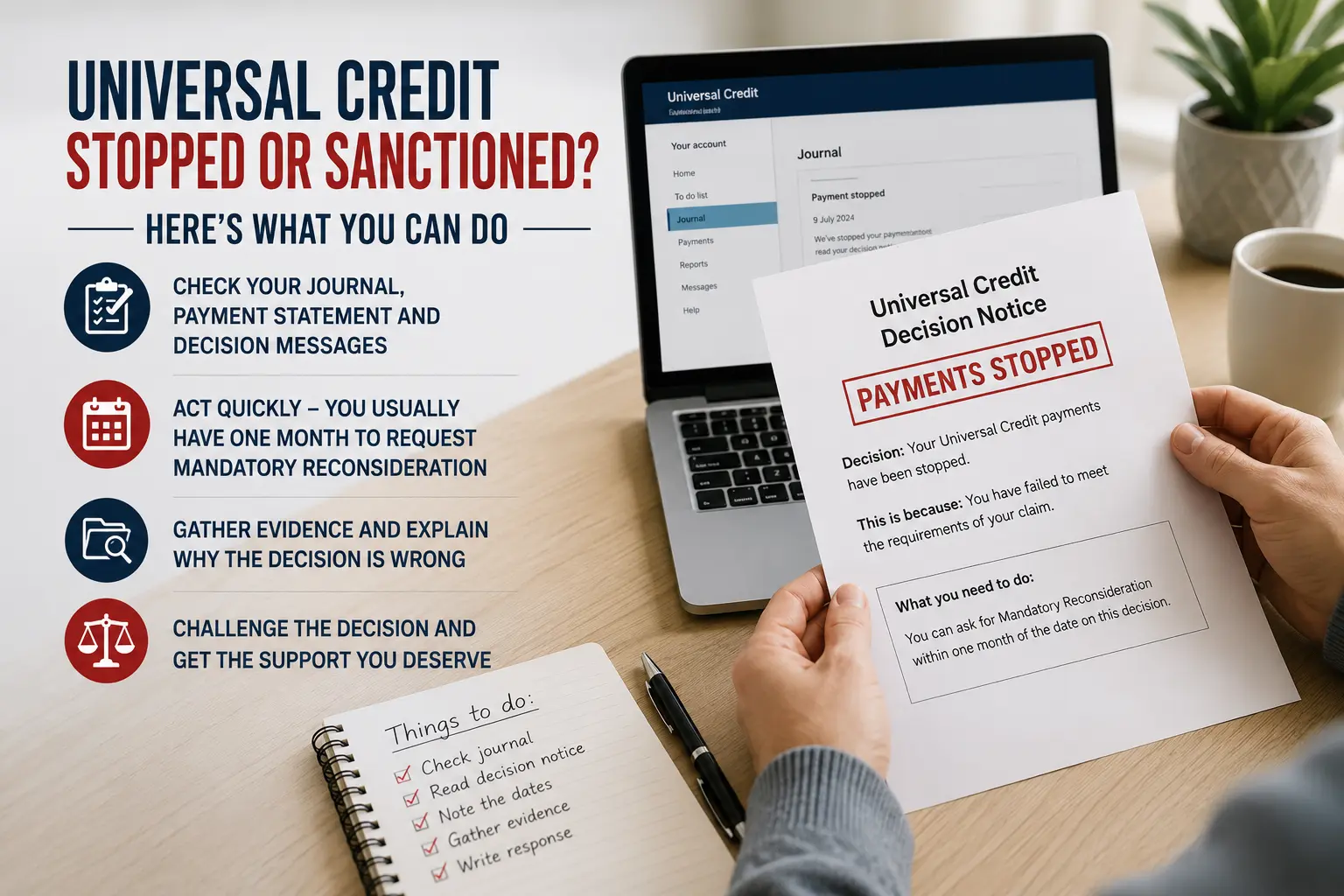
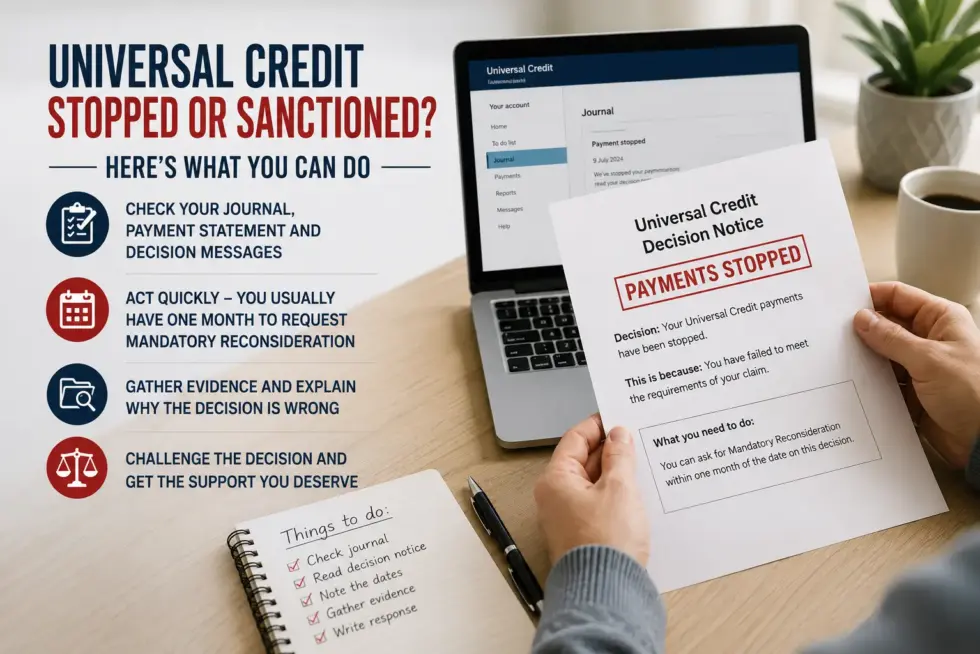
If your Universal Credit has stopped, been reduced, suspended or sanctioned, the first question is not simply “how do I appeal?” You first need to identify what the Department for Work and Pensions (DWP) has actually done. A sanction, a suspended payment, a closed claim, a deduction and a £0 award are different problems. They can require different evidence and different action.
The most important step is to act quickly. Check your Universal Credit journal, payment statement and decision messages. Save screenshots. Write down the dates. Find out exactly why the payment changed. If there is a decision you disagree with, a Mandatory Reconsideration will usually need to be requested within one month of the date on the decision.
Quick answer
Universal Credit can stop or reduce for several different reasons. You might have been sanctioned, your claim might be suspended during a review, DWP may have closed the claim, or deductions and earnings may have reduced the payment. Check the journal and payment statement first. Preserve evidence. If a decision is wrong, challenge the correct decision rather than sending a general complaint.
What Should You Do in the First 24 Hours?
When money is missing, panic can make people send angry journal messages without identifying the decision or evidence. A better approach is to create a clear record immediately.
- Log in to your Universal Credit account and read every recent journal message, to-do and payment statement.
- Take screenshots of the decision, appointment notice, messages, payment statement and anything you submitted.
- Write down the exact date the payment stopped or changed and the date of any decision letter or journal message.
- Ask DWP to confirm whether the issue is a sanction, suspension, claim closure, deduction, overpayment, earnings calculation or another decision.
- If DWP asked for documents or a review appointment, provide what you can immediately and explain any delay.
- If you were sanctioned, identify the exact requirement you are said to have failed and the date it happened.
- Gather evidence of your reason, especially if illness, hospital treatment, a caring emergency, domestic emergency, transport problem or communication failure was involved.
- If you cannot afford food, heating, hygiene or essential housing costs because of a sanction or fraud penalty, ask about a hardship payment.
- Do not let the one-month Mandatory Reconsideration deadline pass while waiting for the situation to resolve informally.
Urgent point
A journal complaint is not always the same thing as a formal challenge. If there is a benefit decision you disagree with, make it clear that you are asking for a Mandatory Reconsideration of the decision dated 2026.
Why Has My Universal Credit Stopped or Been Reduced?
The words people use are often the same: “My Universal Credit has stopped.” The legal and practical reason may be very different. The table below helps separate the main possibilities.
|
What you see |
What may have happened |
First action |
|
“You have been sanctioned” |
A work-related requirement was allegedly not completed without good reason. |
Read the sanction decision. Identify the requirement, date, alleged failure and length. Consider Mandatory Reconsideration. |
|
“Your payment is suspended” |
DWP may be waiting for evidence, reviewing eligibility or conducting a claim review. |
Provide documents and attend any review appointment. Ask exactly what is outstanding. Challenge any later decision to reduce or end entitlement if wrong. |
|
“Your claim is closed” |
DWP has decided that entitlement has ended or the claim cannot continue. |
Ask for the decision and reasons. Check the Mandatory Reconsideration deadline. Consider whether a new claim is also needed for current support. |
|
Payment is lower than expected |
There may be deductions, overpayment recovery, third-party deductions, earnings, childcare or housing-cost calculation issues. |
Check the full payment statement and ask for a calculation or explanation. Provide evidence of any error. |
|
Payment is £0 |
A nil award can arise from earnings or other income, or a sanction may be fully applied where little standard allowance remains. |
Do not assume the claim is closed. Read the statement and decision before deciding the next step. |
|
Payment reduced after a fraud penalty |
A penalty may reduce payment and can also create hardship. |
Read the decision and challenge route. A hardship payment may be available after a lower or missed payment. |
Why Missed Jobcentre Appointments Matter So Much
The latest DWP sanctions data available when this article was reviewed shows how important appointment disputes are. In February 2026, 5.4% of Universal Credit claimants in conditionality regimes where sanctions could be applied were undergoing a sanction. Across the latest year, failure to attend or participate in a mandatory interview accounted for 89.9% of adverse sanction decisions.
That does not mean every missed appointment justifies a sanction. It means claimants should treat every appointment notice, journal message and explanation of non-attendance as important evidence.
If you cannot attend, tell DWP as soon as possible. Use your journal where possible so there is a time-stamped record. If you telephone, keep the date, time, number called, name of the person spoken to and what was said.
What Is a Universal Credit Sanction?
A sanction is a reduction in Universal Credit because DWP says you did not complete an agreed work-related activity without a good reason. The activities come from your claimant commitment and may include attending appointments, taking part in interviews, looking for work, completing training or providing work-related evidence.
If you cannot meet a requirement, contact Universal Credit straight away. Examples in official guidance include illness, a hospital appointment or a domestic emergency. Whether you had a “good reason” depends on the facts, what you knew, what you could reasonably do and the evidence available.
Can a Sanction Take All of My Universal Credit?
A sanction generally reduces the standard allowance. Current DWP guidance states that, for most adults, the reduction can be 100% of the relevant daily standard allowance rate while the sanction applies. In some limited circumstances a 40% rate applies.
Extra amounts for matters such as children or housing costs are not themselves the standard allowance and official guidance says these extra amounts continue to be paid during a sanction. However, your actual payment can still be affected by earnings, deductions, other decisions and the overall calculation. Always check the statement rather than assuming what should have been paid.
How Long Can a Universal Credit Sanction Last?
The length depends on the level of sanction, what DWP says happened and whether there have been previous sanctions. Some sanctions include a period linked to the failure plus a fixed period. High-level sanctions can be much longer; current official guidance states that a first high-level sanction within the relevant period can last 91 days and a repeat high-level sanction can last up to 182 days.
Your journal message or letter should tell you how much the payment is reduced, how long the sanction may last or what you need to do to end it, and what DWP says you failed to do.
I Missed an Appointment: What Can Count as a Good Reason?
There is no single list that guarantees success. “Good reason” is fact-sensitive. The strongest challenge explains exactly what happened and proves it where possible.
- You were unexpectedly ill or receiving urgent medical treatment.
- You had a hospital appointment that could not reasonably be rearranged.
- A child or person you care for had an emergency.
- A domestic emergency or immediate safety issue prevented attendance.
- You did not receive the appointment notice or received it too late to attend.
- A verified transport failure or serious disruption made attendance impossible.
- A disability, mental health condition or communication need affected your ability to understand, remember or attend the appointment.
- You tried to contact DWP or rearrange the appointment but the record was not properly considered.
The key is not the label. Do not simply write “I was ill” or “I had an emergency”. Give the date, symptoms or event, what you did, when you notified DWP, why attendance was not reasonably possible and what evidence supports you.
Worked Example: Turning “The Sanction Is Unfair” Into a Proper Challenge
Weak challenge: “The sanction is unfair. I could not go.”
Stronger challenge: “I ask for Mandatory Reconsideration of the sanction decision dated 18 June 2026. DWP says I failed to attend the work coach appointment on 10 June 2026 without good reason. I was taken to A&E that morning after a sudden medical emergency. I sent a journal message as soon as I was able at 2.14pm and asked for the appointment to be rearranged. I attach the A&E discharge record and screenshot of my journal message. I ask DWP to find that I had a good reason, remove the sanction and restore the affected payment.”
The stronger version identifies the decision, the alleged failure, the reason, the timing, the evidence and the outcome sought. That is easier for a decision maker – and later a tribunal – to understand.
Universal Credit Sanction Challenge Matrix
Use a simple evidence schedule. Do not argue with every journal entry. Focus on the points that decide the case.
|
What DWP says |
What actually happened |
Why it matters |
Evidence |
Outcome requested |
|
Missed 10 June work coach appointment |
Emergency hospital attendance; journal message sent later that day |
Attendance was not reasonably possible and DWP was told as soon as practicable |
A&E discharge note; journal screenshot; phone log |
Remove sanction and restore affected payment |
|
Did not provide requested evidence |
Documents were uploaded but not visible on DWP system |
The requirement may have been completed or there may have been a system issue |
Upload confirmation; screenshots; file timestamps |
Reconsider the decision using the documents provided |
|
Failed to take part in appointment |
Claimant could not understand or participate because an agreed communication adjustment was not provided |
The fairness of the requirement and practical ability to comply may need review |
Adjustment request; medical evidence; journal messages |
Remove sanction and review claimant commitment/adjustments |
What If My Universal Credit Is Suspended or Under Review?
A suspension is not the same as a sanction. Your payment may be paused while DWP checks whether you are still entitled, asks for information or carries out a claim review. Official Universal Credit review guidance states that during a review payment can be stopped if requested documents are not provided, the review telephone appointment is not attended, or DWP decides you are not eligible.
If the journal asks for bank statements, identity documents or other evidence, do not ignore it. If you cannot provide a document, explain why immediately and ask what alternative evidence will be accepted. If you need more time, ask for it before the deadline where possible.
If you have already missed the deadline, provide the information as soon as you can, explain the reason for the delay and ask DWP to accept it late. Keep screenshots showing what you uploaded and when.
What Should I Do During a Universal Credit Risk Review?
- Read every journal message and complete each to-do by the stated deadline.
- Keep copies of all bank statements and documents sent.
- Attend the telephone appointment or ask to rearrange it as soon as a genuine problem arises.
- Ask DWP to identify any specific information it says is still missing.
- If your payment is suspended and you cannot meet basic needs, tell DWP immediately and explain the hardship.
- If DWP later reduces or ends the claim and you disagree, obtain the decision and consider Mandatory Reconsideration.
What If DWP Has Closed My Universal Credit Claim?
A closed claim can be more serious than a temporary suspension because DWP has decided the award has ended. Ask for the decision, the date and the reasons. Do not rely only on a vague journal message if you do not understand what has been decided.
If the closure decision is wrong, a Mandatory Reconsideration can usually be requested. A separate new claim may sometimes be needed to secure current support, but a new claim does not automatically correct the old decision or protect earlier entitlement. The correct approach depends on the facts and timing.
Do not assume “claim closed” means the same as “sanctioned”
A sanction challenges alleged non-compliance with a work-related requirement. A closure challenge may concern eligibility, missing evidence, household circumstances, capital, residence, earnings or another entitlement issue. The evidence and legal test may be different.
My Universal Credit Has Not Stopped, but the Payment Is Much Lower. What Should I Check?
A lower payment is not automatically a sanction. Open the payment statement and check each line. Common issues include earnings, other income, deductions for overpayments or debts, rent arrears, advances, third-party deductions, childcare costs and housing-cost calculations.
Current rules generally cap ordinary deductions and overpayment recovery at 15% of the standard allowance, although some limited “last resort” deductions can exceed that cap. If deductions leave you unable to meet basic living costs, ask DWP to consider reducing the deduction because of financial hardship and provide a clear income-and-expenditure statement.
If the calculation itself is wrong, ask for an explanation and send evidence. Examples may include payslips, bank statements, tenancy documents or childcare invoices. If a formal decision remains wrong, consider Mandatory Reconsideration.
How Do You Challenge a Universal Credit Sanction or Wrong Decision?
The usual first formal step is Mandatory Reconsideration. You normally need to ask within one month of the date on the decision. For Universal Credit, you can ask through your journal, by phone, face to face or in writing. If you are late, explain the reason for the delay and ask DWP to accept the late request.
A focused request should identify:
- the decision you are challenging and its date;
- what DWP says happened;
- which part you say is wrong;
- the correct facts and timeline;
- why you had a good reason or why the decision test was not met;
- the evidence you rely on;
- the outcome you want.
Suggested opening
“I ask for Mandatory Reconsideration of the Universal Credit decision dated 2026. I disagree with the decision because [short reason]. The correct facts are set out below. I attach the evidence listed at the end of this request.”
Avoid a long emotional narrative with no dates or documents. Your circumstances matter, but the decision maker must be able to see the route from the disputed decision to the evidence and the outcome you seek.
What Evidence Can Help Challenge a Universal Credit Sanction or Stopped Payment?
The best evidence depends on the reason for the decision. Useful material can include:
- screenshots of your Universal Credit journal and to-do list;
- the appointment notification and any reminder text or email;
- screenshots showing when you told DWP you could not attend;
- telephone logs and a written note of calls;
- hospital, A&E or urgent-care records;
- medical evidence showing how illness or disability affected compliance;
- evidence of a caring emergency or school/childcare emergency;
- police, refuge or other evidence of an immediate safety or domestic emergency, where relevant;
- transport cancellation or disruption evidence;
- employment rotas or employer messages where work affected attendance;
- upload confirmations, file timestamps and copies of documents DWP says were missing;
- bank statements, payslips, tenancy documents or childcare invoices where the payment calculation is disputed;
- a short witness statement from someone who directly saw what happened.
Evidence should answer the disputed point. A large bundle is not automatically a strong bundle. Ten pages that prove the relevant facts can be more useful than 200 pages with no explanation.
Can You Get a Universal Credit Hardship Payment?
If your Universal Credit payment has been lowered or missed because of a sanction or fraud penalty and you cannot afford essential needs, you may be able to apply for a hardship payment. Official guidance lists needs such as food, heating, hygiene and certain housing costs not met by Universal Credit.
You can only apply after you have actually had a lower or missed payment because of the sanction or penalty. You may need to reapply for each assessment period in which a payment is reduced and show that you still qualify.
If accepted, current GOV.UK guidance says hardship payments are usually paid into your bank account on the same day. They normally have to be repaid after the sanction or fraud penalty ends, with deductions from future Universal Credit payments.
A hardship payment is emergency financial support. It does not replace a challenge to a wrong sanction. You may need to do both: protect your immediate position and challenge the decision.
What Happens If Mandatory Reconsideration Does Not Change the Decision?
DWP will send a Mandatory Reconsideration Notice. If you still disagree, you can usually appeal to the independent Social Security and Child Support Tribunal. The appeal normally needs to be made within one month of the date on the Mandatory Reconsideration Notice.
At that stage, the question is not simply whether you feel the DWP treated you badly. The tribunal will need a clear case about the decision, the facts, the relevant requirement and the evidence. A chronology, focused grounds and organised documents are important.
Common Mistakes That Can Weaken a Universal Credit Challenge
|
Mistake |
Better approach |
|
Calling everything a sanction |
A suspension, closure, deduction and sanction are different. Identify the actual decision first. |
|
Missing the deadline while waiting for a journal reply |
Informal discussion does not necessarily stop the one-month Mandatory Reconsideration clock. |
|
Writing “this is unfair” without facts |
Give dates, the disputed requirement, what happened, why, and evidence. |
|
Deleting messages or failing to take screenshots |
Journal entries and to-dos can become central to the timeline. |
|
Sending evidence with no explanation |
Tell DWP what each document proves and why it matters. |
|
Ignoring a new appointment or claimant commitment |
Challenge the old decision, but also take steps to prevent a repeat problem. |
|
Waiting until the tribunal to organise the case |
Build the chronology and evidence schedule from the start. |
How Can You Reduce the Risk of Another Sanction?
- Check your journal regularly and keep notification details up to date.
- Keep a weekly record of work-search or other activities required by your claimant commitment.
- If you cannot comply, tell DWP as soon as possible and keep proof.
- Ask for your claimant commitment to be reviewed if health, disability, caring responsibilities or changed circumstances make it unrealistic.
- Request reasonable communication or appointment adjustments where needed and keep the request in writing.
- Keep copies of evidence before uploading it.
How Zain Legal & Co Can Help With a Stopped, Suspended or Sanctioned Universal Credit Claim
A Universal Credit payment problem can be difficult because several issues may look the same on the surface. The first value of a proper case review is diagnosis: what has DWP actually done, what decision can be challenged, what is the deadline and what evidence is missing?
Zain Legal & Co can assist with:
- reviewing Universal Credit journal messages, payment statements and decision letters;
- identifying whether the problem is a sanction, suspension, claim closure, deduction, overpayment, earnings issue or evidence request;
- checking the relevant deadline and challenge route;
- preparing a clear chronology of events;
- identifying evidence gaps and documents that should be requested or preserved;
- drafting or reviewing Mandatory Reconsideration grounds;
- preparing an evidence schedule and written submissions;
- reviewing claimant commitment problems and repeated sanction risks;
- preparing tribunal appeal documents and hearing strategy;
- providing hearing preparation and lay representation where permitted.
Why Is a Consultation Important?
The wrong first step can waste time. A person may spend days arguing that a sanction is unfair when the real problem is a suspended review, a closed claim or a payment calculation. A consultation helps separate the issues and create an action plan.
A focused consultation is particularly useful where:
- you do not understand why the payment stopped;
- there is a one-month Mandatory Reconsideration deadline;
- you missed a Jobcentre appointment for a serious reason;
- DWP says you failed to provide evidence that you believe you sent;
- your claim has been closed after a review;
- you are facing rent arrears, debt or immediate financial hardship;
- you have health, disability, communication or caring issues that were not properly considered;
- Mandatory Reconsideration has already been refused and you need to prepare an appeal.
What to have ready for your consultation
Your latest Universal Credit decision or journal message; the payment statement; screenshots of relevant journal entries; your claimant commitment; appointment notices; evidence of the reason you could not comply; and any Mandatory Reconsideration Notice already received.
Frequently Asked Questions
Why has my Universal Credit suddenly stopped?
It may be a sanction, a suspended payment during a review, a closed claim, a nil award because of earnings, or another decision. Check your journal and payment statement and ask DWP to confirm the exact reason.
Can DWP stop Universal Credit without warning?
You should normally receive information in your journal or by letter about a sanction, review or decision. In practice, people sometimes notice a missing payment before they understand the reason. Check the journal, to-do list and statement immediately.
Is a Universal Credit suspension the same as a sanction?
No. A sanction is a reduction for alleged failure to meet a work-related requirement without good reason. A suspension may happen while DWP waits for information or reviews entitlement.
How do I know if I have been sanctioned?
DWP should send a journal message or letter explaining what you allegedly failed to do, how much the payment is reduced and how long the sanction may last or what must be done to end it.
Can Universal Credit sanction all my payment?
A sanction generally reduces the standard allowance and can apply at 100% of the relevant daily standard allowance rate for most adults. Extra elements such as housing or child amounts are treated separately, but your total payment can still be affected by other deductions, earnings or decisions.
Will my housing element still be paid if I am sanctioned?
Official DWP guidance says extra amounts such as housing costs continue during a sanction. However, check the actual payment statement because other deductions, earnings or separate decisions can affect what reaches you.
What if I missed a Jobcentre appointment because I was ill?
Tell DWP exactly what happened, when the illness started, why you could not attend, when you informed them and what evidence supports you. Illness can be relevant to whether you had a good reason.
What counts as a good reason for missing a Universal Credit appointment?
There is no automatic list that guarantees success. Illness, hospital treatment, a domestic emergency, caring emergency, communication problems and other serious circumstances can be relevant. The facts and evidence matter.
Does working mean I cannot get PIP?
No. PIP is not means-tested and work does not automatically prevent entitlement. However, work activities can be considered as evidence, so explain any adjustments, help, reduced hours, sickness absence or differences between work tasks and the PIP activity.
Can I get a hardship payment after a sanction?
You may be able to apply after you have actually had a lower or missed payment because of a sanction or fraud penalty and cannot meet essential needs. You may need to reapply for each affected assessment period.
How do I challenge a Universal Credit sanction?
The usual first step is Mandatory Reconsideration. Identify the decision, explain why it is wrong, give the correct facts and send supporting evidence.
How long do I have to ask for Mandatory Reconsideration?
You normally have one month from the date on the decision. A late request may sometimes be accepted if there is a good reason, but do not rely on this if you can act within time.
What happens if Mandatory Reconsideration is refused?
You can usually appeal to the independent Social Security and Child Support Tribunal. The appeal normally needs to be made within one month of the Mandatory Reconsideration Notice.
What if my Universal Credit claim was closed because I did not provide evidence?
Provide the missing evidence as soon as possible, explain why it was late and ask DWP to consider it. If DWP has made a decision to end entitlement and you disagree, check the Mandatory Reconsideration deadline.
How long does a Universal Credit Mandatory Reconsideration take?
There is no single guaranteed timescale. Keep checking your journal and post, preserve the deadline for any later appeal, and seek urgent financial support separately if you cannot meet basic needs.
Final Point
When Universal Credit stops, the fastest route is not always the loudest complaint. Identify the exact decision. Protect the deadline. Preserve the journal evidence. Explain the facts in order. Match the evidence to the disputed issue. Then use the correct challenge route.
That is how a confused payment problem becomes a clear case.
General information only: This article provides general information about Universal Credit problems in England, Scotland and Wales. It is not legal advice on any individual case. Benefit decisions are fact-specific and rules can change.
Need Urgent Help With Universal Credit?
Do not wait until the evidence disappears or the challenge deadline passes. If your Universal Credit has stopped, been reduced, suspended or sanctioned, Zain Legal & Co can review the documents, identify the correct route and help you prepare a focused challenge.
At the consultation, we can review what DWP has done, identify the strongest issues, explain the next steps and advise what evidence should be obtained. Where further work is needed, we can discuss drafting, case preparation and appeal support.