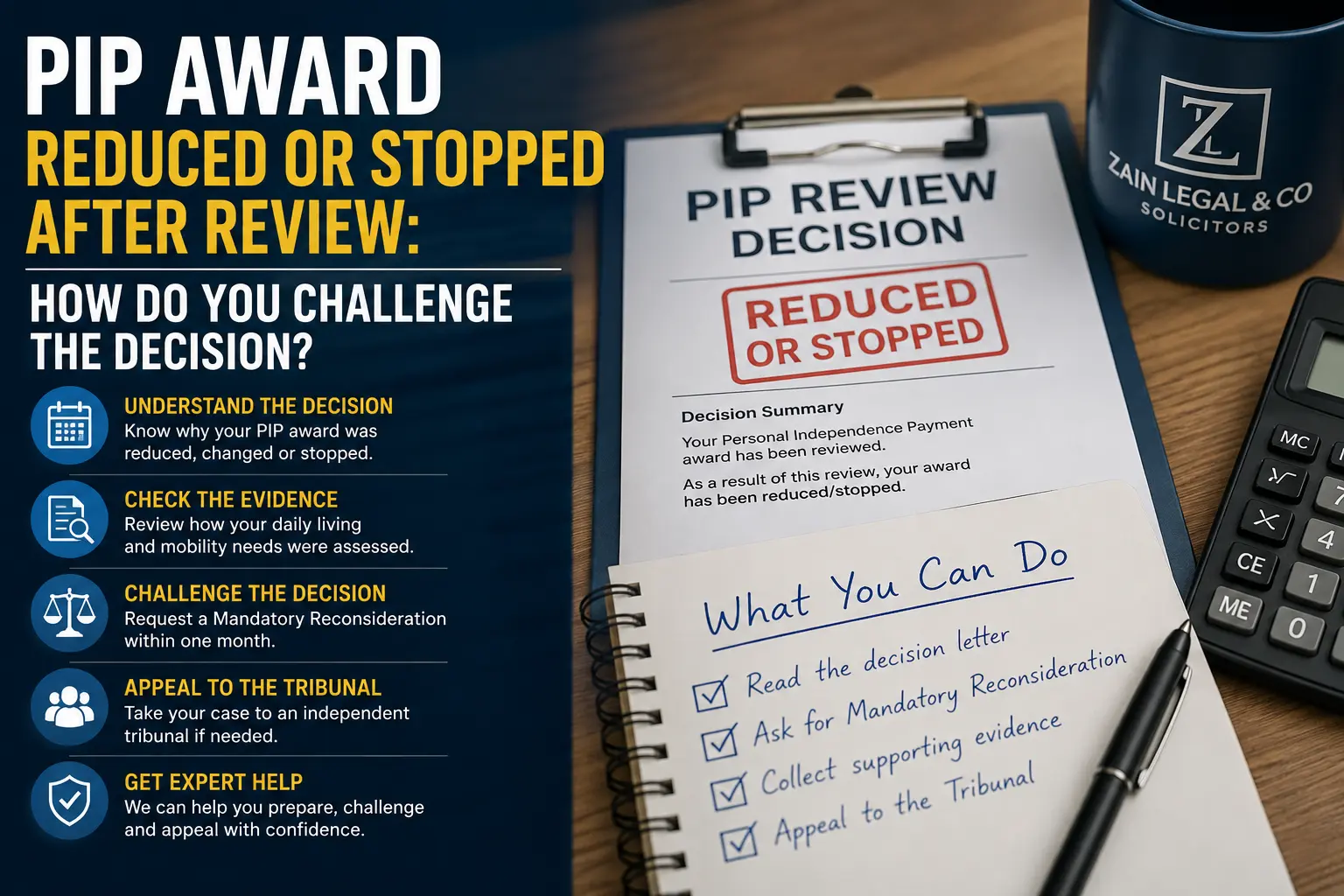
A Personal Independence Payment review can end with an award being maintained, increased, reduced or stopped. If your PIP award has been reduced after review, changed from enhanced to standard rate, or removed even though your condition has not improved, you do not have to accept the decision without examining it. The challenge must be focused on the legal activities, the points awarded and the evidence showing how your health condition affects daily living and mobility.
Quick answer: You normally have one month from the date on the PIP decision letter to ask the Department for Work and Pensions (DWP) for a Mandatory Reconsideration. The review decision usually takes effect while the challenge is ongoing, so a reduced payment may continue at the reduced rate and a stopped award may leave no PIP in payment. If the decision is later changed in your favour, any arrears should normally be backdated to the date the award was reduced or stopped.
This is a common and serious issue. Official DWP statistics covering planned award reviews from May 2021 to April 2026 show that 6% resulted in a decreased award and 16% resulted in the award being disallowed. The same statistics show that, for award-review decisions following an assessment between January 2021 and December 2025, 28% of completed Mandatory Reconsiderations changed the award, 45% of lodged appeals were changed by DWP before the hearing, and 80% of DWP decisions cleared at a tribunal hearing were overturned.Read the official PIP statistics.
What Should You Do in the First 48 Hours?
- Read the decision letter carefully and identify the date, points awarded, rate, component and date the new decision takes effect.
- Compare the new decision with your previous award. Record every activity where the descriptor or points changed.
- Ask DWP for a copy of the assessment report if you do not already have it.
- Find your PIP review form, previous claim form, earlier assessment report, award letter and any evidence sent with the review.
- Write down the one-month Mandatory Reconsideration deadline and act before it expires.
- Check whether the decision has affected linked help such as a Motability vehicle, Blue Badge, benefit premiums, carer support or other concessions.
- Do not send a general complaint saying only that the decision is unfair. Build a descriptor-by-descriptor challenge.
- Book an early consultation so the previous award, review evidence and new decision can be compared before the deadline.
Urgent financial point: If the reduced or stopped award affects rent, food, care, transport or a Motability vehicle, seek welfare and debt advice immediately as well as challenging the PIP decision. The challenge process does not automatically restore the previous payment.
Why Can DWP Reduce PIP Even If Your Condition Has Not Improved?
PIP is not awarded simply because a diagnosis exists or remains unchanged. It is awarded according to how your conditions affect specified daily living and mobility activities. During an award review, DWP considers whether the current evidence supports the same descriptors and points as before.
That means DWP can make a different decision even where the medical diagnosis has not changed. The new decision might arise because the review form was interpreted differently, an assessment report reached different conclusions, evidence was missing, a previous descriptor was not properly addressed, or DWP decided that you can complete an activity without the level of help previously accepted.
An unchanged condition is relevant, but it is not enough on its own
A strong challenge should say more than ‘nothing has changed’. Explain what support you still need, how often you need it, what happens without it, and why the activity cannot be completed reliably. Where appropriate, compare the earlier evidence and award with the new reasoning and ask what evidence justified the change.
What Is the Legal Test DWP Should Apply?
For each PIP activity, the central question is whether you can complete it reliably. DWP guidance requires consideration of whether an activity can be completed:
- safely – without an unacceptable risk of harm;
- to an acceptable standard – well enough for the activity to be properly completed;
- repeatedly – as often as reasonably required; and
- within a reasonable time – normally no more than twice the time taken by a person without your impairment.
Fluctuation also matters. The descriptor should reflect your ability over a 12-month period. A scoring descriptor may apply where the difficulty affects the activity on more than 50% of days. One good assessment day or one isolated example does not necessarily represent your usual ability.
How to Compare the Old Award With the New Decision
The most useful starting point is a side-by-side comparison. This exposes exactly where the new decision departs from the previous award and what evidence must be addressed.
|
PIP activity |
Previous award |
Review decision |
What needs to be proved |
|
Preparing food |
4 points: needs supervision or assistance |
0 points: can prepare food unaided |
Why supervision or physical assistance remains necessary; incidents, risks and frequency. |
|
Washing and bathing |
3 points: needs assistance to wash part of the body |
2 points: needs an aid only |
Why an aid is insufficient and another person must still assist. |
|
Engaging with people |
4 points: needs social support |
0 points |
Nature of overwhelming distress, support provided and what occurs without it. |
|
Moving around |
12 points: cannot stand and move more than 20 metres |
10 points: can move 20–50 metres |
Reliable distance, pain, breathlessness, falls, speed, recovery and repeatability. |
Build a PIP Review Challenge Schedule
Do not challenge every sentence equally. Prioritise the changes capable of altering the daily living or mobility award. Use a structured schedule so DWP can see the error, the correct position and the supporting evidence.
|
What DWP decided |
Why it is wrong |
Correct position |
Evidence |
Descriptor sought |
|
You can prepare food unaided. |
The report relied on grip strength but ignored seizures, burns and the need for supervision. |
Another adult remains present whenever you use knives or the cooker. |
Partner statement, seizure diary, photographs of safety adaptations and GP records. |
Supervision or assistance descriptor. |
|
You can walk 50 metres. |
The assessor recorded the furthest distance but ignored severe pain and inability to repeat it. |
You can usually walk about 15–20 metres before stopping and need prolonged recovery. |
Walking diary, physiotherapy evidence, Blue Badge assessment and witness statement. |
Moving-around descriptor matching reliable distance. |
What Evidence Should You Provide?
Evidence should prove functional impact, not merely confirm a diagnosis. DWP’s own Mandatory Reconsideration guidance says evidence should support the reason the decision is wrong. A long medical bundle is less useful than focused evidence linked to the disputed activities.
|
Evidence |
What it can prove |
|
Previous decision and assessment report |
The descriptors and level of need previously accepted, and any unexplained change in reasoning. |
|
PIP review form and new assessment report |
What you reported, what the assessor recorded, and any omissions or inaccuracies. |
|
Consultant, GP, therapist or mental health evidence |
Symptoms, treatment, prognosis, risk, fatigue, cognitive problems and functional restrictions. |
|
Care plan or social-care assessment |
Prompting, supervision, physical assistance and aids used. |
|
Medication records |
Dosage, side effects, supervision and consequences of missed medication. |
|
Diary covering several weeks |
Bad days, fluctuation, recovery time, frequency and inability to repeat activities. |
|
Witness statement from a carer or family member |
The help actually given, how often it is needed and what happens without it. |
|
Photographs or short records of aids and adaptations |
Why equipment is used and whether it is enough without human help. |
|
Falls, seizure or incident records |
Safety risks and frequency. |
|
Travel, appointment or support records |
The assistance needed to plan, undertake or recover from journeys. |
Do Not Wait Indefinitely for Medical Evidence
Protect the one-month deadline. If an important report is not yet available, submit the Mandatory Reconsideration request on time, explain that further evidence has been requested and send it as soon as possible. Keep proof of posting or submission.
What If the PIP Review Report Is Inaccurate?
An inaccurate assessment report should be challenged precisely. Avoid saying only that the assessor lied or that the whole report is false. Identify the paragraph, state what was actually said or observed, explain why the error matters to a PIP activity and provide evidence.
Weak challenge: “The assessor lied. I cannot walk properly.”
Stronger challenge: “The report states that I can walk 50 metres repeatedly. I said that I managed approximately 35 metres once from the car to the assessment room, stopped twice, used a stick and was in severe pain for the rest of the day. That isolated journey does not show that I can stand and move 50 metres safely, repeatedly or within a reasonable time. My walking diary and physiotherapy letter support a reliable distance of no more than 20 metres.”
Should You Make a Complaint as Well?
A complaint about an assessor’s conduct or factual recording is separate from challenging the benefit decision. A complaint does not replace Mandatory Reconsideration and does not stop the one-month deadline. Where both are needed, pursue them separately.
How Do You Ask for Mandatory Reconsideration?
Contact the office shown on the decision letter by telephone, letter or the official CRMR1 form. You normally need to ask within one month of the date on the decision letter. If writing, the request must normally arrive within that period.
What Your Mandatory Reconsideration Should Include
- Your full name, address, date of birth and National Insurance number.
- The date of the PIP review decision.
- A clear statement that you request Mandatory Reconsideration.
- The daily living and/or mobility component disputed.
- The specific activities and descriptors you say apply.
- Why the new decision is wrong, using the reliability criteria and frequency rules.
- A comparison with the previous award where relevant.
- Focused supporting evidence.
- A request for the award to be revised from the date it was reduced or stopped.
Should You Challenge the Whole Decision or Only One Component?
Your grounds should be targeted, but the risk must be understood. If only the mobility component was reduced, identify the mobility activities and points in dispute rather than making unfocused complaints about the whole process. If daily living was maintained correctly, say so where appropriate.
However, a Mandatory Reconsideration looks again at the benefit decision as a whole. GOV.UK warns that the award may stop, stay the same, increase or decrease. Before challenging, check the points supporting every part of the existing award and obtain advice if there is a genuine risk to an undisputed component.
Can Your Award Be Reduced Further After Reconsideration?
Yes, in principle. The decision maker is not limited to increasing the award. The whole claim is reconsidered, so the award can remain the same, increase, decrease or stop. That does not mean a wrong reduction should go unchallenged. It means the case should be assessed carefully before the request is submitted.
Does PIP Continue While You Challenge the Decision?
Your existing award normally continues while the review itself is being carried out. Once DWP issues a review decision reducing or stopping the award, the new decision usually takes effect. A Mandatory Reconsideration or tribunal appeal does not automatically reinstate the previous rate.
If the decision is later revised in your favour, arrears should normally be paid back to the date the ongoing award was stopped or reduced. Check the decision letter for the effective date and seek advice about linked entitlements immediately.
What If PIP Was Reduced From Enhanced to Standard Rate?
A change from enhanced to standard rate means the component score has fallen below 12 points but remains at least 8 points. The key task is to identify which activity lost points and whether the new descriptor reflects what you can do reliably.
- Compare each old and new descriptor.
- Identify whether DWP removed points because it thought you needed less help or could travel or move further.
- Explain the actual frequency and level of prompting, supervision or assistance.
- Address any isolated examples such as driving, working, shopping or attending an appointment.
- Show why those examples do not prove reliable performance of the PIP activity.
Can DWP Use Driving, Work or Looking After Children Against You?
DWP can consider ordinary activities where they are relevant, but assumptions must be tested. Driving does not automatically prove that a person can prepare food, dress, engage socially or walk a particular distance. Employment does not automatically show that daily living activities can be completed without support. Caring responsibilities do not prove that tasks are performed safely, repeatedly or without significant after-effects.
Explain the detail. For example: adaptations, automatic transmission, short journeys, support from colleagues, reduced hours, home working, tasks performed by another adult, or severe recovery afterwards.
What Happens After Mandatory Reconsideration?
DWP will send a Mandatory Reconsideration Notice explaining whether the decision has changed. If the award remains wrong, you can appeal to the independent Social Security and Child Support Tribunal.
You normally have one month from receiving the Mandatory Reconsideration decision to appeal. The appeal is free. You can appeal online or by form SSCS1 and should provide the Mandatory Reconsideration Notice, your grounds and supporting evidence.
Do Not Assume a Refused Mandatory Reconsideration Means the Case Is Weak
Official PIP statistics show that many review disputes continue beyond Mandatory Reconsideration. For award-review decisions following an assessment between January 2021 and December 2025, 37% of completed Mandatory Reconsiderations went on to appeal. DWP then changed 45% of lodged appeals in the claimant’s favour before the hearing, and 80% of decisions actually cleared at a tribunal hearing were overturned.
What Is a Lapsed PIP Appeal?
A PIP appeal ‘lapses’ when DWP changes the decision in your favour after the appeal has been lodged but before the tribunal hearing. The revised decision should be checked carefully. It may restore one component or increase the award without giving everything claimed.
Do not assume every revised offer fully resolves the appeal. Check the points, component, rate, start date and award length. Depending on the procedural position, a further appeal may be possible if the revised decision remains wrong.
Common Mistakes That Weaken a PIP Review Challenge
- Saying only that the condition has not changed.
- Arguing about the diagnosis instead of the PIP activities.
- Failing to compare the previous and new descriptors.
- Challenging every sentence without prioritising point-changing errors.
- Using labels such as ‘good day’ or ‘bad day’ without explaining frequency and function.
- Sending general medical factsheets rather than evidence about personal needs.
- Waiting for perfect evidence and missing the one-month deadline.
- Assuming the complaint process replaces Mandatory Reconsideration.
- Ignoring the risk to linked benefits, transport or care arrangements.
- Copying a generic template that does not fit the review decision.
Worked Example: PIP Reduced Despite No Improvement
Maria previously received enhanced mobility because she could not stand and move more than 20 metres reliably. At review, DWP awarded standard mobility after the assessor recorded that she walked approximately 35 metres from a car to a clinic.
|
Issue |
Weak response |
Stronger response |
|
Distance |
“I cannot walk far.” |
“I usually stop after 15–20 metres because of severe pain and breathlessness. The 35-metre clinic journey required two stops and was not repeatable.” |
|
Repeatability |
Not addressed. |
“After that journey I needed to lie down for three hours and could not walk the same distance again that day.” |
|
Evidence |
Diagnosis letter only. |
Walking diary, physiotherapy letter, witness statement and records of falls. |
|
Legal test |
No descriptor identified. |
Explains why she cannot move more than 20 metres safely, repeatedly or within a reasonable time on the majority of days. |
How Zain Legal & Co Can Help
A PIP review dispute is rarely won by sending more paperwork without a strategy. The decision must be broken down into the activities, points, evidence and legal reliability tests.
Urgent decision review: We examine the review decision, effective date, points and components and identify the challenge deadline.
Old-versus-new award comparison: We compare the previous award, review form, assessment report and new decision to identify exactly where entitlement changed.
Assessment report analysis: We identify factual inaccuracies, unsupported assumptions, omitted evidence and conclusions that do not reflect safe, acceptable, repeatable or timely performance.
Descriptor and points analysis: We assess the daily living and mobility descriptors that may apply and explain the evidence needed for each disputed activity.
Mandatory Reconsideration drafting: We prepare structured grounds focused on the errors capable of changing the award.
Evidence strategy: We help organise medical evidence, care evidence, diaries, witness statements and practical examples so that each document proves a relevant point.
Tribunal appeal preparation: If Mandatory Reconsideration fails, we can assist with the appeal form, written submissions, bundle review, witness evidence and hearing preparation.
Hearing support: We explain the tribunal process, prepare likely questions and can provide appropriate support or representation where legally permitted.
Why a Consultation Is Important
A consultation allows the decision to be assessed before a challenge is submitted. It identifies whether the reduction is caused by one disputed descriptor, several activities, missing evidence, an inaccurate report or a misunderstanding of reliability and fluctuation.
- It protects the one-month deadline.
- It identifies whether an undisputed component may be at risk.
- It prevents a general complaint from replacing proper legal grounds.
- It shows which evidence is missing and which documents add little value.
- It provides a clear plan for Mandatory Reconsideration and, if required, tribunal appeal.
What to Send Before Your Consultation
- The new PIP decision letter.
- The previous PIP award letter.
- Your PIP review form and any evidence sent with it.
- The old and new assessment reports, if available.
- Relevant medical, care and therapy evidence.
- A short list of the activities where the decision is wrong.
- Any deadline or Motability correspondence.
Frequently Asked Questions
Can DWP reduce my PIP even though my condition has not improved?
Yes. PIP is based on current functional needs rather than diagnosis alone. A strong challenge should show that the relevant support, supervision, prompting, assistance or mobility restriction still applies and ask what evidence justified the different descriptor.
Does PIP continue while my award is being reviewed?
Your current award normally continues during the review process. Once DWP makes a decision reducing or stopping the award, the new decision usually takes effect.
Does PIP continue while I ask for Mandatory Reconsideration or appeal?
A challenge does not automatically restore the previous award. A reduced award may continue at the reduced rate and a stopped award may leave no PIP in payment. If the decision is later changed in your favour, arrears should normally be backdated.
What is the deadline for PIP Mandatory Reconsideration?
You normally have one month from the date on the decision letter. Late requests may be accepted where there is a good reason, but you should not rely on that. Protect the original deadline.
Should I challenge the whole decision or only the component reduced?
Your written grounds should focus on the activities and component that are wrong. However, DWP reconsiders the whole award, so check the points supporting every existing component before proceeding.
Can my PIP award be reduced further after Mandatory Reconsideration?
Yes, in principle. GOV.UK states that the benefit may stop, stay the same, increase or decrease when the whole decision is reconsidered. Obtain advice if you are concerned about the security of an undisputed component.
What evidence should I send?
Send evidence that proves your functional needs: care plans, relevant medical or therapy reports, medication evidence, incident records, a diary and detailed statements from people who help you. Link each item to a disputed PIP activity.
What if the assessment report contains inaccurate information?
Identify the exact statement, give the correct account, explain why the error affected a descriptor and support your response with evidence. A complaint about the assessor is separate from Mandatory Reconsideration.
Can I appeal if Mandatory Reconsideration fails?
Yes. You can appeal to the independent Social Security and Child Support Tribunal, normally within one month of receiving the Mandatory Reconsideration decision.
Is it free to appeal a PIP decision?
Yes. There is no tribunal fee for a benefit appeal, although you may have other costs such as obtaining evidence or professional assistance.
What if my PIP was reduced from enhanced to standard rate?
Identify which component fell below 12 points and which activity lost points. Challenge the specific descriptor and show why your needs still meet the enhanced-rate threshold.
Can DWP reduce PIP because I drive?
Driving may be considered as evidence of some abilities, but it does not automatically prove that every PIP activity can be completed reliably. Explain adaptations, journey length, support, pain, fatigue and the difference between driving and the disputed task.
What if I work or care for children?
Work or caring responsibilities do not automatically disqualify you from PIP. The detail matters: support, adjustments, reduced hours, tasks done by others, safety and after-effects.
What is a lapsed PIP appeal?
It is where DWP changes the decision in your favour after the appeal is lodged but before the tribunal hearing. Check whether the revised award fully resolves the dispute, including the rate, points, start date and award length.
Can Zain Legal & Co help with a PIP review appeal anywhere in England and Wales?
Yes. Paperwork review, Mandatory Reconsideration drafting, evidence analysis and tribunal preparation can usually be provided remotely across England and Wales, subject to the facts and the service required.
Important Legal Notice
This article provides general information for PIP claimants in England and Wales. It is not individual legal advice and does not replace the decision letter, current DWP guidance or advice on your own circumstances. PIP rules and procedures can change. Check the current position and act before the deadline.
A reduced or stopped PIP award can affect essential care, mobility and independence. Do not miss the challenge deadline.
Book a consultation with Zain Legal & Co for a focused review of the decision, assessment report, descriptors, evidence and appeal strategy.