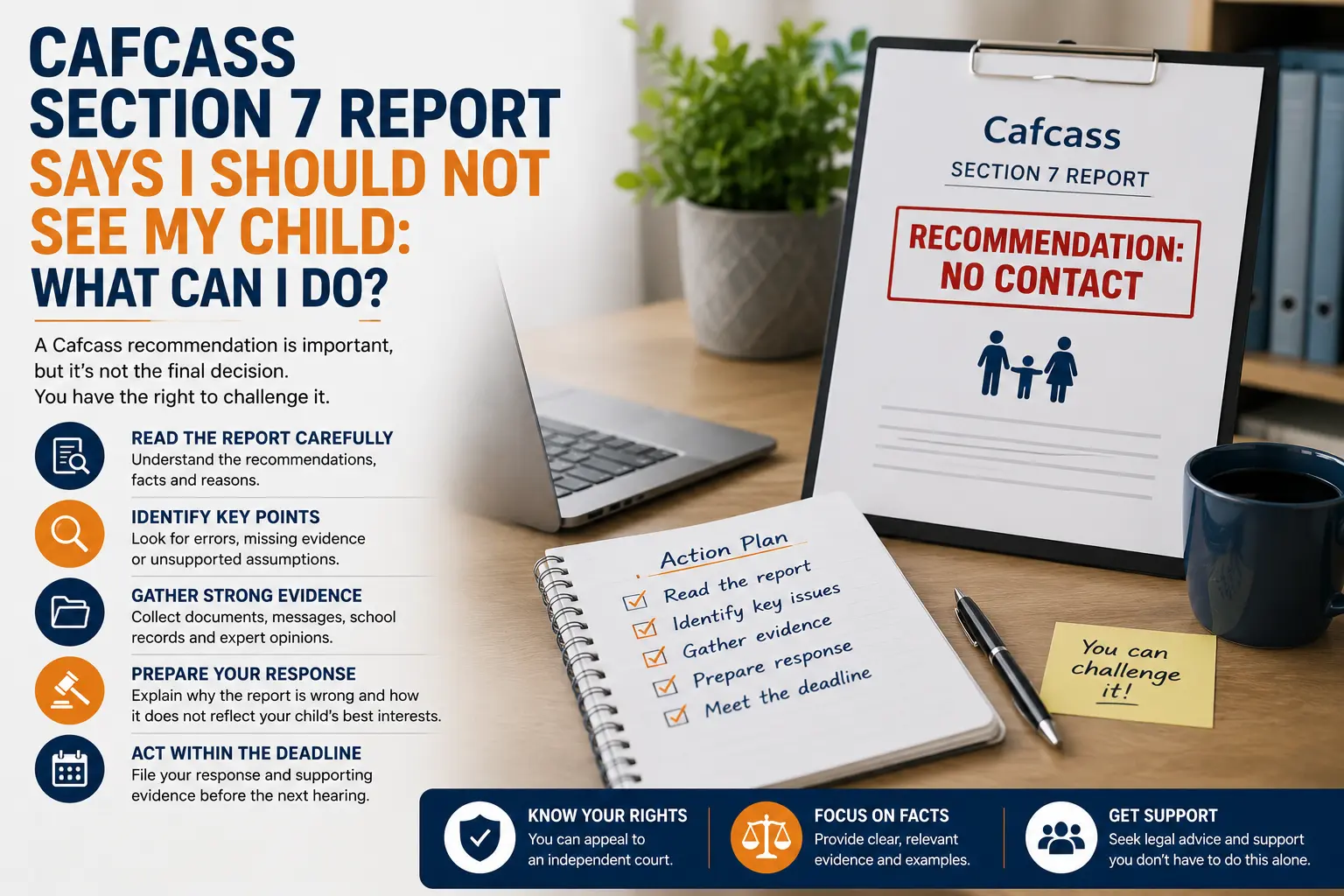
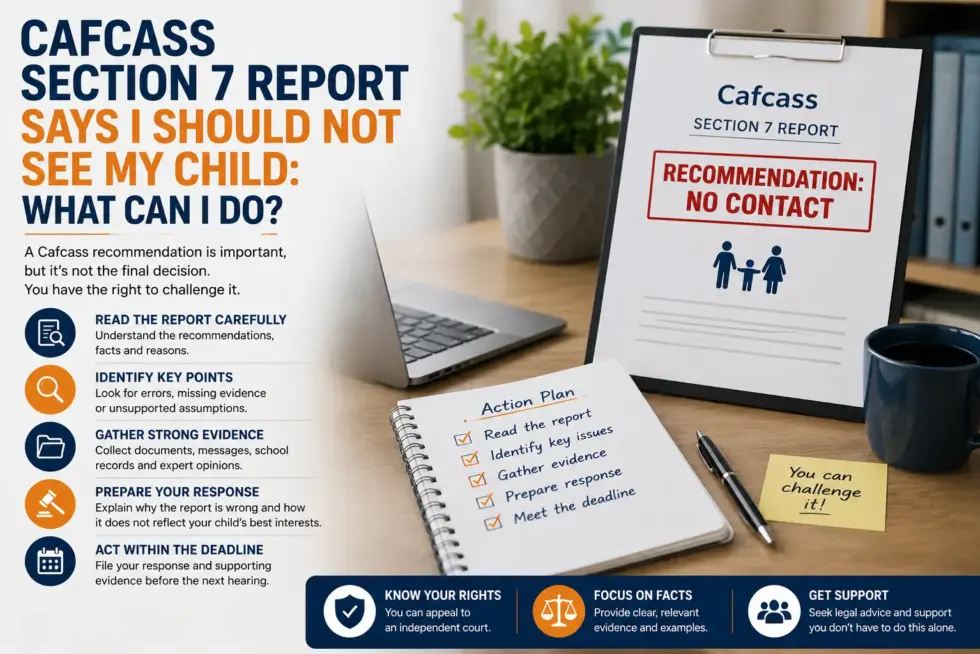
A Cafcass Section 7 report recommending no direct contact, supervised contact or a serious restriction can feel overwhelming. The key point is that a Cafcass report is evidence and advice to the Family Court; it is not itself a no-contact order. The judge or magistrates make the final decision.
If your Cafcass Section 7 report says no contact, the most effective response is a focused, child-centred one: identify material factual errors, missing evidence, unsupported assumptions and a realistic alternative. This guide explains what the report means, how to challenge it, what evidence can help and what happens next.
Quick Answer
You can disagree with and challenge a Cafcass Section 7 report through the family court process. Cafcass can recommend no contact, supervised contact, indirect contact or other arrangements, but it cannot make the final child arrangements order. Read the report and latest court order, identify the points that actually drive the recommendation, match each disputed point to evidence and prepare a child-focused proposal for the next hearing.
Cafcass recommends no contact or restricted contact? Zain Legal & Co can review the full report, court orders and key evidence, identify the points that matter most, and help you prepare a structured response before the next hearing.
What Is a Cafcass Section 7 Report?
A Section 7 report is a welfare report ordered by the Family Court under section 7 of the Children Act 1989. The court can ask Cafcass or, in some cases, a local authority to investigate specified issues and report on the child’s welfare. A Cafcass Family Court Adviser may speak with the parents, engage with the child where appropriate and obtain information from other people or professionals who know the child.
A Cafcass Section 7 assessment can consider the child’s wishes and feelings, safety, allegations of harm, parental conflict, each parent’s ability to meet the child’s needs and practical contact arrangements. It is different from the initial Cafcass safeguarding letter, although safeguarding information may shape the issues the court asks the report to address.
It may contain the adviser’s recommendations at that stage, but it is not the final court decision. If you are still at the application stage, you may also need to understand the C100 form and child arrangements applications.
When Do Cafcass Recommend No Contact?
There is no single reason. Cafcass may recommend no direct contact where it assesses that contact would expose the child or another parent to an unacceptable risk of harm, or where significant welfare concerns have not yet been resolved. The report should explain the concerns and the reasoning behind the recommendation.
Issues can include domestic abuse, coercive or controlling behaviour, substance misuse, emotional harm, serious conflict, unresolved safeguarding concerns or the child’s wishes and feelings. Where domestic abuse is relevant, Practice Direction 12J requires the court to consider safety, risk and whether contact is beneficial for the child.
A Cafcass no-contact recommendation is not best answered by saying only that children should see both parents. Ask instead: what risk is identified, what evidence supports it, what is missing, and could supervised, indirect or staged contact safely address the concern?
Section 7 Report Says No Contact: What to Do Immediately
Read the Latest Court Order First
Check the date of the next child arrangements hearing, any filing deadline and what documents the court has directed you to provide. Do not work from memory. The court order tells you what must happen next.
Understand the Recommendation
Read the recommendation and reasons before arguing with individual wording. Identify whether Cafcass says no direct contact, supervised contact, indirect contact, a pause in contact or another arrangement.
Separate Facts from Opinion
Mark the paragraphs that actually affect the recommendation. Separate factual errors from professional opinion. A wrong date or incorrect account of a missed contact session is different from a professional conclusion such as “limited insight”.
Gather Your Evidence
Relevant documents may include court orders, contact-centre notes, messages, school or health records, police outcomes, course completion evidence, treatment records and a clear chronology.
Prepare a Safe and Realistic Proposal
If immediate unrestricted contact does not address the concerns in the report, consider whether a staged plan, supervision, indirect contact or a defined review point would better answer the welfare issues.
Do not breach an existing court order because you disagree with a Cafcass report. If a court order currently restricts contact, any change needs to be dealt with through the proper Family Court process.
How to Challenge a Cafcass Report
If you disagree with a Cafcass report, focus on material points. Factual inaccuracies can be raised with the Family Court Adviser or manager, while disagreements with the professional assessment or recommendations usually need to be raised through the court process.
A useful response is a short challenge schedule. Identify the paragraph, what is wrong or missing, the supporting evidence and why it matters to the child or the recommendation.
- Report point: “Parent missed contact.”
- Your response: The session was cancelled by the centre.
- Evidence: Centre email or attendance record.
- Why it matters: It may undermine a finding of unreliability.
- Report point: “No direct contact.”
- Your response: Positive supervised sessions are not analysed.
- Evidence: Supervised-contact notes.
- Why it matters: It may support a staged, safer alternative.
Avoid general statements such as “Cafcass is biased” or “the report is full of lies” unless you can identify the specific evidence that supports the criticism. A focused disagreement with the analysis is usually more useful than a personal attack on the adviser.
Does the Judge Always Follow Cafcass Recommendations?
No. The court makes the final decision. A Cafcass report may carry significant weight, but the judge or magistrates consider it alongside the other evidence. The court can accept the recommendation, depart from it, seek clarification or make a different child arrangements order.
A negative report should therefore be taken seriously, but it is not automatically decisive.
What Evidence Helps if Cafcass Says No Contact?
The best evidence answers the reason for the recommendation. More documents are not automatically better.
- Contact-centre reports, supervised-contact notes and handover records.
- Messages showing reasonable proposals, cancellations or attempts to maintain safe child contact.
- Previous court orders, judgments, findings and any fact-finding decision.
- Police, local-authority, school or health records where directly relevant and lawfully available.
- Evidence of completed courses, treatment, testing or other work addressing identified risk.
- A short chronology linking dates to source documents.
- A practical plan explaining how future contact can be safe, stable and child-focused.
If the report relies on domestic abuse or safeguarding allegations, distinguish between disputed allegations, findings already made and matters still to be determined. A generic denial may not answer the court’s concern.
If contact is not happening because an order has been breached, read our guide on what to do when a Child Arrangements Order is breached or contact is not happening.
What Happens After a Cafcass Report?
The next step depends on the court order. The case may be listed for a dispute resolution hearing, directions hearing, review or final hearing. The court can make an order, seek clarification, direct further evidence or list another hearing if issues remain unresolved.
You do not normally “appeal” a Section 7 report itself. If the court later makes an order you say is legally wrong, any appeal is against that court decision and has separate rules and time limits.
Can You Complain to Cafcass?
Yes, but understand the difference between a complaint and a court challenge. Cafcass can investigate matters such as administrative mistakes, inaccurate factual information, unprofessional conduct or failure to follow its policies. Its complaints process cannot determine whether its welfare assessment or recommendation to the court was right. Those disagreements need to be raised in the family court proceedings.
Do not wait for a complaint response while a court deadline passes. If the report affects your child arrangements case, protect your court position first and deal with any separate service complaint in parallel where appropriate.
How Zain Legal & Co Can Help With a Negative Section 7 Report
Zain Legal & Co can help turn a negative report into a practical, evidence-based case plan before the next hearing.
- Detailed report review: We identify the recommendation, reasoning and paragraphs that materially affect the outcome.
- Evidence mapping: We match errors, omissions and disputed points to supporting documents.
- Chronology: We organise hearings, contact events, messages and professional evidence into a clear sequence.
- Written preparation: Where appropriate, we assist with position statements, witness statements, schedules of inaccuracies and other unreserved court documents.
- Hearing preparation: We identify the likely welfare issues, key evidence and the child-focused outcome you want the court to consider.
- McKenzie Friend support: Where appropriate, we can support you at court by taking notes, helping with papers and quietly advising. Any permission to address the court or conduct advocacy is for the court to decide.
Need help responding to a Cafcass Section 7 report? Send us the full report, the latest court order and the date of your next hearing. We can review the recommendation, identify the strongest evidence-based points and help you prepare a clear plan for court.
Frequently Asked Questions About Cafcass Section 7 Reports
What is a Cafcass Section 7 report?
It is a welfare report ordered by the Family Court under section 7 of the Children Act 1989. Cafcass or a local authority investigates the issues identified by the court and reports on the child’s welfare and recommended arrangements.
What happens if Cafcass says no contact?
Cafcass can recommend no direct contact, but the court makes the order. Read the reasons, identify the evidence relied on and prepare a child-focused response before the next hearing.
Can I challenge a Section 7 report?
Yes. You can raise factual errors and challenge disputed evidence, omissions, analysis and recommendations through the court process. The strongest challenge is specific and supported by evidence.
How do I respond to a Cafcass report I disagree with?
Identify the exact paragraphs you dispute, set out the correct facts, attach or refer to the evidence and explain why the point matters to the child’s welfare or the recommendation.
Does the judge always follow Cafcass?
No. Cafcass advises the court. The judge or magistrates make the final decision after considering all of the evidence.
Can Cafcass make a no-contact order?
No. Cafcass may make a no-contact recommendation, but only the court can make or vary a child arrangements order.
Can I see the Cafcass report before court?
In most cases, parties are able to see the Section 7 report before the hearing. Follow the specific directions in your case and check the court order for filing and response deadlines.
How long does a Cafcass Section 7 report take?
There is no single guaranteed national timescale. The court order normally sets the filing date, and the process can vary according to the issues and local procedure. Check the order rather than relying on a generic online estimate.
Can I complain if the Cafcass report is wrong?
You can complain about factual inaccuracies, administrative mistakes, conduct or policy failures. A disagreement with the professional assessment or recommendation itself must normally be dealt with in court.
What if my child says they do not want contact?
The child’s wishes and feelings are important and are considered in light of age and understanding, but they are part of the wider welfare assessment. Do not attack or pressure the child. Focus on the reasons, context, safety and any appropriate route to rebuild the relationship.
2026 Note: Child Focused Courts and Cafcass
Cafcass confirms that the Child Focused Courts model is already operating in areas including Birmingham and Wolverhampton and is being rolled out more widely. The terminology or sequence of welfare assessment work may therefore vary by court area, but the court still decides child arrangements after considering the welfare evidence.
This article concerns Cafcass in England. Cafcass Cymru operates separately in Wales. Always follow the latest order in your own proceedings.