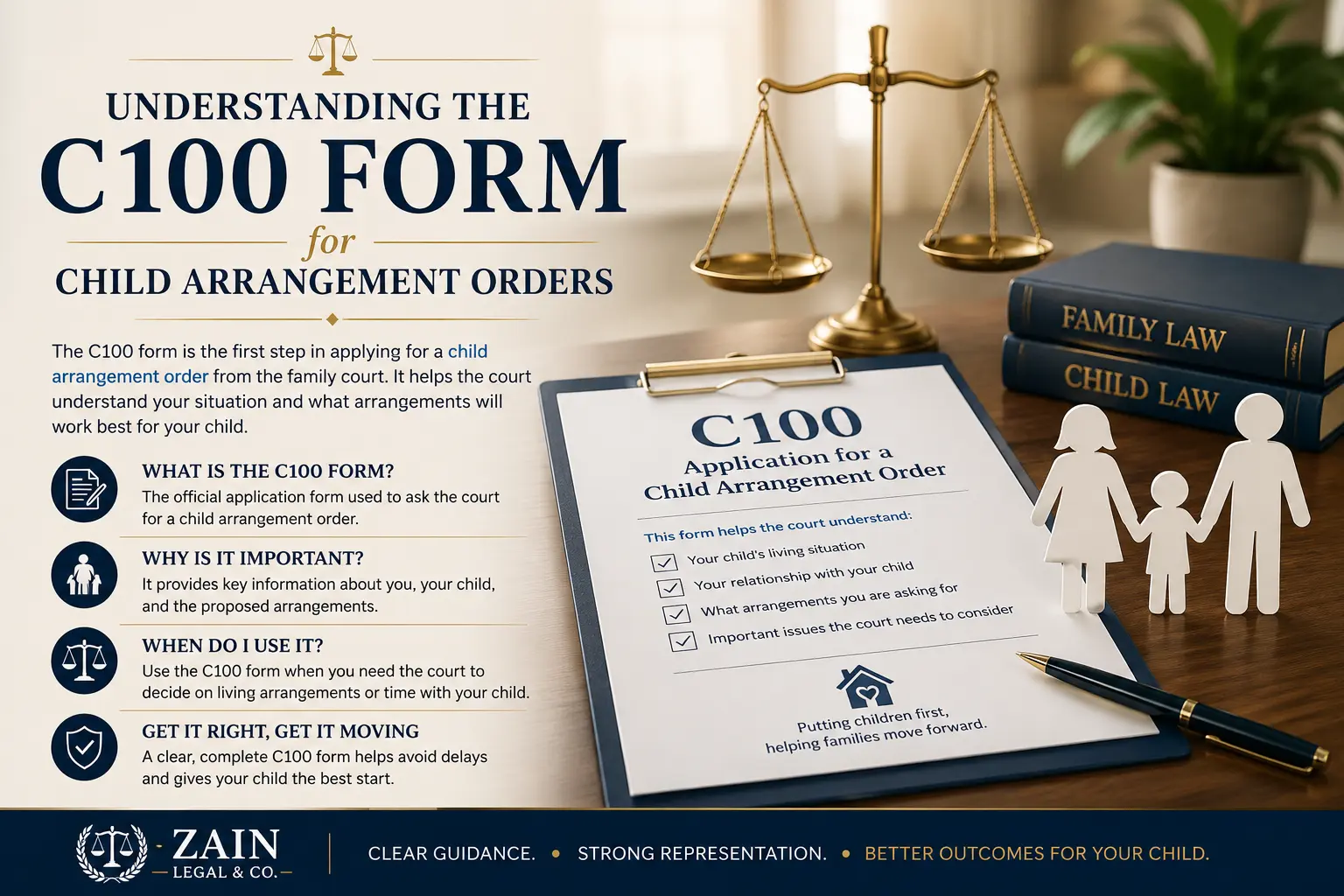
The C100 form is used to ask the Family Court in England and Wales for certain orders concerning a child’s upbringing. These include child arrangements orders, specific issue orders and prohibited steps orders.
Understanding which order you need is the starting point. You should also check whether a Mediation Information and Assessment Meeting (MIAM) is required, whether permission to apply is needed and how to explain any safeguarding concerns.
This guide explains the purpose of the form and what to consider before applying. For help with completing the application, read our step-by-step C100 form guide.
Quick Answer: What Is the C100 Form Used For?
The C100 application can be used to request:
- A child arrangements order: concerning where a child lives, spends time or otherwise has contact.
- A specific issue order: asking the court to resolve a particular question about a child’s upbringing.
- A prohibited steps order: asking the court to restrict a specified step concerning a child.
- A variation or discharge: asking to change or end a relevant existing order.
It is important to distinguish a new application from enforcement or an application within ongoing proceedings, because a different form may be appropriate.
Unsure which application you need? Zain Legal & Co can review the situation, existing orders and proposed arrangements and help you organise the next step.
When Might You Need a C100 Application?
You may be considering court because arrangements have broken down or an important question remains unresolved. Before applying, identify the precise decision you want the court to make.
Write down the present arrangements, the problem and your proposed solution. Explain how that proposal addresses the child’s needs rather than focusing only on disagreement between adults.
A court application is a significant step. Consider suitable ways to resolve the issue outside court, while recognising that urgency or safety concerns may require a different approach.
Child arrangements orders
These orders concern living arrangements and time or contact with another person. A proposal should consider practical details such as school commitments, travel, handovers and the child’s individual needs.
Specific issue orders
These address a particular question, such as a disagreement about schooling. Define the issue clearly and explain the decision you are asking the court to make.
Prohibited steps orders
These concern preventing a particular step being taken without the court’s approval. If the concern is urgent, obtain advice promptly about the appropriate application and procedure.
Who Can Apply Using the C100 Form?
The application asks about your relationship to the child, parental responsibility and whether permission to apply is needed. The position can differ between parents, relatives and other people involved in a child’s care.
Do not assume that everyone can apply on the same basis. Check the current form guidance and obtain advice if your eligibility or permission position is unclear.
Have any relevant birth certificates, parental responsibility documents and existing court orders available when discussing the application.
Do You Have to Attend a MIAM Before Applying?
A MIAM helps assess whether mediation or another suitable process could resolve the dispute. It is different from being required to reach an agreement through mediation.
A MIAM is normally required for relevant applications unless a valid exemption applies. The exemption must be explained correctly, with supporting evidence where required.
Do not state that you are exempt simply because you do not expect mediation to succeed. Check the current criteria and application questions.
Our guide to preparing for a MIAM provides further background.
What if the application is urgent or involves domestic abuse?
There are exemptions connected with matters including certain domestic-abuse evidence, safeguarding risks and urgency. Whether an exemption applies depends on the circumstances and relevant requirements.
Explain the reason accurately. If you need an urgent hearing, identify what may happen, when and why the ordinary timetable would be inadequate.
What Information Should You Prepare?
Preparing the information before starting helps you answer consistently and identify gaps.
- The children’s details and current living arrangements.
- Relevant details of the applicants and respondents.
- Your relationship to the children.
- Parental responsibility information.
- Existing or previous court proceedings and orders.
- The order or change you want.
- A short account of the events leading to the application.
- Your proposed arrangements.
- MIAM information or the exemption relied upon.
- Any urgency, safety or confidentiality concerns.
Use the current application instructions to decide what must be supplied. Keep a complete copy of the final application and accompanying documents.
How Should You Explain Your Reasons for Applying?
Make the explanation clear enough for someone unfamiliar with the family to understand the issue. Use dates where possible and distinguish what you witnessed from information supplied by someone else.
A useful structure is:
- Briefly describe the present arrangements.
- Explain what has stopped working or remains unresolved.
- Describe relevant attempts to resolve the issue.
- Identify the order you seek.
- Explain how your proposal addresses the child’s needs.
Avoid unsupported labels, insults and long accounts of unrelated relationship disputes. Serious allegations should be explained accurately rather than omitted or exaggerated.
Illustrative example
“The child currently lives with [person]. Until 2026, the arrangements were [brief explanation]. Since 2026, [describe the problem]. I propose [arrangement] because [child-focused reasons]. The main issue requiring a decision is [specific point].”
This is a structure for organising information, not wording suitable for every case. Adapt it to the facts and any safety concerns.
How Do You Tell the Court About Harm or Domestic Abuse?
Form C1A provides supplemental information about harm experienced or risks of harm, and can also be used when responding to allegations. Follow the current C100 and C1A instructions about when to complete and submit it.
Set out the relevant events, dates where known, effects and available supporting information. Explain any immediate concern separately so it is easy to identify.
Use care with sensitive material. If there are concerns about disclosing contact details, follow the current confidential-details process and obtain advice about information appearing elsewhere in your documents.
Read our article on domestic abuse and child protection concerns for further context.
What if There Is Already a Court Order?
Read the existing order before deciding what to apply for. A request to change arrangements is different from asking the court to deal with non-compliance.
If proceedings are ongoing, check the court’s directions and the correct route for making a further request. Do not automatically start a separate C100 application.
For non-compliance concerns, see our guide on breaches of child arrangements orders and enforcement.
Need help reviewing an existing order? Zain Legal & Co can review the paperwork and help you identify what you are asking the court to address.
Can You Submit the Application Online?
An online application service and a paper C100 route are available. Check the current official instructions for the application you need, including accompanying documents and submission arrangements.
Use the latest form or online service rather than an old downloaded copy. Read the statement of truth and check the completed answers before submission.
How Much Does a C100 Application Cost?
GOV.UK currently lists a £270 fee for the relevant child-arrangements court application. Check the fee when applying because court fees can change.
Help with Fees may be available depending on your financial circumstances. Professional advice, mediation and other expenses are separate from the court application fee.
What Happens After You Apply?
The court considers how the case should proceed and issues instructions. Read every notice carefully and keep deadlines in a calendar.
Cafcass in England or Cafcass Cymru in Wales may be involved. The court considers the child’s welfare, identifies disputed issues and decides what information or further steps are needed.
Some matters resolve by agreement; others require additional evidence or hearings. There is no single timetable for every family.
Our family court process guide explains the wider stages.
Common C100 Preparation Mistakes
- Requesting an order without explaining the problem it should resolve.
- Using an outdated form.
- Assuming a MIAM exemption applies without checking it.
- Failing to identify existing orders or proceedings.
- Leaving important safety concerns unclear.
- Including unnecessary personal criticism.
- Providing inconsistent dates or arrangements.
- Overlooking confidentiality concerns in attachments.
Review the application as a whole. Names, dates, orders sought and supporting explanations should be consistent.
Frequently Asked Questions About the C100 Form
Is the C100 form only for divorced parents?
No. Its use depends on the order sought, the applicant’s position and the circumstances, rather than simply whether the parents were married.
Is a MIAM the same as mediation?
No. A MIAM provides information and assesses suitability. Attending does not require you to reach a mediated agreement.
Can I apply without the other parent agreeing?
An application may be needed precisely because agreement has not been reached. Check the procedural requirements and explain the outstanding issues clearly.
Does submitting C100 guarantee the arrangements I request?
No. The court determines what order, if any, is appropriate. A clear application explains your proposal but does not guarantee its acceptance.
Do I need a solicitor to complete C100?
You can apply without a solicitor. Advice can help where the application involves urgency, harm allegations, permission issues or complicated existing proceedings.
Can C100 be used outside England and Wales?
This guide concerns England and Wales. Scotland and Northern Ireland have different family-court procedures.
Where can I find help with the individual questions?
Read our C100 completion guide and C100 frequently asked questions, alongside the current official instructions.
Get Help Preparing Your C100 Application
Zain Legal & Co can review your proposed application, existing orders and relevant documents and help you organise a clear explanation of the issues.
For your consultation, prepare the current arrangements, the outcome you seek, any existing orders and a short timeline. Identify urgency and safeguarding concerns at the outset.
Call 0121 817 0033 or book online.
This guide provides general information about C100 applications in England and Wales, checked in October 2026. The appropriate procedure depends on your circumstances and current court requirements.