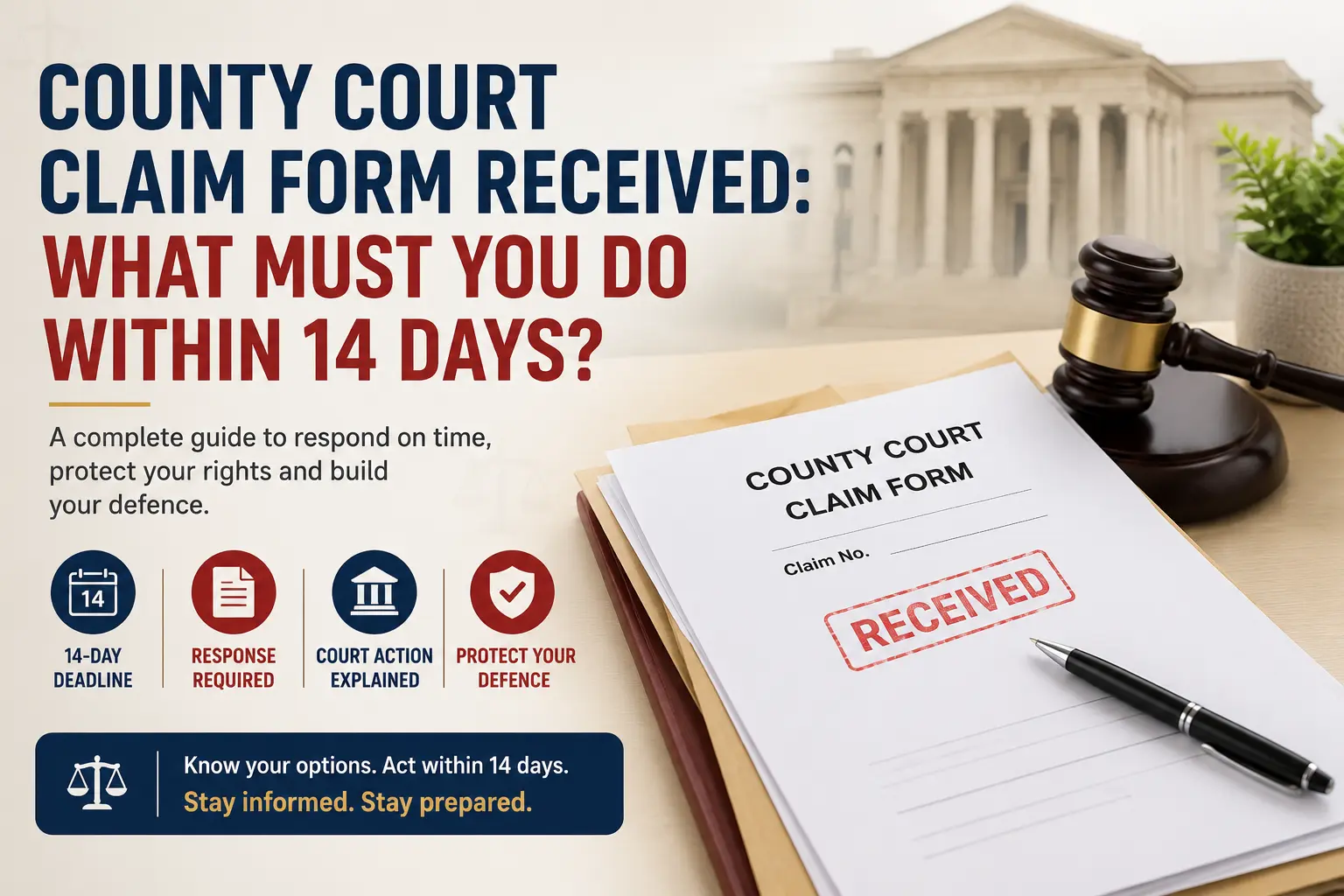
What Should You Do in the First 48 Hours?
A County Court claim form is not a warning that court action might happen. It means proceedings have already started. The most dangerous response is to put the papers aside while trying to negotiate informally. A missed deadline can allow the claimant to request default judgment, leaving you with a County Court Judgment (CCJ) before the court has considered your defence.
Quick answer: In many standard Part 7 claims, you must respond within 14 days after service of the particulars of claim. Filing an Acknowledgment of Service in time usually extends the defence deadline to 28 days after service. However, some Online Civil Money Claims use a different timetable, commonly 28 days from issue. Read the claim form and online notice carefully, record the deadline immediately and do not assume that negotiations stop the clock.
Why immediate action matters. Ministry of Justice figures for January to March 2026 recorded 527,000 County Court claims and 256,000 judgments. Ninety-four per cent of those judgments were default judgments. View the official Civil Justice Statistics Quarterly.
This guide applies to ordinary civil claims in England and Wales. Different rules may apply to possession claims, insolvency proceedings, Part 8 claims, personal injury portals, service outside the jurisdiction and specialist court procedures. Always follow the directions printed on your own claim form.
What Should You Do in the First 48 Hours?
- Read every page, including the claim form, particulars of claim, response pack, covering notice and any schedule of debt or invoices.
- Identify how the claim was issued: paper Part 7 claim, Money Claim Online, Online Civil Money Claims, or another specialist route.
- Write down the issue date, the deemed service date and the response deadline. Do not rely on memory.
- Keep the envelope or email notification. It may be relevant to service and deadline calculations.
- Check the claimant’s name, your name, the address used, the amount claimed, court fee, legal costs, interest and the factual basis of the claim.
- Decide whether you admit the whole claim, admit only part, dispute the whole claim, need more time, or may have a counterclaim.
- If you cannot prepare a proper defence within the first 14-day period on a standard Part 7 claim, file an Acknowledgment of Service before the deadline.
- Preserve contracts, invoices, bank statements, emails, WhatsApp messages, photographs, delivery records, complaint records and witness details.
- Do not make a rushed admission by telephone or email. An admission can have serious procedural and financial consequences.
- Book a focused claim-form consultation early enough for the papers to be reviewed before the deadline.
Is the Deadline Always 14 Days?
No. The phrase ‘14 days’ is correct for many standard Part 7 claims, but it is not a universal rule for every digital or specialist claim. The correct deadline depends on the procedure used and whether the particulars of claim were served with the claim form.
|
Type of claim or response |
General timetable |
What you should do |
|
Standard Part 7 claim with particulars attached |
Reply within 14 days after service. A timely Acknowledgment of Service usually extends the defence deadline to 28 days after service. |
Calculate deemed service and file the correct response before expiry. |
|
Claim form says ‘particulars of claim to follow’ |
The response period normally runs from service of the later particulars of claim. |
Do not ignore the claim form. Record when the later particulars arrive and check whether they were served in time. |
|
Online Civil Money Claims |
The online notice may require a response by 4pm on the 28th day after issue, subject to the applicable online procedure. |
Use the exact response date shown in the online account or court notice. |
|
Agreed extension |
Under CPR 15.5, the parties may agree up to 28 additional days for filing a defence in a standard Part 7 claim. |
Get the agreement in writing and notify the court. Do not assume a casual discussion is enough. |
|
Part 8 or specialist claim |
Different rules may apply. |
Take urgent advice and follow the specific acknowledgment or evidence directions on the form. |
When Does the 14-Day Period Begin?
For a standard Part 7 claim, the deadline generally runs from service, not simply from the day you opened the envelope. CPR 6.14 provides that a claim form served within the United Kingdom is generally deemed served on the second business day after the relevant service step. HMCTS guidance for defendants also states that a posted claim is generally treated as served on the second business day after posting.
Example: If a standard claim form and particulars are posted on a Monday, deemed service may be Wednesday, provided there is no bank holiday. The 14-day response period is then calculated from the deemed service date. Court time-calculation rules can be technical, so record dates carefully and act before the final day.
Do not use a generic online calculator as your only safeguard. Check the issue route, service method, separate particulars, weekends, bank holidays and any court order. Where the papers show a specific response date, treat it as urgent and seek clarification before it expires.
What Is an Acknowledgment of Service?
An Acknowledgment of Service is not a defence. It tells the court that you have received the claim and intend to respond. Under CPR Part 10, it is normally required where you cannot file the defence within the initial period or where you intend to dispute the court’s jurisdiction.
On a standard Part 7 claim, a timely Acknowledgment of Service usually changes the defence deadline from 14 days to 28 days after service of the particulars of claim. It does not give 28 days from the date you file the acknowledgment. It also does not protect you indefinitely.
Does an Acknowledgment of Service Mean I Admit the Claim?
No. Filing an Acknowledgment of Service does not ordinarily admit liability. It preserves time to prepare a defence or, where appropriate, to make a jurisdiction application. You must still file the next required document on time.
Can I Get More Than 28 Days?
The claimant and defendant may agree an extension of up to 28 additional days under CPR 15.5. The agreement should be precise, recorded in writing and notified to the court. For online claims, the extension may also need to be recorded through the online service. Never assume that silence or an informal promise extends the deadline.
What Are Your Main Response Options?
|
Your position |
Typical response |
Main risk to avoid |
|
You accept the whole claim |
Pay in full or make a formal admission and, if needed, propose instalments. |
Do not admit more than you genuinely owe or ignore interest and costs. |
|
You accept only part |
Part-admit the amount accepted and defend the balance. |
Explain clearly why the remaining sum is disputed. |
|
You dispute the whole claim |
File a properly pleaded defence. |
A bare denial such as ‘I do not owe this’ is rarely sufficient. |
|
The claimant also owes you money |
Consider set-off or a formal counterclaim. |
A counterclaim may require a fee and must be properly particularised. |
|
Service or jurisdiction may be defective |
Take urgent advice on the correct procedural application. |
Do not confuse an old-address issue with a jurisdiction challenge. |
|
You need more information |
Make a focused request and protect the defence deadline. |
A document request does not automatically stop time running. |
Should You Admit, Part-Admit or Defend?
Your response must match your actual legal and evidential position. A person may genuinely owe part of an invoice but dispute defective work, duplicated charges, interest, contractual penalties or items never agreed. Another defendant may dispute the entire claim because no contract existed, the debt was paid, the claimant sued the wrong person, the claim is time-barred, or the claimant failed to perform its own obligations.
Do not select an option merely because it appears to buy time. The response should be based on the contract, chronology, payment history, documents and available legal defences.
What Must a Defence Contain?
A defence is a formal statement of case, not a witness statement and not an emotional narrative. CPR 16.5 requires the defendant to deal with every allegation in the particulars of claim. You should state what is admitted, what is denied with reasons, and what you cannot admit or deny but require the claimant to prove.
- Identify the parties and the relevant agreement or relationship.
- Respond to the allegations in a logical order, preferably using the claimant’s paragraph numbers.
- Give reasons for every material denial.
- Set out your own version where it differs from the claimant’s case.
- State any payment, set-off, cancellation, limitation, defective performance, misrepresentation or other positive defence relied upon.
- Challenge the amount, interest, charges and losses where they are not admitted.
- Identify any documents or contractual terms central to the defence.
- Include any counterclaim after the defence where appropriate.
- End with the correct statement of truth.
A Practical Defence Matrix
Before drafting, create a table that forces you to answer each allegation. This prevents important points from being missed and helps separate evidence from argument.
Claimant’s allegation | Your response | Reason and evidence |
‘The defendant agreed to pay £8,000.’ | Partly denied. | The signed quotation was £5,500. The alleged variation was never authorised. Attach the quotation and messages. |
‘The works were completed satisfactorily.’ | Denied. | The contractor left before completion. Photographs, snagging messages and a remedial quotation support the defence. |
‘No payment was received.’ | Denied. | Bank records show payments totalling £3,000 on specified dates. |
‘Contractual interest is payable.’ | Not admitted; proof required. | The claimant has not identified the contractual term or calculation relied upon. |
What Is the Difference Between a Defence, Set-Off and Counterclaim?
A defence explains why the claimant should not obtain the remedy sought. A set-off argues that money due from the claimant should reduce or extinguish the amount claimed. A counterclaim is your own claim against the claimant and may produce a judgment in your favour if successful.
A counterclaim should not be added as a threat. It requires a proper legal basis, facts, loss calculation, remedy and statement of truth. Under CPR Part 20, a counterclaim against the claimant can usually be filed without permission when it is filed with the defence. A court fee may be payable.
Can You File a Counterclaim on Form N9B?
Form N9B is used for a specified money claim where you wish to dispute all or part of the claim and/or make a counterclaim. Form N9D is used for certain unspecified money and non-money claims. Online cases may leave the digital route and transfer to the Civil National Business Centre if a counterclaim is made. Use the form and procedure stated on your own response pack.
What If the Claim Form Went to an Old Address?
An old address does not automatically make the claim invalid. CPR 6.9 permits service on an individual at their usual or last known residence. However, if the claimant had reason to believe that you no longer lived there, the claimant must take reasonable steps to find your current address before relying on the old address.
- When did you move?
- When and how did the claimant learn of your new address?
- Did you notify the claimant, creditor, landlord, bank or contracting party in writing?
- Was post redirected?
- What address appears on the contract, invoice, account or correspondence?
- Did the claimant receive returned mail or messages showing the old address was no longer current?
If the response deadline is still open, do not simply ignore the claim because service may be disputed. Take advice on whether to respond, seek directions or make an application. If default judgment has already been entered, the issue may require an urgent application to set the judgment aside.
Can You Challenge Service?
Service challenges are technical. A claim may have been sent to the wrong place, served by an unauthorised method, served late, or accompanied by defective particulars. The remedy depends on the precise defect and whether the document actually came to your attention.
Do not confuse defective service with a challenge to the court’s jurisdiction. A jurisdiction challenge under CPR Part 11 normally requires an Acknowledgment of Service first and an application within 14 days after filing it. That procedure should not be used casually.
Can You Ask the Claimant for More Information or Documents?
Yes, but a request for documents does not automatically extend the defence deadline. Ask only for information that is necessary to understand and answer the pleaded case.
- The contract, signed agreement, quotation or relevant terms and conditions.
- Invoices, account statements and a clear breakdown of the amount claimed.
- Evidence of assignment where a debt purchaser is suing.
- Default notices or termination notices where legally relevant.
- Delivery records, work logs, photographs, reports or acceptance records.
- The calculation of interest, contractual charges and alleged losses.
Formal CPR Part 18 requests may not be appropriate in every case. Part 18 does not generally apply once a case is on the small claims track unless the court orders otherwise. A focused voluntary request may still be sensible, but it must not become a substitute for filing a defence on time.
Should You Negotiate Before Filing the Defence?
Settlement discussions can be sensible, especially where the dispute is about price, quality, instalments or a narrow factual issue. However, negotiations do not stop the procedural clock.
- File the required response unless a valid written extension has been agreed and notified.
- Label genuine settlement correspondence ‘Without Prejudice’ where appropriate.
- Do not make admissions that undermine the defence without understanding the consequences.
- Record any agreed payment plan or settlement terms precisely.
- State whether the settlement disposes of the whole claim, costs, interest and any counterclaim.
Small money claims may later be referred to the HMCTS Small Claims Mediation Service. Mediation can be useful, but it is not a reason to delay the initial response.
What Happens If You Ignore the Claim Form?
The claimant may request default judgment. That can result in a CCJ without a trial on the merits. The claimant may then seek enforcement, including a warrant of control, attachment of earnings, charging order, third-party debt order or an order to obtain information, depending on the circumstances.
Paying after judgment is not the same as successfully defending the claim. A judgment can affect credit, borrowing, housing and business decisions. An application to set aside judgment can be costly and is not guaranteed. The safer course is to protect the original deadline.
What If You Missed the Deadline but No Judgment Has Been Entered?
Act immediately. File the response as quickly as possible and contact the court to confirm the status. A late defence may still be processed if default judgment has not yet been entered, but you must not assume this will happen. The claimant may be entitled to request judgment at any time after the relevant deadline.
What Happens After a Defence Is Filed?
- The court serves or notifies the claimant of the defence.
- The claimant decides whether to continue.
- The parties may be required to complete directions questionnaires.
- The court considers allocation to the small claims, fast, intermediate or multi-track.
- Suitable small money claims may be referred to mediation.
- The court issues directions for documents, witness statements, expert evidence where permitted, hearing bundles and trial.
Online Civil Money Claims can operate differently. In some OCMC cases, a defendant who files a full defence must also complete the online directions questionnaire at the same time. Follow the instructions in the online account rather than assuming the paper process applies.
What Evidence Should You Gather?
|
Issue |
Useful evidence |
|
What was agreed |
Contract, quotation, terms, order confirmation, purchase order, emails and messages. |
|
Payment |
Bank statements, receipts, invoices, credit notes and account statements. |
|
Quality or performance |
Photographs, videos, complaint emails, inspection reports, snagging lists and remedial quotations. |
|
Delivery or completion |
Delivery notes, timestamps, job records, tracking data and witness evidence. |
|
Cancellation or termination |
Notices, emails, contract clauses and evidence of when they were received. |
|
Loss and amount |
A clear calculation, supporting invoices, mitigation evidence and proof of interest entitlement. |
|
Address and service |
Tenancy records, council tax bills, change-of-address notices, redirected post and correspondence showing the claimant knew the new address. |
Common Mistakes That Weaken a Defence
- Ignoring the claim because the claimant’s case seems weak.
- Counting the deadline from the wrong date.
- Filing an Acknowledgment of Service but forgetting the defence deadline.
- Sending an informal email to the claimant instead of filing the required court response.
- Using a generic internet defence that does not answer the actual particulars.
- Denying everything without reasons.
- Attaching hundreds of pages but failing to plead the defence clearly.
- Making allegations of fraud or dishonesty without a proper factual basis.
- Failing to raise limitation, payment, set-off or a counterclaim in time.
- Assuming a request for documents or settlement discussion stops the deadline.
- Changing the story later because the first response was rushed.
Worked Example: From a Weak Response to a Proper Defence Strategy
Weak response: “I do not owe this money. The claimant is lying and the work was terrible.”
Stronger structure: “Paragraph 4 is denied. The agreed price was £5,500 under the written quotation dated 12 March 2026, not £8,000. No written variation was agreed. The defendant paid £3,000 by bank transfer on 20 March and 14 April 2026. The claimant left the works incomplete on 2 May 2026 despite written requests to return. The defendant relies on the quotation, bank statements, photographs and messages exhibited to the later witness statement. The alleged balance and contractual interest are denied.”
The stronger version identifies the exact allegation, gives a reasoned denial, states the defendant’s positive case and identifies the supporting evidence. The defence should still be tailored to the law, pleadings and documents in the actual case.
How Zain Legal & Co Can Help
A County Court claim often looks straightforward because the response pack contains boxes and forms. The real difficulty is deciding what the case is legally, calculating the deadline, identifying the correct response and presenting the defence without making damaging admissions.
Urgent claim-form review: We review the claim form, particulars, response pack and supporting documents and identify the immediate deadline and procedural route.
Service and limitation analysis: We assess address history, deemed service, contractual notices, limitation issues and whether a procedural application may be needed.
Defence strategy: We identify the strongest factual and legal defences, weak points, evidential gaps and the allegations that must be answered.
Defence and counterclaim drafting: We prepare a structured response that deals with the pleaded case, sets out your version clearly and includes a counterclaim where justified.
Evidence organisation: We create a clear chronology, payment schedule, issue list and evidence plan from contracts, messages, invoices, photographs and bank records.
Negotiation and settlement support: We help you make or assess realistic proposals without losing control of the court deadline.
Directions questionnaire and case preparation: We assist with track allocation, mediation preparation, witness statements, schedules, hearing bundles and compliance with court directions.
Hearing preparation and support: We help you understand the issues, likely questions and documents required, and can provide practical court support or lay representation where legally permitted and appropriate.
Why an Early Consultation Matters
The first consultation is not merely a discussion about whether the claim feels fair. It is used to identify the deadline, the correct procedural route, the evidence required, any admissions that should be avoided, the strength of the defence and whether settlement, set-off or counterclaim should be considered.
- A defence drafted before the evidence is organised may omit decisive points.
- A rushed admission may be difficult to reverse.
- A weak generic defence can damage credibility and increase costs.
- Early review creates time to request focused documents, preserve evidence and negotiate from a stronger position.
- Where the case requires a solicitor, barrister or specialist regulated representation, we will say so plainly.
What to Send Before Your Consultation
- The complete claim form and particulars of claim.
- The N9 response pack or screenshots from the online claim account.
- The envelope, issue notice or email showing how and when the papers arrived.
- Any letter before claim and your response.
- The contract, quotation, invoice, terms and relevant correspondence.
- Payment records and a short chronology.
- Any photographs, reports or evidence supporting your defence or counterclaim.
Frequently Asked Questions
When does the 14-day period begin?
For many standard Part 7 claims, it begins from deemed service of the particulars of claim. If the particulars are attached to the claim form, the response is normally due 14 days after service. If the particulars follow later, the period usually runs from service of those particulars. Online claims may use a different timetable, so follow the response date shown on the notice or account.
Does an Acknowledgment of Service give me 28 more days?
It usually gives a total of 28 days from service of the particulars of claim in a standard Part 7 case. It does not normally give 28 days from the date you file the acknowledgment.
Does an Acknowledgment of Service give me 28 more days?
It usually gives a total of 28 days from service of the particulars of claim in a standard Part 7 case. It does not normally give 28 days from the date you file the acknowledgment.
What if the claim form says ‘particulars of claim to follow’?
The claimant should serve the particulars separately. Your response period normally runs from service of those particulars. Keep the envelope or email and record the date received.
Should I use Form N9B
Form N9B is generally used to defend or counterclaim against a specified money claim. Other claims may use N9D or an online response. Use the instructions provided with your claim.
What happens if I ignore the claim?
The claimant may request default judgment. That can result in a CCJ and later enforcement without the court hearing your defence.
Can I admit part of the claim and defend the rest?
Yes. You should identify the amount admitted and clearly explain why the balance is disputed. Use the correct admission and defence forms or online response.
Can I file a counterclaim?
Yes, where you have a genuine legal claim against the claimant. It should normally be filed with the defence, properly particularised and supported by the required fee where applicable.
What if the papers were sent to my old address?
Service may still be valid at a last known residence, but the claimant may have been required to take reasonable steps if they had reason to believe you no longer lived there. The facts and timing must be examined urgently.
Can I ask the claimant for the contract and invoices?
Yes. Make a focused written request, but do not assume the request extends the defence deadline. File the required response or obtain a valid extension.
Can I argue that the claim is too old?
Possibly. Limitation depends on the type of claim, the date the cause of action arose, acknowledgments, part-payments and other factors. It must be pleaded properly rather than merely stating that the debt is old.
Should I negotiate before filing a defence?
You can negotiate, but settlement discussions do not stop the court timetable. Protect the deadline unless a proper extension is agreed and notified.
Do I need a solicitor for a small claim?
Not always. Many parties represent themselves. However, a focused document review can prevent missed defences, weak pleadings and procedural errors. The need for regulated representation depends on the case and the support required.
What if I missed the defence deadline but there is no CCJ yet?
Act immediately. File the response and check the court record. The claimant may be able to request default judgment at any time, so delay is dangerous.
What if default judgment has already been entered?
You may need to consider an application to set aside the judgment. The test depends on service, promptness, the proposed defence and the circumstances. Take urgent advice.
Does this guide apply in Wales?
Yes. The County Court and Civil Procedure Rules cover England and Wales. Welsh forms and language services may be available, but the same need for prompt procedural action applies.
Important Legal Notice
This article provides general information for civil claims in England and Wales. It is not legal advice on any individual case and does not replace the instructions on your claim form or a court order. Deadlines and procedures differ between claim routes. If you have received proceedings, obtain advice immediately.
Do not leave a live County Court claim until the final day.
Book an urgent consultation with Zain Legal & Co so the claim form, deadline, evidence and response strategy can be reviewed before default judgment is requested.