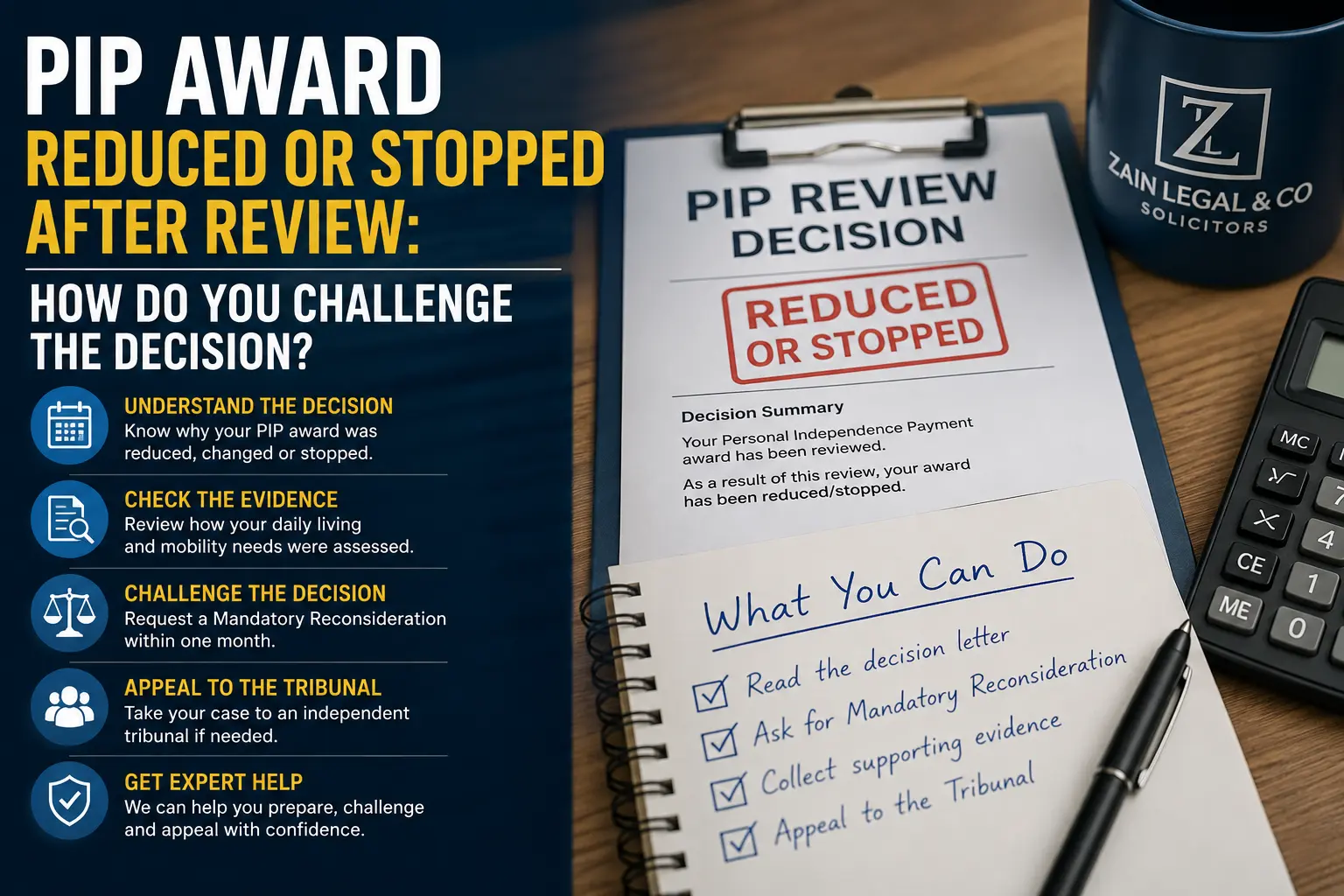
If your PIP award has been reduced after review, changed from enhanced to standard rate, or stopped altogether, the decision can have an immediate effect on your income, mobility and day-to-day support. It can be especially difficult to understand where your condition has not improved but the Department for Work and Pensions has awarded fewer points than before.
A PIP award review can result in the award staying the same, increasing, reducing or ending. The important point is that you do not have to accept a decision without checking how DWP reached it. A challenge should focus on the daily living and mobility activities, the descriptors and points awarded, the reliability rules and the evidence showing how your condition affects you.
This guide explains why PIP can be reduced or stopped after a review, what to do immediately, how to ask for Mandatory Reconsideration, how to appeal a PIP reduction, what evidence can help and what happens while the challenge is ongoing.
Quick Answer: What Should I Do if My PIP Is Reduced or Stopped?
- Read the new decision letter and note the date, effective date, components, rates and points.
- Compare the new decision with your previous award activity by activity.
- Ask for the assessment report if you do not already have it.
- Gather focused evidence showing the help, supervision, prompting, aids or mobility restrictions that still apply.
- If you disagree with the decision, you normally have one month from the date on the decision letter to ask for Mandatory Reconsideration.
- If Mandatory Reconsideration does not resolve the dispute, you can usually appeal to the independent Social Security and Child Support Tribunal.
Has your PIP been reduced or stopped after review? Zain Legal & Co can review the old award, new decision, assessment report and evidence, identify the points in dispute and explain the next step.
Why Was My PIP Reduced or Stopped After Review?
PIP is awarded according to how a long-term health condition or disability affects specific daily living and mobility activities. It is not awarded simply because a diagnosis exists. During a PIP award review, DWP looks again at the evidence and decides which descriptors it believes apply at that time.
A PIP award may be reduced or stopped because DWP decides that you need less help than before, can complete an activity without prompting or assistance, can move further than previously accepted, or no longer score enough points for one or both components. Sometimes the change follows a new assessment report; in other cases it can arise from the way the review form or supporting evidence has been interpreted.
That does not mean the new decision is necessarily correct. The key is to identify exactly which descriptors changed and whether the new decision reflects what you can actually do reliably.
How Common Is It for PIP to Change After a Review?
The latest DWP statistics to July 2026 show that, over the five years from August 2021 to July 2026, 79% of planned award reviews resulted in an increase or no change to the level of award. That means a significant minority resulted in a lower award or no continuing award.
For award-review decisions following an assessment between April 2021 and March 2026, DWP statistics show that 26% of completed Mandatory Reconsiderations changed the award. Of appeals that were lodged, 44% were lapsed because DWP changed the decision in the claimant’s favour before the tribunal hearing. Of DWP decisions that were actually cleared at a tribunal hearing, 79% were overturned in the claimant’s favour.
These figures provide context only. They do not predict the result of an individual case. A challenge succeeds or fails on the specific descriptors, evidence and facts of that award review.
Why Can PIP Be Reduced Even if Your Condition Has Not Improved?
A common question is: “Why has my PIP been reduced when nothing has changed?” An unchanged diagnosis or continuing treatment is relevant, but PIP entitlement depends on functional impact. DWP may decide that the evidence at review supports different descriptors from the previous award.
For example, the new assessment may say that you can prepare food without supervision, wash using an aid rather than another person, undertake journeys without support, or move further than previously accepted. The challenge should therefore do more than say that your condition is unchanged. It should explain what support you still need, how often you need it, what happens without it and why the activity cannot be completed reliably.
Where appropriate, compare the earlier award and evidence with the new reasoning. If DWP previously accepted a need that still exists, ask what evidence justifies the change and provide current evidence showing why the previous level of need remains.
PIP Reduced Without Warning or Stopped Without Notification: What Should You Do?
Some claimants first realise something has changed when the payment into their bank account is lower than expected or does not arrive. After an award review, you should receive a letter telling you what will happen with your PIP.
If your PIP appears to have been reduced without warning, or you believe your PIP has been stopped without notification, contact the PIP enquiry line promptly and ask for the decision letter or a replacement copy. Confirm the decision date, the date the new award takes effect, the points awarded and the reason for the change.
Do not wait for several payment cycles before acting. The normal Mandatory Reconsideration time limit is linked to the date of the decision, so obtaining the decision letter quickly is important. If there has been a postal problem or another reason for delay, explain this when making any late request.
What to Do if Your PIP Award Changes
The first few days after the decision are important. Work through the decision methodically rather than sending a general complaint.
- Read the decision letter carefully and note the date of the decision and the effective date.
- Record the daily living and mobility components, rates and total points awarded.
- Compare every activity with the previous award and note where points have been removed or reduced.
- Find your PIP review form, previous award letter, earlier assessment report and the evidence sent with the review.
- Request the latest assessment report if you do not already have it.
- Identify factual errors, assumptions and missing evidence that affected a point-scoring activity.
- Write down the one-month Mandatory Reconsideration deadline.
- Check whether the change affects linked support such as Motability, a Blue Badge, premiums or other entitlements.
- Get advice quickly if the reduction creates an immediate financial or mobility problem.
How DWP Should Assess Your PIP Activities
For each PIP activity, the issue is not simply whether you can perform it once. DWP guidance requires consideration of whether you can complete the relevant activity reliably.
The reliability test asks whether the activity can be completed:
- safely – without an unacceptable risk of harm during or after the activity;
- to an acceptable standard;
- repeatedly – as often as reasonably required; and
- within a reasonable time period – generally no more than twice as long as a person without the relevant impairment would normally take.
Fluctuation also matters. The assessment should consider your ability over time rather than relying on one isolated good day or one activity observed during an assessment. If an activity cannot be performed reliably at a particular level, that can affect which descriptor applies.
Compare Your Old PIP Award With the New Review Decision
A side-by-side comparison is one of the most useful ways to identify why the award changed. Do not begin with a general statement that the decision is unfair. Begin with the activities and points.
- Preparing food: if the previous award accepted supervision or assistance but the review says you can prepare food unaided, explain why supervision or physical assistance is still required, including risks, incidents and frequency.
- Washing and bathing: if the previous award accepted help from another person but the review says an aid is enough, explain why the aid is not enough and what another person actually does.
- Engaging with people: if social support has been removed, explain what support is needed, why it is needed and what happens without it.
- Moving around: if the review says you can move further than before, explain reliable distance, pain, breathlessness, speed, falls, recovery and repeatability.
The comparison should show exactly where the new decision differs from the old one. That gives you a focused list of issues for Mandatory Reconsideration and helps you avoid wasting time on parts of the decision that do not affect the award.
What Evidence Helps if PIP Is Reduced or Stopped?
The best evidence is evidence that explains your functional needs and links directly to the activities in dispute. A large medical bundle is not automatically stronger than a smaller set of relevant documents.
- The previous award letter and earlier assessment report, where they show needs that continue to apply.
- The PIP review form and new assessment report.
- Relevant GP, consultant, therapist or mental-health evidence explaining symptoms and functional restrictions.
- Care plans or social-care assessments showing prompting, supervision, assistance or aids.
- Medication records where side effects, supervision or missed medication are relevant.
- A diary showing fluctuation, recovery time, bad days and the ability to repeat activities.
- A statement from a partner, relative, friend or carer who sees the support you need.
- Falls, seizure, incident or safety records where relevant.
- Evidence about mobility distance, speed, pain, breathlessness and recovery where the moving-around activity is disputed.
Do not miss the challenge deadline while waiting indefinitely for perfect evidence. If important evidence has been requested but has not yet arrived, make the Mandatory Reconsideration request in time, explain that further evidence is being obtained and submit it as soon as possible.
What if the PIP Review Report Is Inaccurate?
If the assessment report contains incorrect or misleading information, challenge the important errors precisely. Avoid simply saying that the assessor lied or that the whole report is wrong.
For each material error, identify what the report says, explain what actually happened, state which PIP activity or descriptor the error affects and point to evidence supporting your account.
For example, if the report says you walked 50 metres repeatedly but you say you walked a shorter distance once with stops, severe pain and prolonged recovery, explain the actual distance, the stops, the after-effects and why the isolated journey does not show that you can move that distance safely, repeatedly or within a reasonable time.
A complaint about the assessment service is separate from challenging the benefit decision. A complaint does not replace Mandatory Reconsideration and does not stop the challenge deadline.
How to Ask for Mandatory Reconsideration After a PIP Reduction
Mandatory Reconsideration is normally the first formal challenge to a PIP review decision. You usually need to ask for Mandatory Reconsideration within one month of the date on the decision letter. A late request may be considered if you have a good reason, but you should not rely on an extension if you can act within the original time limit.
Your Mandatory Reconsideration should identify the parts of the decision that are wrong and why. It should be focused on the point-scoring activities rather than being a general complaint.
- State the date of the PIP review decision and that you are requesting Mandatory Reconsideration.
- Identify whether daily living, mobility or both are disputed.
- Set out the activities and descriptors you say should apply.
- Explain why the review decision is wrong using the reliability criteria and frequency of the difficulty.
- Compare the previous award where that comparison genuinely assists the challenge.
- Refer to focused evidence supporting each disputed activity.
- Ask DWP to revise the award from the correct effective date if the reduction or stoppage is overturned.
Can Your PIP Award Be Reduced Further After Mandatory Reconsideration?
Yes, in principle. Mandatory Reconsideration looks again at the decision, and the benefit can stop, stay the same, increase or decrease. That does not mean a wrong decision should go unchallenged. It means the existing award should be checked carefully so that you understand the strengths, weaknesses and any risk before submitting the challenge.
If only one component has been reduced, keep your written grounds focused on the activities that are wrong, but make sure you understand the points supporting any part of the award you are not challenging.
Does PIP Continue While You Challenge the Decision?
Your existing PIP normally continues while the award review itself is being carried out. Once DWP issues a new review decision reducing or stopping the award, the new decision usually takes effect. Asking for Mandatory Reconsideration or lodging an appeal does not automatically restore the previous rate.
If the decision is later revised in your favour, DWP should recalculate entitlement from the effective date of the revised award and deal with any arrears due. Check the decision notice carefully and keep copies of all correspondence.
How to Appeal a PIP Reduction if Mandatory Reconsideration Fails
If the Mandatory Reconsideration Notice still leaves the award too low or stopped, you can usually appeal to the independent Social Security and Child Support Tribunal. The tribunal is supported by HM Courts & Tribunals Service and is independent of DWP.
You usually need to appeal within one month of the date of the Mandatory Reconsideration Notice. You can appeal online or by post using the appropriate form. The appeal is free.
Your grounds of appeal should remain focused: identify the activities, descriptors and points in dispute and explain why the evidence supports a different award. The PIP tribunal can consider the evidence independently and is not bound by the DWP assessment report.
How Long Does It Take to Challenge a PIP Reduction?
There is no single fixed time for a Mandatory Reconsideration to be completed. Processing times can vary depending on the case and DWP workload.
If the case proceeds to tribunal, a benefit appeal usually takes at least six months to be heard. Some cases take longer. This is why it is important to protect the deadlines, submit focused evidence promptly and keep your contact details up to date.
For a fuller explanation of waiting times and each stage of the process, read our separate guide on how long a PIP appeal takes.
What if PIP Was Reduced From Enhanced to Standard Rate?
A change from enhanced to standard rate usually means the total points for that component have fallen below the enhanced-rate threshold but remain high enough for the standard rate. The practical task is to identify where the points were removed and whether the new descriptor accurately reflects your functional ability.
- Compare every old and new descriptor.
- Identify why DWP says you need less help or can move further.
- Explain the actual level and frequency of prompting, supervision or assistance.
- Address isolated examples such as driving, shopping, working or attending an appointment where DWP relied on them.
- Explain why those examples do not demonstrate reliable performance of the PIP activity if that is the case.
Can DWP Use Work, Driving or Caring Responsibilities When Reviewing PIP?
DWP can consider everyday activities where they are relevant, but the assumptions drawn from them still need to be tested against the PIP criteria. Working does not automatically prove that you can complete all daily living activities without help. Driving does not automatically establish a particular walking distance. Looking after children does not necessarily show that every PIP activity can be completed safely and repeatedly.
Explain the detail. Relevant facts might include workplace adjustments, home working, reduced hours, support from colleagues, adapted driving, short journeys, tasks carried out by another person or significant recovery time afterwards.
What Is a Lapsed PIP Appeal?
A PIP appeal can “lapse” where DWP changes the decision in the claimant’s favour after the appeal has been lodged but before the tribunal decides it. The revised decision should still be checked carefully.
Do not assume that every revised offer gives the full award you were seeking. Check the component, rate, points, effective date and award length. If the revised decision does not fully resolve the dispute, obtain advice about the next procedural step.
Common Mistakes That Weaken a PIP Review Challenge
- Saying only that your condition has not changed.
- Arguing mainly about the diagnosis rather than the PIP activities.
- Failing to compare the previous and new descriptors.
- Challenging every sentence in the assessment instead of prioritising errors that affect points.
- Using vague labels such as “good days” and “bad days” without explaining frequency and function.
- Sending general medical information that does not explain your own functional needs.
- Waiting for perfect evidence and missing the one-month Mandatory Reconsideration deadline.
- Treating an assessor complaint as a substitute for challenging the decision.
- Ignoring the effect on Motability or other linked support.
- Using a generic template that does not address the actual review decision.
Worked Example: PIP Reduced Despite No Improvement
Maria previously received enhanced mobility because DWP accepted that she could not stand and move more than 20 metres reliably. At review, DWP awarded standard mobility after an assessment recorded that she walked about 35 metres from a car to a clinic.
A weak challenge would simply say: “My condition has not changed and I cannot walk far.” A stronger challenge would explain that the clinic journey involved two stops, severe pain and prolonged recovery, that it could not be repeated later that day, and that her usual reliable walking distance remained around 15 to 20 metres. It would then point to a walking diary, physiotherapy evidence and a witness statement supporting that account.
The difference is focus: the stronger challenge addresses the descriptor and the reliability criteria rather than relying only on diagnosis or disagreement with the assessor.
How Zain Legal & Co Can Help
A PIP review dispute is usually strongest when the decision is broken down into the activities, points, evidence and reliability tests rather than challenged in general terms.
- Decision review: checking the new decision, effective date, components, points and challenge deadline.
- Old-versus-new award comparison: identifying exactly where entitlement changed.
- Assessment report analysis: identifying factual inaccuracies, unsupported assumptions and omitted evidence that matter to the descriptors.
- Descriptor and points analysis: identifying the activities in dispute and the evidence needed for each one.
- Mandatory Reconsideration support: helping structure focused grounds of challenge.
- Evidence strategy: organising relevant medical, care, diary and witness evidence.
- Tribunal preparation: helping with appeal grounds, written submissions, bundle review and hearing preparation where appropriate.
What to Send Before a Consultation
- The new PIP review decision letter.
- The previous PIP award letter.
- The PIP review form and evidence sent with it.
- The old and new assessment reports, if available.
- Relevant medical, therapy or care evidence.
- A short list of the activities where you believe the decision is wrong.
- Any urgent Motability or linked-benefit correspondence.
FAQs: PIP Award Reduced or Stopped After Review
Why has my PIP been reduced after review?
DWP may decide that different descriptors apply at review because it believes you need less help, can perform an activity without assistance or can move further than previously accepted. The decision should be checked activity by activity against the evidence and the reliability rules.
Can PIP be stopped after a review?
Yes. An award review can result in PIP being increased, reduced or stopped. If you disagree with the decision, you can usually ask for Mandatory Reconsideration.
Can PIP be reduced without warning?
After a review, you should receive a decision letter explaining what will happen with your PIP. If you notice a lower payment before receiving or understanding the letter, contact PIP promptly and ask for the decision date, effective date and a copy of the decision.
Can PIP be stopped without notification?
You should receive a letter telling you the outcome of the award review. If payment stops and you have not received the letter, contact PIP immediately and request the decision. Do not delay because the normal challenge time limit runs from the decision date.
What is the deadline for Mandatory Reconsideration after a PIP review?
You usually need to ask for Mandatory Reconsideration within one month of the date on the decision letter. A late request may be considered if you have a good reason, but it is safer to act within the original deadline.
What evidence helps when appealing a PIP reduction?
Use evidence that explains your functional needs and the activities in dispute. This can include relevant medical or therapy evidence, care plans, diaries, incident records and statements from people who regularly help you.
Does my old PIP award prove I should keep the same rate?
No. A previous award is relevant evidence, particularly where your needs have not changed, but it does not automatically bind DWP at review. The stronger argument explains why the same descriptors still apply and what evidence supports that position.
Does PIP continue during Mandatory Reconsideration?
Once a review decision reduces or stops the award, the new decision usually takes effect. Mandatory Reconsideration does not automatically restore the previous rate.
Can my PIP be reduced further at Mandatory Reconsideration?
Yes, in principle. The decision is looked at again and the benefit can stop, stay the same, increase or decrease. Check the existing award carefully before challenging.
Can I appeal a PIP reduction if Mandatory Reconsideration fails?
Yes. You can usually appeal to the independent Social Security and Child Support Tribunal within one month of the date of the Mandatory Reconsideration Notice.
How long does a PIP appeal take?
There is no fixed Mandatory Reconsideration completion time. If the case proceeds to tribunal, a benefit appeal usually takes at least six months to be heard.
Will I get back pay if the PIP reduction is overturned?
If the decision is revised in your favour, DWP should recalculate entitlement from the effective date of the revised award and deal with any arrears due. Check the revised decision carefully for the rate, start date and award period.
Get Help if Your PIP Has Been Reduced or Stopped
A PIP award reduction can affect far more than the payment itself. The most useful response is usually a focused comparison of the old and new award, the descriptors that changed and the evidence showing what support you still need.
Zain Legal & Co can review the decision, assessment report and supporting evidence, identify the key points in dispute and help you understand the next stage of the challenge.
Speak to Zain Legal & Co about a PIP award reduced or stopped after review.
Important Information
This article provides general information about PIP award reviews and challenges in England and Wales. It is not a substitute for advice on the facts of an individual case. PIP rules, statistics and tribunal procedure can change.