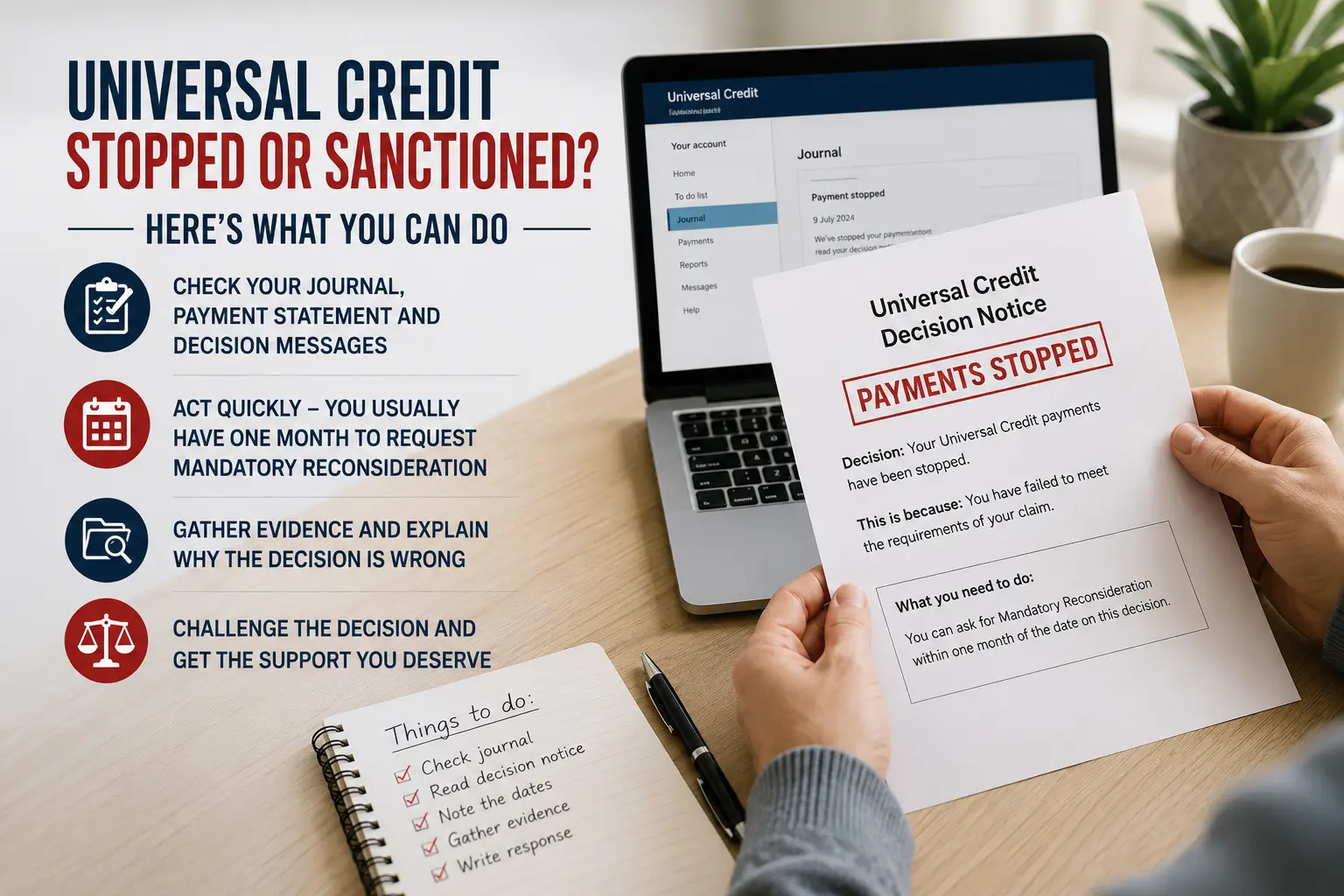
Universal Credit Stopped or Suspended? What to Do Next
If your Universal Credit has stopped, been suspended, reduced or sanctioned, the first step is to work out exactly what DWP has done. A missing or lower payment can happen for several different reasons, including a claim review, missing evidence, a sanction, a closed claim, earnings, deductions or a payment delay.
This guide explains what to check first, how to tell the difference between a suspension and a sanction, what evidence may help, and when you may need to challenge the decision.
Quick Answer
- Check your Universal Credit journal, to-do list and payment statement immediately.
- Ask DWP to confirm whether the issue is a suspension, sanction, claim closure, nil award, deduction or payment delay.
- Save screenshots of journal messages, decisions, appointment notices and uploaded evidence.
- If there is a formal decision you disagree with, ask for Mandatory Reconsideration within the normal deadline.
- If a sanction or fraud penalty has reduced your payment and you cannot meet essential needs, you may be able to apply for a hardship payment.
What to Do if Universal Credit Is Stopped: The First Five Steps
1. Check your journal and to-do list
Log in to your Universal Credit account and read the latest journal messages, to-do list items and decision notices. Look for any request for documents, a review appointment, missed appointment notice, sanction decision or claim closure message.
2. Open your payment statement
Your payment statement can show whether the payment is reduced because of earnings, deductions, rent arrears, advance recovery, overpayment recovery, sanctions or another calculation issue.
3. Ask DWP to identify the exact reason
If the reason is unclear, send a journal message asking DWP to confirm whether your payment has been suspended, sanctioned, stopped because of a closed claim, reduced by deductions, or delayed for another reason.
4. Save evidence before it becomes difficult to find
Take screenshots of the journal, decision messages, appointment notices, upload confirmations and payment statement. Keep copies of documents you uploaded and make a note of any calls.
5. Protect any challenge deadline
If DWP has made a formal decision you disagree with, you may need to request Mandatory Reconsideration. Do not wait for informal journal messages until the deadline has passed.
Why Has My Universal Credit Stopped, Been Suspended or Gone Down?
A Universal Credit payment can stop or reduce for different reasons. The solution depends on the reason, so avoid assuming every problem is a sanction.
- Claim review: DWP may pause or check payments while reviewing entitlement or asking for documents.
- Missing evidence: Payment may be affected if DWP says bank statements, ID, rent evidence, childcare evidence or other documents are missing.
- Sanction: DWP may reduce your standard allowance if it says you failed to meet a work-related requirement without a good reason.
- Closed claim: DWP may decide your Universal Credit claim has ended or cannot continue.
- Nil award: Your payment may be £0 for an assessment period because of earnings, income or other calculation rules.
- Deductions: Advances, overpayments, rent arrears, third-party deductions or other debts can reduce the amount paid.
- Payment delay: Sometimes the issue is not a sanction or entitlement decision but a delay in processing or payment release.
What Is a Universal Credit Suspension?
A Universal Credit suspension usually means payment has been paused while DWP checks something. This may happen during a claim review, where DWP asks for documents, bank statements, ID evidence or a telephone appointment.
A suspension is not always the same as a sanction. A suspension is usually about checking entitlement or waiting for information. A sanction is a penalty reduction linked to an alleged failure to meet a work-related requirement.
What Should You Do if Your Universal Credit Is Suspended?
- Read the journal message carefully and identify what DWP is asking for.
- Complete outstanding to-dos as soon as possible.
- Upload the requested documents and keep proof of upload.
- Attend any review appointment or explain immediately if you cannot attend.
- Ask DWP to confirm what is still outstanding if you have already provided everything.
- If DWP makes a decision you disagree with, consider Mandatory Reconsideration.
How Long Does a Universal Credit Suspension Last?
There is no single fixed time for every Universal Credit suspension. It depends on why payment has been paused, what information DWP needs, whether a review appointment is outstanding and whether DWP makes a formal entitlement decision.
If you have provided everything requested, send a journal message asking DWP to confirm what remains outstanding and when the review will be considered.
What Happens When Your Universal Credit Is Suspended?
When Universal Credit is suspended, you may receive no payment or a reduced payment while DWP checks the issue. You should continue checking your journal and responding to any requests. If DWP later decides that you were entitled, payment may be released or adjusted.
If DWP decides that you were not entitled, or that your claim should close, that may create a formal decision which can potentially be challenged.
What if the Problem Is a Universal Credit Payment Delay?
Sometimes the payment has not stopped because of a sanction or suspension. It may be delayed because of processing, bank details, verification, technical issues or a decision still being made.
Check your payment date, statement and journal. Ask DWP to confirm whether a payment has been issued, whether it is delayed, or whether there is a decision affecting entitlement.
What Is a Universal Credit Sanction?
A Universal Credit sanction is a reduction in your Universal Credit because DWP says you failed to meet a work-related requirement without a good reason. Requirements can include attending appointments, taking part in interviews, searching for work, completing training or providing work-related evidence.
If you cannot meet a requirement, contact Universal Credit as soon as possible through your journal or using the contact details provided by your work coach. If DWP accepts that you had a good reason, the payment should not be reduced for that failure.
Universal Credit Suspended vs Sanctioned: What Is the Difference?
A sanction is a penalty reduction linked to an alleged failure to meet a work-related requirement. A suspension is usually a pause while DWP checks entitlement or waits for information.
The difference matters because the evidence and remedy are different. A sanction challenge may focus on whether there was a good reason. A suspended review may be resolved by providing documents, attending the review appointment or challenging a later entitlement decision.
What Should a Universal Credit Sanction Notice Tell You?
A sanction notice should explain what DWP says you failed to do, how much your payment is reduced by, how long the sanction may last or what you need to do to end it. Read the notice carefully before preparing a challenge.
How Long Can a Universal Credit Sanction Last?
The length depends on the sanction level, the requirement DWP says was not met and whether there has been a previous sanction. Sanction rules can be technical, especially where there have been earlier sanctions.
Use the dates and sanction level stated in the DWP decision. If you believe the sanction is wrong, or DWP failed to consider your reason properly, you may need to challenge the decision.
How Much Can a Universal Credit Sanction Reduce Your Payment?
A sanction usually reduces the Universal Credit standard allowance. Extra amounts, such as housing or child elements, may be treated separately, but the amount actually paid can still be affected by earnings, deductions and other decisions.
Always check the full payment statement rather than looking only at the headline amount.
What if You Missed an Appointment or Requirement for a Good Reason?
If you were sanctioned after missing a Jobcentre appointment or another requirement, the issue is not only whether you missed it. DWP should consider whether you had a good reason.
A strong challenge explains exactly what happened, why compliance was not reasonably possible, what you did to notify DWP and what evidence supports you.
- Unexpected illness or urgent medical treatment.
- A hospital appointment that could not reasonably be rearranged.
- A caring emergency involving a child or another person you care for.
- A domestic emergency or immediate safety issue.
- Not receiving the appointment notice, or receiving it too late to attend.
- Serious transport disruption supported by evidence.
- A disability, mental health condition or communication need that affected your ability to understand, remember or attend the requirement.
- Evidence that you contacted DWP or tried to rearrange the appointment but this was not properly considered.
Avoid vague statements such as “I was ill” if you can provide more detail. Give the date, what happened, when you informed DWP and the evidence you have.
Example: Turning a Vague Sanction Complaint Into a Focused Challenge
A weak journal message might say: “The sanction is unfair. I could not go.”
A stronger Mandatory Reconsideration request identifies the sanction decision and date, the missed appointment or requirement, the reason attendance was not reasonably possible, when DWP was informed, the documents that support the explanation and the outcome you want.
For example, if you were taken to A&E on the morning of a work coach appointment, say this clearly, attach the A&E record and provide the journal screenshot showing when you contacted DWP.
How Do You Challenge a Universal Credit Sanction or Stopped-Payment Decision?
The normal first formal challenge to a Universal Credit decision is Mandatory Reconsideration. You usually need to request it within one month of the date on the decision.
Do not assume that a general complaint in the journal automatically counts as a Mandatory Reconsideration. Make the request explicit. Identify the decision and date and say that you want it reconsidered.
If the issue is a formal benefit decision, our Universal Credit Appeals page explains the wider Mandatory Reconsideration and tribunal process.
A focused challenge should normally identify:
- the decision being challenged and its date;
- what DWP says happened;
- which part of the decision you say is wrong;
- the correct facts and chronology;
- why you had a good reason or why the decision test was not met;
- the evidence you rely on; and
- the outcome you want DWP to reach.
If you are outside the normal one-month period, do not give up automatically. A late Mandatory Reconsideration request may be accepted in some circumstances where there is a good reason for the delay, but explain the reason clearly and act as soon as possible.
What Evidence Can Help if Universal Credit Is Stopped, Suspended or Sanctioned?
The best evidence depends on why the payment changed. Evidence should answer the disputed point rather than simply creating a large bundle.
- screenshots of your Universal Credit journal, to-do list and decision messages;
- the relevant payment statement;
- appointment notifications and reminder texts or emails;
- screenshots showing when you told DWP that you could not attend;
- telephone logs and a short written note of important calls;
- hospital, A&E, GP or urgent-care records where health was relevant;
- evidence of a caring, childcare or domestic emergency;
- transport cancellation or disruption evidence;
- employment rotas or employer messages where work affected attendance;
- upload confirmations, file timestamps and copies of documents DWP says were missing;
- bank statements, payslips, tenancy records or childcare invoices where the payment calculation is disputed;
- a short witness statement from someone who directly saw what happened.
Keep a simple chronology. A decision-maker should be able to see what DWP asked you to do, what actually happened, what you did next and which document proves each point.
Can You Get a Universal Credit Hardship Payment?
If your Universal Credit has been reduced because of a sanction or fraud penalty and you cannot meet essential needs, you may be able to apply for a hardship payment.
A hardship payment is not the same as winning a sanction challenge. It is emergency financial support while the sanction or penalty affects your payment. You may need to do both: apply for hardship support and challenge a decision you believe is wrong.
Hardship payments are normally recoverable, which means future Universal Credit payments may be reduced until the hardship payment is repaid.
What if Universal Credit Has Not Stopped but the Payment Is Much Lower?
A lower payment is not automatically a sanction. Open the payment statement and check every line. Common causes include earnings, other income, overpayment recovery, advances, rent arrears, third-party deductions, childcare calculations and housing-cost issues.
If debt deductions are causing financial hardship, ask DWP whether deductions can be reviewed. If the calculation itself is wrong, request an explanation and provide the evidence that corrects the figure.
If DWP maintains a formal decision that you believe is wrong, consider Mandatory Reconsideration.
What if DWP Has Closed Your Universal Credit Claim?
A closed claim is different from a temporary suspension. It usually means DWP has decided that entitlement has ended or that the claim cannot continue. Ask for the decision, the effective date and the reasons.
If the closure is wrong, Mandatory Reconsideration may be the correct challenge route. Depending on the circumstances, a new claim may also be needed to secure current support.
A new claim does not automatically correct the old decision or restore entitlement for the earlier period, so deal with the historical decision and current position separately.
What Happens if Mandatory Reconsideration Does Not Change the Decision?
DWP will issue a Mandatory Reconsideration Notice. If you still disagree, you can usually appeal to the independent Social Security and Child Support Tribunal.
At tribunal stage, organise the case around the actual decision. A clear chronology, focused grounds, journal screenshots and relevant evidence are more useful than a general statement that DWP acted unfairly.
If your issue is specifically about a sanction, read our guide on Universal Credit sanction appeal steps.
Common Mistakes That Can Weaken a Universal Credit Challenge
- Calling every stopped payment a sanction: First identify whether the problem is a suspension, sanction, closed claim, deduction, nil award or delay.
- Waiting too long for an informal journal response: Protect the Mandatory Reconsideration deadline while continuing to communicate with DWP.
- Only saying the decision is unfair: Give dates, the disputed decision, the correct facts and evidence.
- Failing to save journal messages or upload proof: Take screenshots and keep copies of everything sent.
- Sending evidence without explaining what it proves: Link each document to the specific disputed point.
- Ignoring new appointments while challenging the old sanction: Challenge the old decision but continue taking reasonable steps to prevent a further problem.
- Focusing only on the sanction when the claim is actually under review: Deal with outstanding review documents or appointments as well as any formal challenge.
How Can You Reduce the Risk of Another Universal Credit Problem?
- Check your journal regularly and keep your contact details up to date.
- Complete to-dos and keep proof of what you upload.
- If you cannot attend an appointment, tell DWP as soon as possible and keep a screenshot of the message.
- Ask for your claimant commitment to be reviewed if health, disability, caring responsibilities or changed circumstances affect what you can reasonably do.
- Request communication or appointment adjustments where needed and keep the request in writing.
- Keep copies of bank statements and other review documents before uploading them.
- Read each payment statement instead of assuming every reduction is a sanction.
Need help because Universal Credit has stopped, been suspended or sanctioned? Zain Legal & Co can review the decision and journal evidence, identify whether the problem is a sanction, suspension, closure or calculation issue, and help prepare the appropriate challenge.
Frequently Asked Questions About Stopped or Suspended Universal Credit
Why is my Universal Credit suspended?
Your payment may be suspended because DWP is carrying out a claim review, waiting for requested documents or a review telephone appointment, or checking whether you remain entitled. Check the journal for the exact reason and respond to outstanding requests quickly.
What do I do if my Universal Credit payment stops?
Check your journal, to-do list and payment statement first. Ask DWP to confirm whether the issue is a suspension, sanction, closed claim, deduction, nil award or payment delay. Save screenshots and act on any formal challenge deadline.
How long does a Universal Credit suspension last?
There is no single fixed duration for every suspension. It depends on why DWP stopped payment and what information or decision is outstanding. If you have supplied everything requested, ask DWP to confirm what remains outstanding and when the review will be considered.
Is a Universal Credit suspension the same as a sanction?
No. A sanction is a reduction linked to an alleged failure to meet a work-related requirement without a good reason. A suspension usually pauses payment while DWP checks entitlement or waits for information.
Can I challenge a Universal Credit sanction?
Yes. If you disagree with a sanction decision, the normal first formal challenge is Mandatory Reconsideration. Explain which decision is wrong, what actually happened and provide supporting evidence.
How long do I have to ask for Mandatory Reconsideration?
You usually need to ask within one month of the date on the decision. A late request can sometimes be accepted where there is a good reason, but it is safer to act within the normal deadline if possible.
Can I get help while waiting for Universal Credit to be sorted out?
If a sanction or fraud penalty has reduced your payment and you cannot meet essential needs, you may be able to apply for a hardship payment. Other forms of local or emergency support may also be available depending on your circumstances.
Can I get a hardship payment after a sanction?
You may be able to apply if the sanction or fraud penalty has caused a lower or missed payment and you cannot meet essential needs. Hardship payments normally have to be repaid.
What happens if my Universal Credit claim is reviewed?
DWP may ask for documents and a telephone appointment. The review may find that your payment is correct, that you were underpaid or that you were overpaid. If DWP makes a decision during the review that you disagree with, you can challenge that decision.
Why has my Universal Credit stopped even though I was not sanctioned?
A payment can stop or go to £0 for reasons other than a sanction, including a claim review, claim closure, earnings or other income, missing evidence or another entitlement decision. Check the payment statement and journal before deciding how to challenge it.
What happens if Mandatory Reconsideration is refused?
If the decision is not changed, you can usually appeal to the independent Social Security and Child Support Tribunal. The appeal normally needs to be made within the relevant deadline shown on the Mandatory Reconsideration Notice.
Can Universal Credit be stopped without me understanding why?
You should normally receive information in your journal or by letter about decisions and requests. In practice, some claimants notice the missing payment before they understand the reason. Check the journal, to-do list and payment statement immediately and ask DWP to identify the exact decision.
How Zain Legal & Co Can Help With Universal Credit Issues
A Universal Credit problem can be difficult because several different decisions can produce the same immediate result: less money or no payment at all. The first task is to identify what DWP has actually done, the deadline that applies and the evidence needed to resolve or challenge it.
Zain Legal & Co can assist with reviewing journal messages, payment statements and decision letters; identifying whether the issue is a sanction, suspension, claim closure, deduction or calculation problem; preparing a chronology; reviewing evidence; and helping prepare Mandatory Reconsideration or tribunal documentation where appropriate.
If your wider case involves benefit appeal proceedings, you can also read about our Benefit Appeals service.
If the issue is urgent, have your latest Universal Credit journal messages, payment statement, decision letter, claimant commitment, appointment notices and relevant evidence ready for the consultation.
Universal Credit stopped or suspended? Do not wait until the journal evidence disappears or the challenge deadline passes. Book a fixed-fee consultation with Zain Legal & Co or call 0121 817 0033.
Important Information
This article provides general information about Universal Credit in England, Scotland and Wales. It is not a substitute for advice on the facts of an individual case. Universal Credit rules and official guidance can change, so time-sensitive information should be checked against current DWP and GOV.UK guidance.